
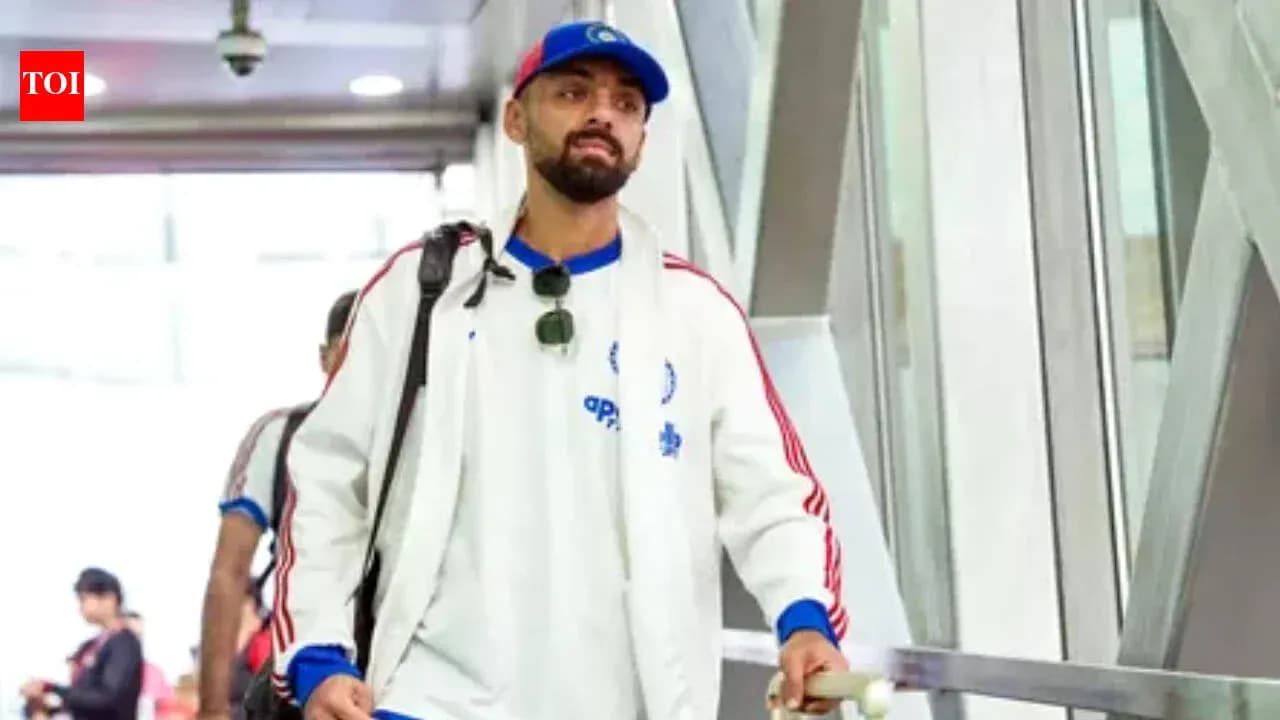
Varun Chakravarthy's Journey: Late Bloomer Embraces New Challenges
NEW DELHI: Varun Chakravarthy has never moved to cricket’s clock. He came to the international game at 29, an age when most T20 specialists are already being judged on their mileage. At 35, after the year he has just lived, he feels like he is only getting started.
A home T20 World Cup where he finished as India’s joint-highest wicket-taker with 14. An IPL season played through hairline fractures in his left hand and toe. Then, just when the body finally protested, the first muscle injury of his career and weeks of rehab.
Most players would call that the beginning of the end. Chakravarthy calls it half-time.
"At this stage of my career, I still feel I'm in my first half of my career because I started cricket very late. So I still feel there's a long way to go," he told TimesofIndia.com in an interaction facilitated by equipment manufacturer ASICS.
It sounds simple. It explains a lot.
He has never been the five-year-plan type. No grand public targets, no big declarations. In a format that can flip in a single over, the Tamil Nadu spinner prefers to chase the next tiny improvement rather than the next headline milestone.
Now fully recovered from the Grade 2 left hamstring injury suffered during the England T20I series, he walks back into a packed schedule: three T20Is against Afghanistan, a historic one-off international against Japan, and the Asian Games in Aichi-Nagoya, where defending champions India enter straight in the quarterfinals.
The clock says 35. His mind says: still early days.
Learning to Trust a New Kind of Pain
For most of his career, pain had a familiar pattern. Collisions. Impact. Freak accidents on the field. Tape it, ice it, get on with it.
This time, it was different.
"This is actually my first ever muscle injury. So all of my injuries have been impact injuries and other accidents that have happened on field," he said. A torn hamstring is not just a physical setback; for a spinner whose game leans heavily on rhythm and repeatable movements, it can rattle the mind.
The BCCI Centre of Excellence in Bengaluru became his base. Long days. Longer routines.
"The expertise at CoE helped me and people helped me to gain my confidence. Every person working there helped me," he explained. The work was relentless: running drills, strength sessions, rebuild, repeat. "Definitely, I spent a lot of time there and did a lot of running and did a lot of strength training, which helped me."
Medical clearance is one thing. Bowling like Varun Chakravarthy is another.
His variations depend on more than just a flexible wrist. They need a body he can trust, a base that lets his imagination take over at the crease. "Yeah, it will take some time to gain confidence. But once you gain confidence, you just start becoming more expressive and that's how it is," he said.
He refuses to see time away from the game as wasted.
"When you're away, you can start sharpening your skills. You can upskill yourself, which you don't get much time to do when you're playing continuously."
The injury, then, becomes a workshop. Not a pause.
Why His Feet Matter More Than the Mystery
Mention Varun Chakravarthy and the conversation usually jumps straight to mystery spin: the angles, the grip, the release that batters struggle to pick.
He starts somewhere else. At the feet.
His partnership with ASICS may now be commercial, but the association began long before the contract. He had already moved to their shoes around 2022, only formalising the deal in January 2026. The way he talks about footwear sounds less like a pitch and more like an engineer breaking down a design problem.
"For a bowler, shoes are the biggest equipment they can have. Batters, they have many other equipments, but for a bowler, it's the shoes only," he said.
Then he zoomed in on the detail most fans never think about.
"As a spinner, your feet start becoming little broader as in it starts changing shape once you pivot because the spinners have to pivot more after landing. So broad shoes in the toe area that is very important," he added.
Add a strong heel counter, strip away unnecessary weight, and you have what he considers a spinner’s real toolkit.
It is the architect in him talking. Before he became an elite cricketer, Chakravarthy trained to design buildings. The same analytical, process-driven mind now dissects biomechanics, footwear and marginal gains. The mystery is not magic; it is method.
Beyond the Boundary: Curiosity in the Village
The Asian Games, starting September 19, offer him something even a World Cup cannot: life inside a multi-sport village.
"It's my first time in Japan. I've never been to Japan and any games also. So all I've played is ICC tournaments and ACC tournaments," he said, the excitement clear in his voice.
Cricketers usually move in tight circles — hotel, bus, ground, repeat. At Aichi-Nagoya, Chakravarthy will share space with sprinters, shuttlers, wrestlers, gymnasts. That prospect lights him up.
"I'm very much looking forward to meeting other athletes also from other different sports and all those things."
He is not talking about selfies. He wants to study them.
"I want to see how a 100-metre athlete prepares himself, how a badminton professional prepares himself or herself," he said.
In a cricket calendar bursting at the seams, chances for this kind of cross-pollination barely exist. The Asian Games crack open that door. Different routines, different disciplines, different ways to think about performance — all of it appeals to a player who already treats his craft like a science lab.
On the field, too, the challenge will be unfamiliar. The pitches at Korogi Sports Park are expected to behave differently from the surfaces he knows in India. Chakravarthy understands that adaptability, not preconceived plans, will dictate how India’s attack fares.
For a 35-year-old who insists he is still in his first half, it is a perfect test: new country, new conditions, new opponents, same quiet obsession with getting just a little bit better.
The late bloomer has no interest in winding down. He is busy building what comes next.





