Varun Aaron: From Fast Bowler to Empowered Coach
Daniel Vettori’s phone call caught Varun Aaron in a place he had spent most of his playing career chasing: peace.
He had walked away from professional cricket earlier in 2025, at 35, content with a microphone in his hand and no new targets on the horizon. The body that once thrilled selectors and speed guns had finally been granted a truce. Coaching? That was never supposed to be the next chapter.
Yet, in a way, he’d been doing it for years.
From rehab rooms to the coaching chair
Aaron’s career, as much as it was about pace, was about pain. Stress fractures, long spells in rehab, lonely hours with video and physios. Those breaks forced him to study his action, his body, and the science of fast bowling in a way few healthy quicks ever need to.
“I think I've coached myself quite a bit because of the amount of injuries I've had,” he says. That self-taught grind spilled into dressing rooms. Teammates at Jharkhand would drift over with questions about their run-up, wrist position, follow-through. He found he liked the problem-solving, the quiet satisfaction of seeing someone else’s ball kiss the seam a little better.
There was structure too, not just informal chats. The new MRF Pace Foundation High Performance Center was largely his blueprint. Aaron helped design and execute the facility, the protocols, the programme, even the redevelopment of the ground and gym. It was a tangible way to give back to the academy that had shaped him. Later, he took on a formal role with the Jharkhand State Cricket Association as a bowling consultant.
Still, this was all side work, not a grand career plan. When he retired, he promised himself a simple life.
“I really was not setting out any targets,” he says. “I was not thinking, ‘I want to coach, I want to commentate.’ After having a journey which was hampered by injuries throughout, all I wanted to do was enjoy myself after retiring, and whatever came about after that just happened on its own.”
Then one day, the phone rang.
Dan Vettori. Sunrisers. Interested in coaching?
The answer changed everything.
Building a pace pack from scratch
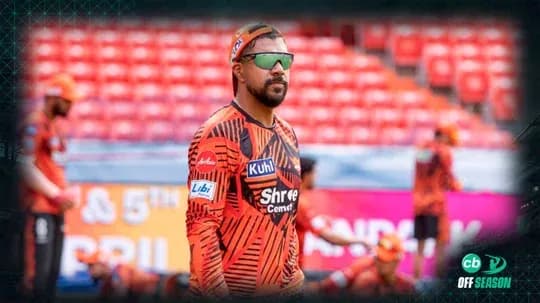
Aaron’s first assignment with Sunrisers was not a gentle introduction. He had to help assemble a bowling group and sharpen young quicks for the pressure cooker of the IPL. Crucially, he was given a voice in the auction room.
Two names leapt out: Praful Hinge and Sakib Hussain.
“What I saw was not what they were doing, but what they could do,” Aaron says. He wasn’t buying finished products; he was betting on ceilings. “I had a feeling that we could achieve what I could envision they could do, which they weren't doing. I'm glad it just worked out."
It worked out in a hurry. Against Rajasthan Royals, both Hinge and Sakib ripped through line-ups with four-wicket hauls in their very first IPL games. Those spells were the visible peak of months of work that had been squeezed into a chaotic schedule.
Because Aaron, at the same time, was also a broadcaster at the T20 World Cup.
So he improvised. Some days he brought Sakib to Mumbai, called games in the morning and coached in the evening. On other days, the order flipped. As the World Cup calendar grew heavier and the travel ramped up, he found a solution he trusted: Rao Cricket Academy.
SS Rao, his former Jharkhand captain, became an extension of his own coaching hand.
“Me and SS Rao have a brotherly relationship,” Aaron says. “He was captain when I played for Jharkhand and I wanted them to go to somebody who I trust, and basically if I tell that person what has to be done, he does exactly that and nothing different.”
He sent Hinge and Sakib with detailed instructions. Rao followed them to the letter, adding his own presence and experience to the mix. The work continued without the philosophy being diluted.
The young talent didn’t stop there. Shivang Kumar impressed him deeply. Onkar Tarmale, who picked up an ill-timed injury, also stayed lodged in Aaron’s mind — a bowler, he says, who can touch 145 kph and offers something “really interesting.”
These weren’t random punts. They were part of a clear, aggressive strategy.
Freedom to create
For a rookie franchise coach, the latitude Aaron received was rare.
“When you're empowered by the head coach and the team owner in that fashion, I really feel your job becomes all that much easier,” he says. “I think I was really lucky to be a part of a brilliant team, because it's not very common that in your first year you get an almost free hand to do what you want to.”
That freedom unlocked him.
“Through that, I just felt I could express myself creatively in whatever I did and it was a lot of fun."
Creative, for Aaron, doesn’t mean complicated. His philosophy is disarmingly simple: fast bowling is not rocket science; players just make it feel that way.
“Fast bowling is really simple, but I think as a player you complicate it a lot,” he explains. “You try different things. But at the end of the day, it just boils down to a few very basic principles.”
The coach’s job, in his eyes, is to strip away the noise. Simplify the action. Simplify the thinking. Make the journey “a whole lot more enjoyable and easy.”
But simplicity doesn’t mean uniformity.
Coaching the individual, not the stereotype
Aaron bristles at the idea of a one-size-fits-all method.
“There's no set method to coaching. It completely depends on the individual,” he says. Every bowler, he believes, arrives with a unique combination of skills, body type, mind, and biomechanics.
“Number one, you've got to identify what's unique about the bowler. And amplify it. And if there are any shortcomings, you just have to make the bowler more efficient.”
Some bowlers glide in with textbook actions and can do almost anything they want with the ball. Others drag a history of injuries, awkward actions, and physical limitations. That’s where the real work lies — tailoring drills, workloads, and technical tweaks to the person, not the stereotype.
“Everybody's different. Every bowler presents differently. And I feel that's where coaching has to head,” he says. “Everybody has different musculature, everybody's got different minds, everybody's got different coordination, everybody's got different biomechanics."
His approach to performance follows the same logic. Numbers on a scoreboard are just the surface.
“I genuinely think that you can't look at somebody's performance and be like, 'Oh, that was a bad performance' or 'that was a good performance',” he says. A coach, in his view, must go hunting for the why.
If a bowler has a good day, Aaron wants them to understand precisely what clicked — rhythm, run-up, mindset, field setting. If it goes wrong, the failure becomes material to learn from. What he will not accept is drift: “just bowl, go home, bowl, go home.” That, he says, “doesn't really add up to anything.”
The speed gun and the truth about pace
Few people understand the seduction of the speed gun like Varun Aaron. His own rise exploded after he clocked 153 kph in the 2010/11 Vijay Hazare Trophy final, in an era when genuine Indian pace was still an outlier.
Young quicks still arrive with the same first question: “How do I bowl faster?”
Aaron’s answer cuts through the myths.
“Fast bowling is all about timing,” he says. The comparison he draws is with batting: time your initial movement, stay balanced, keep the head still, and the game opens up. For bowlers, the critical timing comes just before release — the sequencing of the action, the alignment of the body.
“If your timing and the sequencing of your action is right, I think you've won the battle,” he says. “You will bowl as fast as you can, you won't be injured and you bowl the ball where you want to. And you can only bowl as fast as you can. You can't bowl faster than your body is going to allow."
That last line is not theory. It is biography.
Aaron spent much of his career trying to push past what his body could safely deliver. After his Ranji Trophy debut in 2008/09, three stress fractures of the back followed. Test cricket brought the same story: a debut in 2011, then almost three years before his second Test in 2014 because of more back trouble.
Now, as a coach, he stands on the other side of that tension. He knows the hunger for speed. He also knows the cost.
Between commentary boxes and training nets
His life today is a juggling act. IPL commitments, franchise duties, academy work, commentary gigs across tournaments. It’s exhilarating. It’s exhausting. And not everyone at home is thrilled.
"How do I balance that? That's a question you have to ask my girlfriend because she's not the happiest customer - I'm hardly at home,” he says, half-joking, fully aware. “But, yeah, I'm trying to give her and my family more time. It is quite hectic, but it is very enjoyable."
The dual role of coach and broadcaster has given him a rare vantage point. The coach sees the inner workings; the commentator tells the story. One feeds the other.
“It gives me a lot more insight,” he says. When he’s on air, he’s not guessing a bowler’s mindset under pressure; he’s drawing on conversations from the nets. He knows the go-to ball, the preferred field for a certain delivery, the little tells in a run-up.
“So, from that angle, coaching definitely helps broadcasters because you have a lot more recency and first-hand information about players,” he says. The traffic runs both ways. Broadcasting keeps him watching players across competitions, spotting trends, tactics, and emerging talent that can feed back into his coaching.
A job he never wanted, and now doesn’t want to leave
For someone who never set out to be a coach, Aaron sounds like a man who has stumbled into his calling.
“What it has taught me about myself is that coaching gives me immense happiness,” he says.
The joy isn’t in the big public moments, the four-fors on debut or the auction-room vindications. It’s in the quiet ones: a session ends, a bowler walks off having ticked every box they set out at the start, and both know why.
There, in that conversation, the former tearaway quick finds something he chased for years with a new-ball in hand — clarity, purpose, and a future that, for once, doesn’t depend on how his back feels in the morning.