
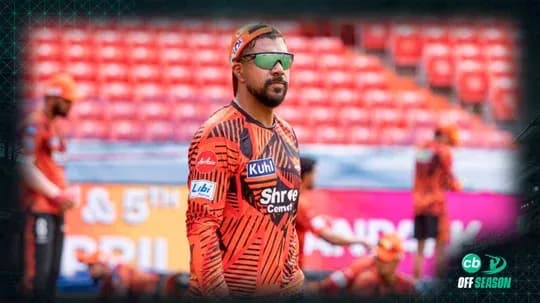
Varun Aaron's Journey from Player to Coach
Daniel Vettori’s phone call reached Varun Aaron at a time in life cricketers rarely plan for. The boots were off, the body finally at peace, and the microphone had replaced the new ball. At 35, having retired earlier in 2025, Aaron was enjoying the clean lines of broadcasting – no rehab, no scans, no stress fractures lurking in the shadows.
Coaching? That was never on the whiteboard.
Or so he thought.
The call that changed the script
“One day, Dan rang me up and asked me if I was interested to coach Sunrisers.”
No long-term plotting. No carefully drawn career arc. Aaron had stepped away from a playing career scarred and shaped by injury, determined to simply enjoy whatever came next. If that meant commentary, so be it. If it meant nothing at all, he was fine with that too.
Yet, in truth, coaching had been seeping into his life for years. At Jharkhand, teammates would drift over, ask about their actions, their run-ups, their rhythm. The constant injuries that stalked his own career forced him to become his own biomechanist, physio, and bowling coach rolled into one.
“I think I've coached myself quite a bit because of the amount of injuries I've had,” he says. That education, earned on treatment tables and in lonely rehab spells, became the foundation of something bigger.
Building a fast-bowling lab
Before Sunrisers, there was MRF Pace Foundation. Not as a trainee this time, but as an architect.
The new MRF Pace Foundation High Performance Center was Aaron’s project from the ground up – design, facility layout, protocols, programme, even the redevelopment of the ground and gym. It was his way of paying back an academy that had once polished his own raw pace.
He then moved into a more formal role as bowling consultant with the Jharkhand State Cricket Association. Bit by bit, the broadcaster was turning into a coach, even if he refused to label it that way.
So when Vettori called, the step into the IPL dugout wasn’t quite as abrupt as it looked on paper.
A first assignment: build a pace pack
The brief for his first season with Sunrisers was clear: shape a bowling group, prepare young quicks, and do it quickly.
He had a voice in the auction room. He used it. Praful Hinge and Sakib Hussain were two names he locked onto early, not for what they already were, but for what they could become.
“What I saw was not what they were doing, but what they could do,” Aaron says. He believed there was a higher ceiling, a version of them they hadn’t yet accessed. The franchise backed his judgement.
The payoff came fast.
Against Rajasthan Royals, Hinge and Sakib ripped through the opposition with four-wicket hauls each in their first IPL game. For the outside world, they were overnight stories. For Aaron, they were the product of weeks of tailored work – squeezed into a schedule that would test even the most organised coach.
Commentary in the morning, coaching at night
During their build-up, Aaron was also on T20 World Cup duty as a broadcaster. The calendar left him juggling roles with the precision of a death bowler nailing yorkers.
Some days, Sakib would be flown into Mumbai. Aaron would be on air in the morning, then on the ground in the evening. On other days, the order flipped. Mic off, cones out. Studio lights to floodlights.
As the World Cup schedule intensified and travel mounted, he needed help he could trust. He sent Hinge and Sakib to Rao Cricket Academy, to a man who knew him better than most – SS Rao, his former Jharkhand captain.
“Me and SS Rao have a brotherly relationship,” Aaron says. He handed over a clear set of instructions, knowing Rao would follow them to the letter and add his own experience and energy without changing the core plan. The work continued, the message stayed consistent, the young quicks grew.
They weren’t the only ones to catch his eye. Shivang Kumar impressed him deeply. Onkar Tarmale, capable of touching 145 kph, was another standout in the group, even though injury struck at the wrong time and kept him out of view. Inside the camp, though, Sunrisers knew they had assembled something interesting.
“When you're empowered by the head coach and the team owner in that fashion, I really feel your job becomes all that much easier,” Aaron says. In his very first year, he had something many coaches wait years for: genuine autonomy. A near free hand.
It allowed him to be creative, to coach with instinct, to enjoy the job.
The simplicity behind pace
Aaron’s coaching, like his bowling at its best, leans on clarity.
“Fast bowling is really simple, but I think as a player you complicate it a lot,” he says. He’s lived that arc – the tinkering, the searching, the overthinking. For him, it all comes back to a handful of basic principles.
Simplicity, though, doesn’t mean a one-size-fits-all template.
“There’s no set method to coaching. It completely depends on the individual.” That line could be a mission statement. Every bowler arrives with a unique action, body, mind, and history. Some glide in with textbook mechanics. Others carry scars, awkward angles, and long medical files.
The job, as he sees it, is twofold: identify what’s unique and amplify it; then quietly clean up the inefficiencies without stripping away identity.
Everybody’s musculature is different. So are their biomechanics, coordination, and mental wiring. He wants coaching to move in that direction – away from rigid models, towards true individualisation.
Beyond good and bad days
He refuses to reduce performances to simple labels.
“I genuinely think that you can't look at somebody's performance and be like, 'Oh, that was a bad performance' or 'that was a good performance',” he says. For Aaron, the real work lies in the why.
If a bowler has a good day, he wants them to remember exactly what clicked – the feel, the rhythm, the fields, the plans. If it goes badly, there must be something to take away, a lesson, a pattern, a correction.
What he won’t accept is drift: bowl, go home, repeat. That, in his eyes, leads nowhere.
The truth about speed
Few coaches in India understand the lure of the speed gun like Aaron. His own career exploded into view when he hit 153 kph in the 2010/11 Vijay Hazare Trophy final, at a time when genuine pace was still a rarity in Indian cricket.
Young quicks still come to him, eyes lit up, wanting to talk about velocity. He gives them a different angle.
“Fast bowling is all about timing,” he says. Not just brute strength or gym numbers. Timing of the run-up, the jump, the gather, the release. The sequencing of the action.
Get that right, and a bowler can reach their maximum speed, stay on the park, and still hit their areas. Crucially, he reminds them: you can only bowl as fast as your body allows. Anything beyond that is fantasy – and often, the road to injury.
He knows this better than most. After his Ranji Trophy debut in 2008/09, he suffered three stress fractures of the back. Test debut in 2011, then almost three years to his second cap in 2014 because of more back trouble. His entire career became a balancing act between the hunger for pace and the limits of his body.
Now, he helps others walk that same tightrope.
Two jobs, one lens
The schedule is relentless. Coaching assignments, franchise duties, commentary gigs, travel. It doesn’t always go down well at home.
“How do I balance that? That's a question you have to ask my girlfriend because she's not the happiest customer – I'm hardly at home,” he says, half joking, half resigned. He’s trying to carve out more time for family, but the game keeps pulling him in.
The crossover between his two worlds has surprised even him. Coaching has sharpened his commentary.
When he talks about a bowler on air now, he often knows more than just the numbers. He understands how they think under pressure, what their go-to ball is, how they set a field for a particular delivery. It allows him to read the game a beat earlier, to anticipate rather than react.
And the reverse is true as well. Broadcasting keeps him plugged into players and competitions across formats and leagues, feeding his coaching eye with fresh information and trends.
A job he never planned, and doesn’t want to leave
For someone who never set out to be a coach, Aaron sounds like a man who has found his calling.
“What it has taught me about myself is that coaching gives me immense happiness,” he says. The joy, for him, is not in the big public moments, but in the quiet ones – a post-session chat with a bowler who has ticked off every goal for the day, who walks away clearer, sharper, better.
The fast bowler who once chased numbers on a speed gun now chases something subtler: the satisfaction of seeing others unlock their best. And as long as that feeling lasts, the microphone will have to share him with the coaching clipboard.





