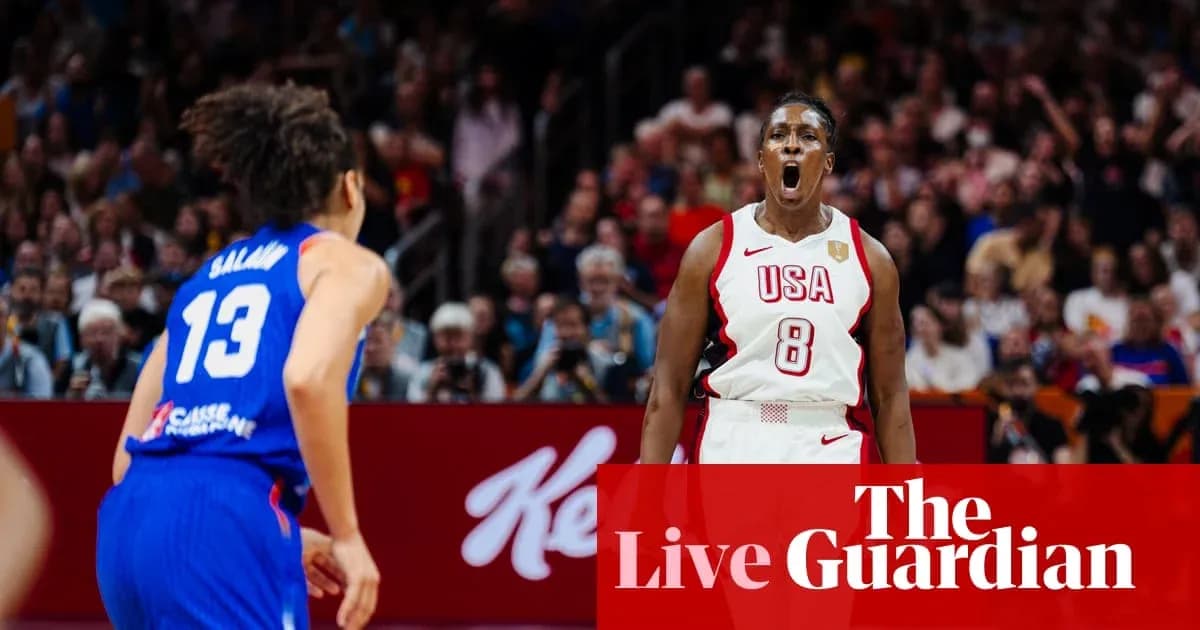
USA Secures Fifth Straight World Cup Title Despite French Challenge
The USA are still on top of the world. Just don’t call them invincible anymore.
In Berlin, in a World Cup final that briefly threatened to rewrite the sport’s hierarchy, a veteran American core steadied, tightened the screws and walked away with a fifth straight title, beating France 97-79. It was not the procession the scoreline suggests. For long stretches, the champions were second-best.
France had them. Or at least, it felt that way.
France land the first punch
Early on, the blue jerseys ran the game. They carved up the US defense with sharp cuts and fearless drives, piling up layups and rhythm threes. The scoreboard flashed 31-17 France in the second quarter. The Americans looked rushed, disjointed, oddly mortal.
Gabby Williams – the Nevada-born, UConn-made star who now headlines France – dictated the tempo. She glided to the rim, hit from deep and finished the half with 16 points, the same relentless, two-way presence who nearly forced overtime in the 2024 Olympic final. Dominique Malonga bullied the paint. Marine Johannes spaced the floor. The US, for once, were chasing.
Kara Lawson’s team coughed up turnovers, settled for tough looks and watched France stretch the lead into double digits. Angel Reese missed two free throws. Caitlin Clark’s first real involvement was a pair of turnovers, dribbling herself into trouble and stepping on the baseline. The European challenge that had been promised for years was suddenly very real.
Then the veterans went to work.
Stewart, Young and Gray drag the US back
Breanna Stewart, Jackie Young and Chelsea Gray have seen every kind of game, every kind of storm. They didn’t panic. They just started winning possessions.
Stewart, already climbing the all-time scoring charts – she passed Cheryl Miller early with two free throws to become the fifth-leading scorer in US history – turned the second quarter into a personal stabilizing act. She rebounded, drew fouls, and kept France from running away with it. Young and Gray, the perimeter brain trust, began to find seams.
A crucial sequence midway through the second quarter changed the tone. France led 31-17 when Williams drilled another three. The US looked wobbly. Young finally stemmed the bleeding with a three of her own, just as Toure fouled Stewart off the ball. Stewart added two free throws. In one trip, the deficit shrank and the US found a foothold.
Aliyah Boston, one of the new generation, chipped in with deflections and a transition bucket. Gray threaded no-look passes through traffic, punishing even the slightest French hesitation. The lead, once 14, kept nudging down.
Then, on the final play of the half, the player everyone came to see reminded Berlin she was still there.
Clark, quiet and error-prone to that point, drifted to the corner. The ball swung her way. She rose and buried a three at the buzzer. Officially, it was 45-43 France at the break. Emotionally, it felt like the US had just re-entered the fight.
A brutal third quarter turns the tide
Whatever Lawson said at halftime, it worked.
On the first possession of the third quarter, Stewart tied it at 45. The US defense ratcheted up. France, so fluid in the first half, suddenly found bodies in every driving lane and hands in every passing angle. Open looks dried up. The shots that had fallen so easily began rimming out.
Collier’s hustle basket gave the US their first lead in what felt like forever at 52-47. Copper’s three soon followed. The scoreboard – and the body language – flipped.
Gray, who had flirted with cooling off, went back to hitting the kind of shots that separate stars from everyone else: late-clock fadeaways, pull-ups with a hand in her face, drives that drew contact and whistles. Young stretched the floor from deep. Stewart owned the glass. Every French miss seemed to trigger an American answer.
France tried to hang on. Malonga and Williams worked a neat two-woman game to cut the deficit to four at 58-54, but each time they threatened, the US response was ruthless. Young hit from three off a Gray assist. Collier rose for a pull-up. Rhyne Howard jumped a passing lane and went coast to coast. The lead, once fragile, ballooned into double digits.
Then came the moment that effectively broke France’s resistance.
With under a minute left in the third, Copper attacked the rim and was hammered by Johannes. Officials went to the monitor and upgraded it to an “act of violence,” granting four free throws and possession. Copper hit three of four. On the ensuing play, Clark slipped a pass inside to her Indiana Fever teammate Boston for another bucket. A tight game had become a 73-57 American stranglehold by the end of the quarter.
France’s dream third quarter? It never arrived. Instead, they endured a nightmare.
Closing the door
The fourth quarter was about control. And about Malonga refusing to go quietly.
The 20-year-old French center finished with 21 points, battling until the final horn. She hit a corner three, scored through contact, and strung together a personal run that trimmed a 27-point deficit to something more respectable. Her stat line – 21 points, strong work on the glass, relentless presence – underlined why Seattle view her as a cornerstone.
Williams, who ended with 20 points and seven assists, kept firing, but her second half turned ragged: turnovers on wild drives, missed free throws, the toll of carrying France’s offense against a defense that had finally locked in.
By contrast, the US looked composed. Copper crashed the offensive glass for a putback. Stewart added free throws. Young, Gray and Stewart kept the ball moving and the clock bleeding. Every time France flickered, the Americans snuffed it out.
With just under two minutes to play and the lead back at 20, Lawson finally emptied the bench. Stewart, Gray and Young checked out to deserved ovations from the US contingent. Clark returned alongside Reese, with Sonia Citron and Kiki Iriafen getting late cameos that spoke to the depth waiting in the wings.
Clark’s stat line told a complicated story: 12 points on 4-of-5 shooting, including 2-of-3 from deep, in just over 10 minutes, but four turnovers and a technical foul after arguing a call early in the fourth. It mirrored her tournament – flashes of brilliance, stretches of struggle, still learning how to bend elite international defenses to her will.
Reese, meanwhile, brought her trademark edge in limited minutes, blocking shots and finishing inside once Stewart found her late to push the margin to 20. Boston gave solid minutes in the middle. Paige Bueckers, Citron and Iriafen hardly featured, a reminder of just how hard it is to crack this rotation.
The final numbers underscored the US dominance in the areas that matter most in knockout basketball. Stewart led all American scorers with 22 points and nine rebounds, one board shy of a double-double. Young added 18 points and five assists. Copper poured in 15. Gray and Clark each finished with 12, with Gray also dishing five assists to match Young’s playmaking.
On the glass, the US owned it, 36-27. They shot 55% from the field, punished France’s mistakes and, crucially, stayed calm when they were 14 down and wobbling.
France shot well enough – 52% at one stage, 8-of-14 from three in the first half – but when the pressure rose, the touch deserted them. The third quarter, in which a 45-40 halftime lead evaporated into a 16-point deficit, will sting all the way back to Paris.
A dynasty that now has company
Strip away the margin and this final told a different story to the blowouts that once defined US dominance. Italy pushed this team to the brink in group play. Spain were tied with them at 58 late in the semifinal. France led by 14 in a World Cup final. The aura has cracks.
That’s not a crisis for USA Basketball. It’s a sign the sport has finally grown into the juggernaut that chased so many of these players overseas in the first place.
Eight members of this French roster are in the WNBA. Williams and Janelle Salaun share a locker room with Natalie Nakase on the Golden State Valkyries staff, the same Nakase now serving as an assistant for the US. Malonga is anchoring Seattle’s future. Johannes runs the perimeter for the New York Liberty. The women’s game is no longer a one-country show; it’s a global circuit, with Berlin just the latest stop.
The US still sit on the throne. Five straight World Cups. A combined 121-1 record in World Cup and Olympic play since 1994, with the only blemish a 2006 semifinal loss to Russia. Seventy-one consecutive wins at the sport’s highest level. The dynasty is intact.
But the gap is closing. Italy, Spain, France – and others watching from home – will leave this tournament knowing the Americans can be rattled, can be trailed, can be forced into ugly stretches.
So the question shifts.
Stewart, Gray, Collier, Copper and Young just delivered again. Behind them wait Clark, Reese, Boston, Bueckers, Howard, Citron, Iriafen – a potential golden generation still finding its feet on this stage. The US will be favored at the next Olympics and the next World Cup. For the first time in decades, though, that favoritism comes with a genuine caveat.
Can this next wave keep the reign alive against a Europe that no longer flinches?
France, on this evidence, fully intend to ask that question again.