.svg&w=384&q=75 "logo")
USA Women's Basketball Dominates China in World Cup Opener
The United States arrived at the FIBA Women's World Cup as they always do – carrying the weight of history and the expectation of gold. Eleven world titles, four straight championships, and only one slip from the top step of the podium since 1998. This is their tournament until someone proves otherwise.
On opening day, nobody did.
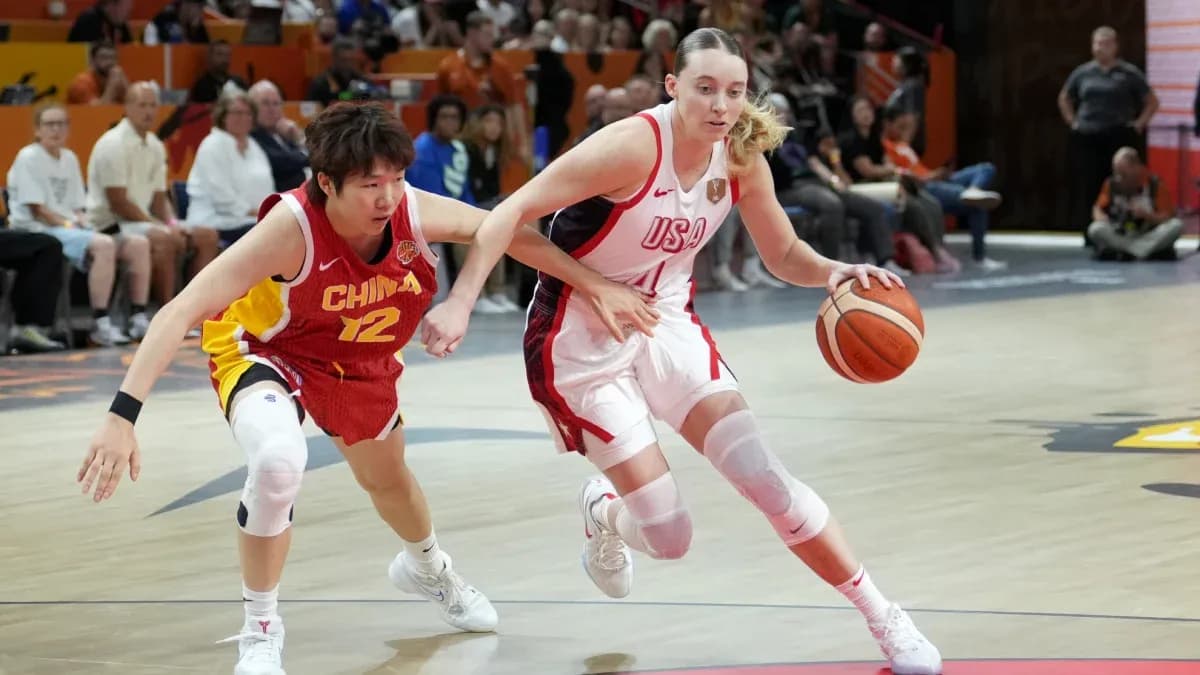
Spain rolled. France rolled. The United States did more than that, dismantling China 94-61 in a performance that felt brutally familiar: waves of pressure, relentless pace, and a level of depth no one else in the field can quite match.
At the heart of it, though, was something new on the world stage – the live-wire connection between Caitlin Clark and Paige Bueckers.
Clark and Bueckers Take Center Stage
Clark came off the bench and immediately seized the game. She logged a team-high 25 minutes, orchestrating the offense with 11 assists – the most by an American player at this tournament in 28 years – and adding 14 points. Bueckers matched her with 14 of her own, the two guards effectively turning the contest into a showcase of modern perimeter play.
China never solved it. Every time Clark handled the ball, defenders shaded, then swarmed. Her reputation followed her into the arena: lethal from deep, ruthless in pick-and-roll, and almost impossibly secure with the ball. The response from China was predictable – traps, hard hedges, extra help – and Clark punished all of it.
The numbers told the story. Eleven assists, many of them created simply because defenses cannot afford to leave her alone. It's the same dynamic that has helped her rise to the top of the assist charts in the WNBA. In this setting, with this talent around her, those reads looked almost effortless.
Bueckers thrived in the gaps Clark created. While China scrambled to contain the ball, she slipped into pockets of space, cut off the weak side, and attacked closeouts. The partnership already looks instinctive, a blend of timing and trust that rarely appears this quickly on an international roster.
"We know how to play well off of each other. She draws so much defensive attention, so a lot of the defense is worried about her and she has great vision as well," Bueckers said afterward, summing up what everyone had just watched.
The box score backed every word.
A Viral Moment, and a Statement Win
The game also produced one of the early viral snapshots of the tournament. Bueckers, listed at 6-foot, stood next to China's 7-foot-3 center Zhang Ziyu, craning her neck upward in disbelief. It was a reminder of the physical mismatches that define international basketball – and how the United States often sidesteps them with speed, skill, and spacing.
While that image raced around social media, the more important picture emerged on the court: a U.S. team already in stride. The margin ballooned past 30, the rotations stayed sharp, and the backcourt dictated everything.
Clark's floor-mapping, Bueckers' cutting and shot-making, and the collective defensive intensity left China with little room to breathe. The Americans did not just win; they imposed their identity from the opening tip.
Group D Road Ahead
The schedule offers no time to linger on the performance. Next up is Italy on Sunday, a side that opened its campaign with a win over Czechia and will not lack confidence. Italy moves the ball, shoots in rhythm, and will test how well this U.S. defense closes out to the perimeter.
After that, the United States finishes Group D play on Monday against Czechia, a quick turnaround that will demand both depth and discipline.
The broader story, though, is already taking shape. The United States arrived as overwhelming favorites to claim a fifth consecutive world championship. If this first outing is any indication, the rest of the field is not just chasing the defending champions.
They are chasing a backcourt that looks ready to define this World Cup.