.svg&w=384&q=75 "logo")
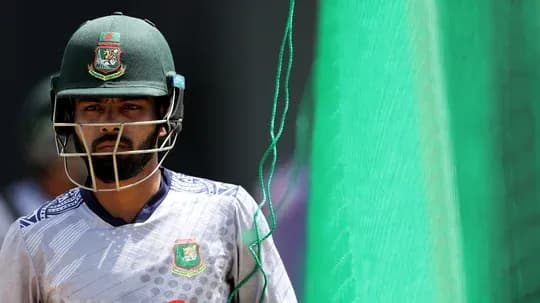
Towhid Hridoy Makes History with Unbeaten 350 in First-Class Cricket
Potchefstroom has already given Towhid Hridoy one life-changing memory. Now it has handed him another.
Four years after lifting the ICC Under-19 World Cup trophy on this South African ground, the right-hander returned and carved his name into Bangladesh’s first-class record books with an unbeaten 350 against South Africa A – the highest score ever by a Bangladeshi batter in first-class cricket.
He did it as a late addition, too. Hridoy was not originally pencilled in as a pillar of this tour. He flew out with Nurul Hasan, Rishad Hossain and Mohammad Saifuddin only after injuries and visa issues ripped holes in the initial Bangladesh A squad. The board needed bodies; they sent reinforcements.
One of those reinforcements has just rewritten history.
A reluctant traveller, a ruthless innings
At the airport in Dhaka, Hridoy did not sound like a man obsessing over four-day cricket. His mind was already jumping ahead to white-ball battles: a national team tour of South Africa in November, limited-overs series against the Proteas, and an ODI World Cup next year.
“The preparation is very important and as we have a national team tour and the World Cup (ODI), will try to prepare for it,” he told reporters before boarding. His focus was on conditions, not on a statement in red-ball cricket.
Maybe that helped. With no public declarations about reviving his Test career, no visible burden of expectation, he walked into Potchefstroom with a looseness that can be priceless in long-form cricket. Once in, he did not leave. South Africa A’s bowlers kept coming; Hridoy kept answering. By the time he walked off, unbeaten on 350, he had barged past Tamim Iqbal’s 334* and Raqibul Hasan’s 313* to stand alone at the top of Bangladesh’s first-class scoring charts.
Only two Bangladeshis had ever reached a triple hundred before. Hridoy not only joined that club, he took the record and slammed the door behind him.
A Test dream stalled at three days
The sheer scale of the innings throws an uncomfortable light back on his Test journey – or lack of one.
Hridoy waited more than three years after his white-ball debut to finally pull on a Test cap. When the chance came, it vanished almost instantly. One match. Three days of Test cricket. A failure in the second Test of the Zimbabwe tour in Harare, and he was gone.
The debate around his red-ball credentials started almost immediately. Some said he had been pushed into Tests too early. Others questioned whether his technique, so effective in white-ball cricket, truly suited the longer format. Very few, crucially, were loudly arguing to keep him in the Test side and let him grow.
The selectors, for their part, have often repeated a familiar line: breaking into the national team is hard, but once a player gets in, he will get opportunities to prove himself. Hridoy’s case stands as an awkward counterexample. One Test, one failure, and the door closed.
No wonder he has been guarded about his Test ambitions. No grand statements. No public demands. Just a simple acceptance that his fate lies elsewhere.
“This is not entirely my call, as a professional player I always want to do well, I have said this on many occasions before, how many matches I will play for the national team will depend on the selectors, if I get the opportunity I will try to do well,” he said after his 350, when asked about his red-ball plans.
The words were measured. The bat had already spoken louder.
A record that demands an answer
His innings against South Africa A has changed the conversation whether he wants it to or not. You cannot become only the third Bangladeshi to score a first-class triple hundred, and the highest of them all, and expect silence when the next Test squad is picked.
Hridoy will now be at the heart of every selection meeting before Bangladesh’s upcoming Test series. The numbers force the issue. The context sharpens it. This was not a flat-track stroll at home, but a marathon knock away, against a strong A side, in conditions Bangladesh’s senior team will soon have to negotiate.
The challenge for the selectors runs deeper than simply squeezing his name into a squad list. It is about trust. If they recall him, they must convince him – and the dressing room – that this time he will not be discarded after a single misstep. That this record-breaking effort is the start of a fair run, not another brief cameo in whites.
For now, Hridoy is not chasing that narrative. He has kept his public gaze on white-ball cricket, on the tours and tournaments that first made him a national talking point. His reluctance to fixate on the red-ball future might actually be his greatest asset. It freed his mind in Potchefstroom. It allowed him to bat, not to audition.
But 350 runs without dismissal in foreign conditions leave a mark that no one can brush aside. The innings has turned a once-forgotten Test hopeful into the central question of Bangladesh’s red-ball planning.
The next time Bangladesh name a Test squad, the selectors will not just be choosing a team. They will be answering a very simple, very pointed question: what, exactly, does a batter have to do to earn a real chance?