.svg&w=384&q=75 "logo")
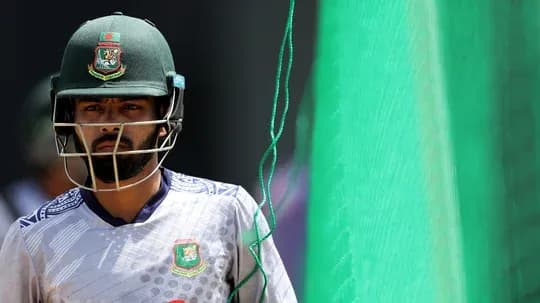
Towhid Hridoy Makes Cricket History with Unbeaten 350
In Potchefstroom, a ground already etched into his memory, Towhid Hridoy quietly walked into cricket history.
The venue where he once lifted the ICC Under-19 World Cup trophy in 2020 has now given him something even more personal: an unbeaten 350 for Bangladesh A against South Africa A, the highest first-class score by a Bangladeshi batter. He went past Tamim Iqbal’s 334* and Raqibul Hasan’s 313*, and did it with the air of a man who had arrived for something else entirely.
Because this trip, on paper, was never meant to be about redemption in whites.
A late call, a different agenda
Hridoy was not originally earmarked as a key figure for this A tour. He was sent to South Africa alongside Nurul Hasan, Rishad Hossain and Mohammad Saifuddin after injuries and visa issues left the touring party short of players. He was, in essence, cover. Insurance.
At the airport in Dhaka, there was no grand declaration about reviving his Test career or staking a claim for a long red-ball run. He spoke instead like a man on a white-ball mission.
“The preparation is very important and as we have a national team tour and the World Cup (ODI), will try to prepare for it,” he told reporters before boarding. For him, South Africa was supposed to be a rehearsal for the upcoming limited-overs series against the Proteas and the ODI World Cup next year, a chance to understand conditions, not rewrite record books.
He had every reason to keep Test dreams at arm’s length.
Three days in whites, then the door shut
Hridoy’s relationship with red-ball cricket at international level has been brief and bruising. He waited more than three years after his white-ball debut to finally crack the Test squad. When the chance came, it vanished almost as quickly.
One Test. Three days. Then out.
His only appearance in whites came in the second Test against Zimbabwe in Harare, where he failed to make an impact. The response was ruthless. While the national selection panel often talks about giving players time to settle in once they break through in any format, that promise never truly extended to Hridoy.
He was judged early, and harshly. Some said he had been picked too soon. Others dissected his technique and boxed him as a white-ball specialist. Few stood up and argued that he deserved a longer rope in Tests.
That experience left a mark. It explains why, even now, he resists looking too far ahead when the conversation turns to red-ball cricket.
A triple hundred, and still uncertainty
On the field in Potchefstroom, none of that baggage showed. Detached from the noise, Hridoy batted as if liberated from consequence. The lack of expectation became his greatest ally.
He became only the third Bangladeshi to score a triple hundred in first-class cricket, and he did it with a clarity that contrasted sharply with the uncertainty surrounding his Test future. Ball after ball, session after session, he built an innings that selectors simply cannot ignore.
Yet his words after the game revealed a player still wary of the system that once spat him out.
“This is not entirely my call, as a professional player I always want to do well, I have said this on many occasions before, how many matches I will play for the national team will depend on the selectors, if I get the opportunity I will try to do well,” he said when asked about his red-ball ambitions.
No demands. No proclamations. Just a reminder that his fate lies in other hands.
A selection dilemma that can’t be dodged
Bangladesh’s next Test series will now arrive with an unavoidable talking point. A batter who has just produced a record-breaking 350* against South Africa A, in South African conditions, cannot be brushed aside as a mere white-ball option.
The question is no longer whether Hridoy deserves a place in the Test squad. His numbers have answered that. The real issue is what happens after he gets there.
Does he walk into a dressing room knowing he will be backed through the natural ups and downs of Test cricket? Or does he return to the same fragile reality he faced in Harare, where one failure can send him straight back to the margins?
For Bangladesh, the challenge is not just about rewarding form. It is about trust. About convincing a player who has already felt the cold edge of selection that this time, the opportunity will be real, not a three-day trial.
On the evidence of Potchefstroom, Hridoy has already shown what he can do when he stops worrying about his future and simply bats. The next move belongs to the selectors.