Tiffany Teo Wins Singapore's First Gold at 20th Asian Games
TOKYO — In Tiffany Teo’s hands, the 265g disc of gold was never just metal. It was a decade of bruises, lonely hours on the mats and a stubborn belief that a Singaporean mixed martial artist belonged on the biggest stage in Asia.
On Tuesday in Nagoya, that belief finally had its proof.
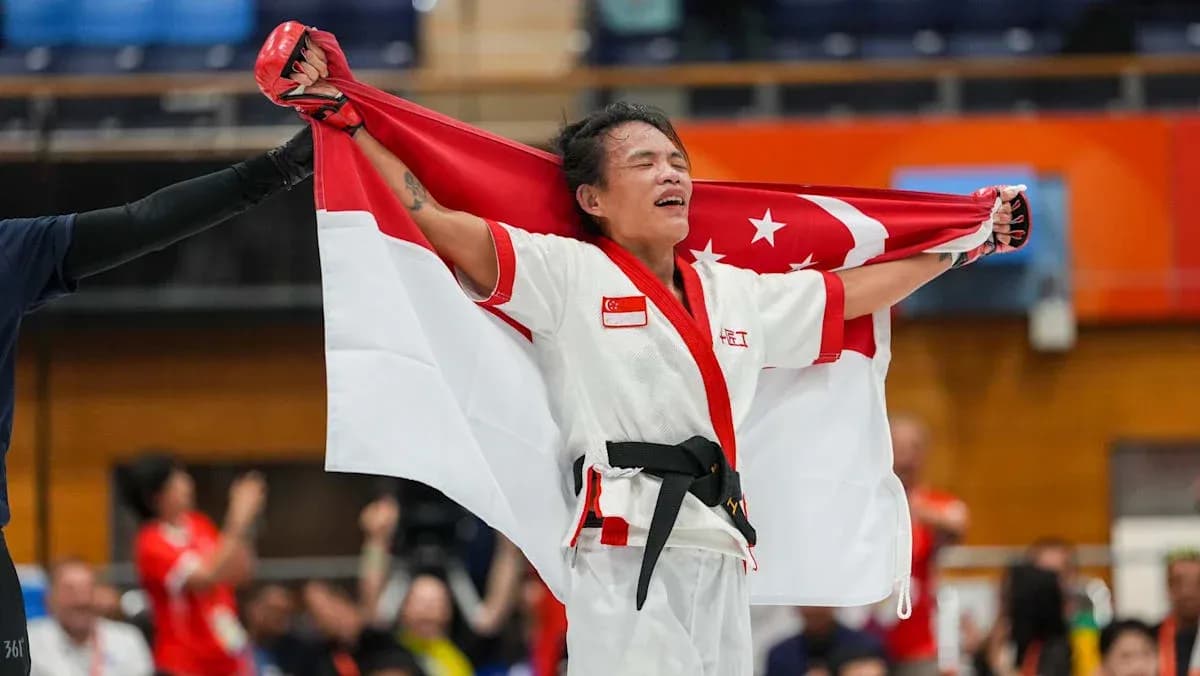
Teo outlasted Uzbekistan’s Khilola Sobirova in a gruelling women’s traditional 60kg final at the Nagoya City Inae Sports Center to claim Singapore’s first gold medal of the 20th Asian Games, winning in an extra overtime round after the judges had the bout level at one round apiece.
When her hand was raised, the 34-year-old broke.
“I was so overwhelmed when I won the fight,” she told reporters, still trying to process it all. “I just started crying; it was just tears of joy.”
A decade to a single moment
Teo spoke like someone who understood that this triumph had not been built in a single fight camp.
“I feel like this entire journey kind of led up to this moment. It's not just the past couple of months of fight camp, it was the hours people didn't see when I started, when I was a total beginner,” she said. “Coming into this Asian Games, I felt like I deserved to be here and I definitely deserved the gold medal.”
The gold capped a quietly simmering rivalry. In May, at the Asian Mixed Martial Arts Championship, Sobirova had beaten Teo in the final. That defeat stung, but it also sharpened her.
“In retrospect, I'm glad that I lost to her,” Teo admitted. “I feel like with losses it makes you reflect more. When you win, you reflect a little bit because it doesn't hurt that much.”
That reflection showed on Tuesday, in a contest that swung on small margins and mental steel. When the first two rounds were split, the pressure of an overtime decider would have cracked lesser fighters. Teo leaned into it, pushed the pace and seized the round — and with it, a slice of history.
Drama before destiny
Her path to the final had already tested her composure.
On Monday, Teo’s semi-final against India’s Suchika Tariyal descended into confusion and controversy. The pair were level after two rounds and, like the final, were sent to an overtime frame. Teo was initially announced the winner.
Then came the twist.
Tariyal’s camp lodged an immediate challenge. Officials reviewed the bout, overturned the decision and declared it a draw. Under Asian Mixed Martial Arts Association rules, that triggered a rarely seen tiebreaker: the morning weigh-in.
Teo advanced by the slimmest of margins, her 58.8kg edging Tariyal’s 59.85kg.
For an athlete who prides herself on performance, it was a hollow way to move on.
“We realised that in retrospect, I was hesitating a lot in yesterday's fight and honestly, I was pretty disappointed with my performance yesterday,” she said. “I felt like I could have dominated a lot more and a big part was my fault. My cornerman gave me the game plan, and I was overly eager to grapple and I kind of didn't follow the game plan in the first round, which led the match to a very close call.”
That brush with elimination appeared to harden her resolve. There was no hesitation in the final, no drifting from the plan. Where she had second-guessed herself on Monday, she imposed herself on Tuesday.
A pioneer’s bigger fight
Teo’s gold arrives in a landmark year for the sport. This is the first Asian Games to feature MMA on its programme, with the discipline one of six debutants for Aichi-Nagoya 2026, alongside freestyle BMX, padel, surfing, teqball and virtual taekwondo.
For Teo, the medal is only part of the mission.
“I've been doing it for a decade and I see myself as a pioneer in the sport,” she said. “I feel that it's quite sad to see that it's kind of not as popular now; I would like more people to take up this sport.”
So the gold around her neck carries extra weight. It is a personal vindication, yes, but also a statement piece for a discipline still fighting for attention back home.
On a night when a tiebreaker came down to decimal points on a scale, Teo left Japan with something far less fragile: proof that Singaporean MMA can stand on the podium — and a challenge to the next generation to join her on the mats.