.svg&w=384&q=75 "logo")
Team USA Dominates China in World Cup Opener
Team USA didn’t just ease into the 2026 FIBA Women’s Basketball World Cup. It stormed the door.
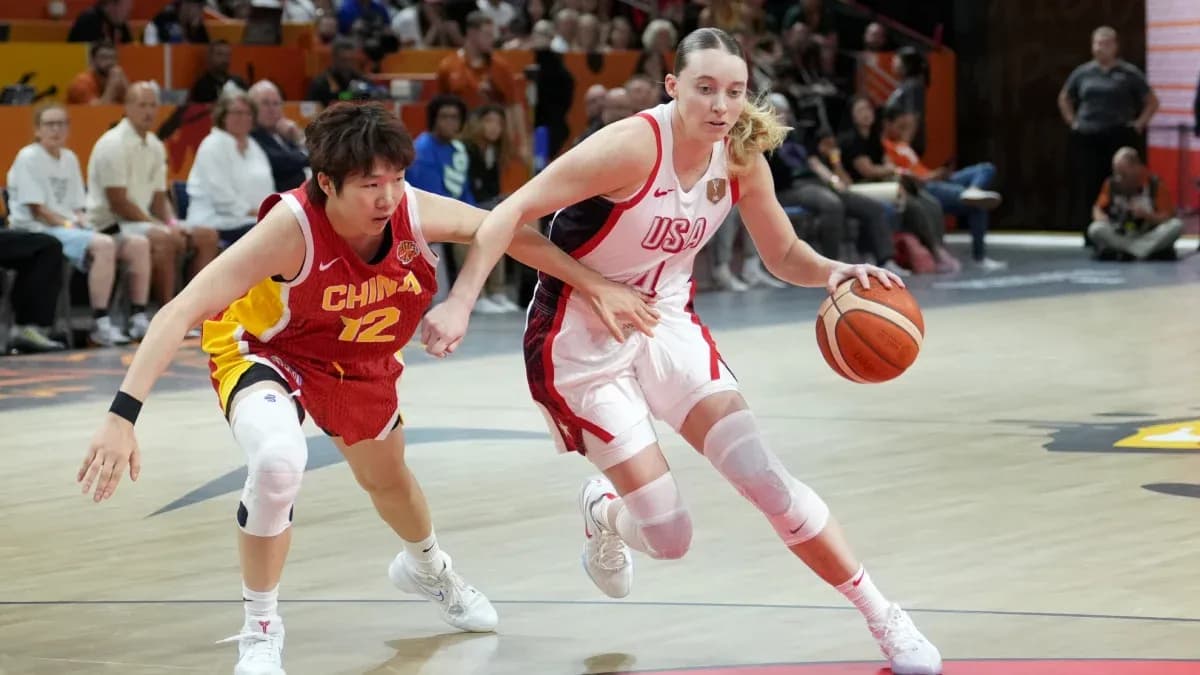
A 94-61 demolition of China in Berlin on Friday was as emphatic an opening statement as a four-time defending champion could script. The scoreline matched the expectation. The manner of it underlined why the rest of the field has spent the past decade chasing shadows.
The Americans walk away from Game 1 with what they came for: two competition points, a commanding point differential, and an early grip on Group D. They also leave with something less tangible but just as important – confirmation that a revamped roster still carries the familiar edge of a team that expects, not hopes, to win gold.
The path out of Group D
The format gives that dominance real, practical value.
Sixteen teams. Four groups of four. Three games each. At first glance, it looks simple. It isn’t.
Top spot in every group goes straight to the quarterfinals. Second and third? They get thrown into a single-elimination qualification game just to reach the last eight. One bad night, one hot opponent, and a medal favorite can vanish before the real weekend even starts.
That’s why first place matters so much more than just avoiding embarrassment.
Team USA sit in Group D with China, Italy and Czechia. After the opening round, the picture is already taking shape: the United States at 1-0 after overpowering China, Italy at 1-0 after beating Czechia. Two wins on the board, two early markers laid down.
The schedule gives the Americans a quick chance to settle the group. Italy on Sunday. Czechia on Monday. Blink, and group play is over.
From a qualification standpoint, the math is clear. One more win, any win, and the U.S. are safe. A 2-1 record guarantees a top-three finish in a four-team group, which means at worst a spot in that qualification round.
But this program doesn’t build its summers around “at worst.”
Three wins from three would lock up first place in Group D, provided the U.S. finish ahead on record. That route cuts out the extra do-or-die game, buys an extra day of rest and shrinks the margin for chaos. Even a 2-1 record might still be enough to win the group depending on other results and tiebreakers, but the cleanest solution is brutally straightforward: beat Italy, beat Czechia, and leave the calculators in the drawer.
A new-look USA, same old pressure
The most intriguing part of the opener wasn’t the margin. It was who delivered it.
Caitlin Clark stepped onto the World Cup stage and looked like she’d been there for years, finishing with 14 points and 11 assists. She dictated tempo, bent China’s defense out of shape, and turned a tricky matchup into a showcase. Rhyne Howard matched her with 14 points of her own, while Paige Bueckers added 14 as well, giving the Americans a trio of perimeter threats that China simply couldn’t contain over 40 minutes.
The final gap – 33 points – told its own story. The U.S. didn’t just win; it layered options on top of options, exactly what a contender wants to see in Game 1 of a long tournament.
All of this came with two major names missing.
A'ja Wilson and Kelsey Plum withdrew before the tournament with health and injury concerns, stripping away two pillars of recent American dominance. That could have left a hole. Instead, it reshaped the hierarchy.
Sonia Citron and Kiki Iriafen stepped into the group, adding fresh legs and hunger, while the responsibility on veterans like Breanna Stewart and Napheesa Collier only grew heavier. They now serve as the spine of a roster that mixes established champions with ambitious newcomers who see Berlin as their proving ground.
Even with those absences, the numbers around the program haven’t shifted. The United States still sit as FIBA’s No. 1-ranked team and arrived in Germany as the clear favorite to extend an extraordinary run of four straight World Cup titles. The standard hasn’t moved. The names have, slightly. The expectation hasn’t.
Why winning the group really matters
The wider field won’t make this easy.
France pushed the Americans to the brink in the 2024 Olympic final, losing by a single point. That performance, and the depth of their current roster, has them widely viewed as the most serious threat again. Belgium and Australia, both loaded with experience and size, have the tools to reach the latter stages and cause real problems in a one-off game.
China, even in defeat, offered a reminder of what can go wrong for anyone who drifts. Its huge frontcourt created awkward angles and forced the Americans to work for clean looks, particularly early on. The U.S. eventually solved the puzzle, but the warning stands: one off-shooting night against a big, disciplined opponent can flip a tournament on its head.
That’s why the stakes in Group D go beyond simple seeding.
Win the group and the Americans skip that extra qualification game. No extra scouting. No extra 40 minutes of risk. Just a direct line into the quarterfinals, where the bracket settles into a familiar shape: quarters, semis, medal games, and a straight fight for the podium.
Leave the door open by slipping into second or third, and that single-elimination qualifier becomes a live grenade in the middle of the campaign.
The expectation from here
On paper, the outlook is blunt.
Team USA should win Group D. They already own a 1-0 record, the best point differential in the group, and a roster that still looks deeper than any of their immediate rivals. Italy and Czechia must still face each other. The U.S., even without Wilson and Plum, have already shown they can roll out wave after wave of scoring and playmaking.
The real intrigue starts after the group dust settles.
France loom as the most obvious obstacle. Belgium and Australia have the pedigree to turn a semifinal or quarterfinal into a knife-edge contest. Pre-tournament assessments pointed to the United States and France as the leading favorites, and nothing from the opening day has shaken that view.
For now, the equation is stripped down to its essence: beat Italy or Czechia and the Americans are through. Beat both, and they walk straight into the quarterfinals on their own terms.
Given the blend of experience, athleticism, creation and depth on this roster, the safest call is that Team USA will do exactly that – take Group D, lock in the direct route, and keep the march toward a fifth consecutive World Cup crown very much alive.
The question isn’t whether they can. It’s who, if anyone, can stop them once the real pressure games arrive.