
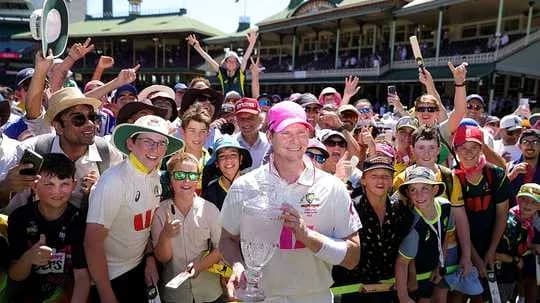
Steve Smith Focuses on Series, Not Ashes
Steve Smith refuses to look that far ahead. Not even for the Ashes.
At 37, with a legacy already chiselled into Australian cricket history, Smith still won’t commit to one last crack at an Ashes series win in England. The temptation is obvious. The decision is not.
“I don't even know if I’ll be there yet,” he told The Telegraph, laying out his career philosophy with the same clarity he once reserved for the coaching staff’s whiteboard. “I'm in kind of a series-by-series proposition, as I’ve been for a while, and that’s still a fair way away for me right now. I’d love to win one there or to have won one there, but you wait and see if that comes to fruition.”
No grand farewell tour. No carefully staged final act. Just the next series, then the one after that—if he still feels like it.
One series at a time
Australia’s schedule would test any ageing body and mind, even one as fiercely competitive as Smith’s. South Africa away. India away. Then, potentially, England.
It’s a brutal run, and Smith has chosen to narrow his gaze. His focus is on the looming three-Test series against the current World Test Championship holders, a return to South Africa in the format that once left a scar on his career.
For the first time since the 2018 ball-tampering scandal, he will walk out in a Test match in South Africa. The narrative writes itself, but Smith is no longer interested in that chapter.
“For me, it’s just another series,” he said. “All that happened a long time ago, and we’ve played a lot of cricket and have been back to South Africa since then for one-dayers. They’re a good side at the moment, obviously beat us in the World Test Championship final. They have a really good pace attack as well, so should be a cracker of a series.”
The emotion, the baggage, the noise—he has boxed it up. What remains is the contest: a proud Australian side against a quick, aggressive South African attack on hard, unforgiving pitches.
No Test end date, no cricket farewell
If the Ashes future is cloudy, Smith’s broader cricketing horizon looks brighter. He has no plans to step away from the game entirely. Test retirement, when it comes, will not mean disappearing from the sport.
He is leaning harder into T20, embracing the format that once sat on the periphery of his reputation. The target that keeps coming up is not a World Cup or another IPL title. It is the Olympics.
“Right now probably it’s just the Olympics to try to be a part of that,” Smith said, with Los Angeles 2028 firmly on his radar.
He has already started shaping his calendar around that ambition. “One of the reasons why I wanted to play with Amsterdam [at the European T20 Premier League] was just to continue playing as much T20 cricket as I can.”
There is no farewell statement drafted on his phone. No private deadline circled on a calendar. Just a simple equation: enjoyment plus performance.
“I still like to think I could play T20 cricket for a while. What’s next for me when I finish? I’m not sure, but yeah, hopefully a bit more time left playing.
“I've achieved a lot in the game. It’s been a great ride for the last 15 years or thereabouts. I’ve had a lot of fun. I’m still enjoying it, so I don’t have an end date, we’ll wait and see. But it’s been a good ride.”
Batting through the era of movement
If anything might push a great player towards the exit, it is the changing nature of Test batting. Seamers now thrive on surfaces that offer relentless movement. Scoring has become harder. Patience alone no longer guarantees survival.
Smith, though, has adapted. Quietly, effectively.
He averages 49.4 over the last two years in Tests and has lifted his century tally to 37. Those numbers belong not to a fading star, but to a player who still bends matches to his will.
“I feel like I’m batting really nicely,” he said. “I’ve found different ways to go about things on these tricky surfaces and still be able to score runs. So trying to contribute as well as I can for the team, score runs, take catches, help out in leadership areas where I need to. It’s been a good, fun couple of years.”
This is Smith in his late-career phase: less consumed by aesthetics, more obsessed with solutions. Different guards, altered trigger movements, new scoring areas—he has retooled his game without losing its essence.
He is no longer Australia’s official captain, but his influence lingers in the dressing room. Advice here, a quiet word there, an example set in the nets. Leadership without the title suits him now.
The question that hangs over all of this is simple: how long does it last?
Smith won’t answer it. Not yet. Not for the Ashes, not for his career.
For now, it’s South Africa, then whatever comes next. If that journey happens to run through one last English summer and a shot at the Ashes he has never won away from home, it will be because he still feels the itch to compete, not because the script demands a perfect ending.





