
Steve Smith's Journey: From Cheater to Redemption in Cricket
Steve Smith returns to South Africa this week still carrying a label no cricketer wants and no champion can quite outrun. Not “modern great”. Not “Australia’s best since Don Bradman”. Cheater.
Eight years on from the Cape Town Test that detonated his captaincy and scarred his reputation, Smith has spoken of being “traumatised” by the fallout. The word jars. Not because the experience wouldn’t have cut deep, but because it lands awkwardly against the backdrop of what actually happened — and who paid the heaviest price.
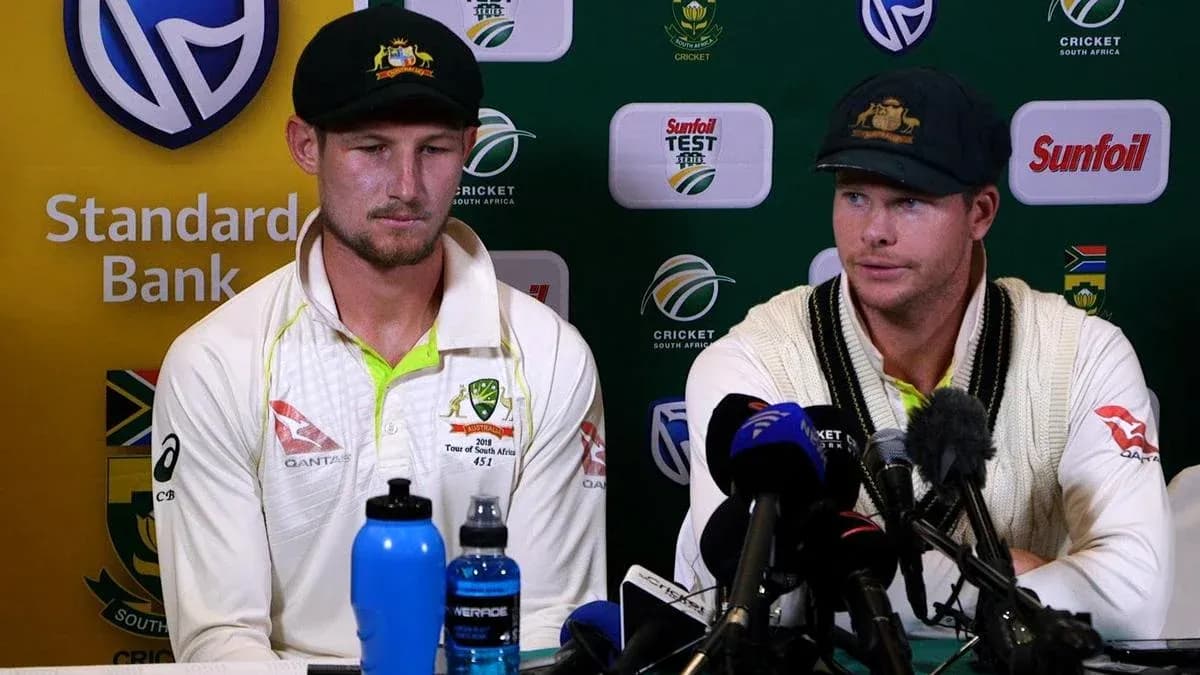
On that 2018 tour, Smith was the captain, the standard-bearer of Australian cricket. He was also, crucially, the man who signed off on a plan for Cameron Bancroft to use sandpaper on the ball. David Warner, his vice-captain, was central to the scheme and banned as well. The image of Bancroft fumbling with the yellow paper and then lying about it on camera is now stitched into the game’s darker tapestry.
The bans came. The tears came. The mea culpas came. So did something else: a strange split-screen narrative of redemption.
When Smith walked back out after his suspension, into a cauldron at Edgbaston during the 2019 Ashes, the English crowd went after him with unrelenting venom. Boos, songs, masks, taunts. He answered with 144 in the first innings, 142 in the second, and a series tally of 774 runs that felt like a defiant act of will. It was batting as resistance, genius weaponised against hostility.
Was that the beginning of redemption, or the moment it quietly ended? The question has never quite gone away.
On the other side of the same story stood Warner. In that Ashes series he made 95 runs in 10 innings, seven times undone by Stuart Broad, who seemed to have him on a string. Warner looked lost, his technique fraying under pressure. Then, almost out of nowhere, came an unbeaten 335 against Pakistan — the highest score by an Australian against them, a monumental innings that sat uneasily beside his public image.
Geoff Lemon, who chronicled the sandpaper saga in forensic detail, captured the mood neatly: “Public opinion firmly settled on Warner being the criminal and Smith the innocent bystander.” One was cast as architect, the other as tragic prodigy who let things happen around him.
Yet Smith was no bystander. He was the captain. He owned the dressing room, the culture, the tone. His batting numbers are extraordinary — the best average among players with over 10,000 Test runs, for a long time north of 60, second only to Bradman. But greatness with the bat does not automatically translate to clarity of conscience.
His recent focus on what the scandal did to him, rather than what it did to his team, his sport, or the trust that underpins both, exposes a tension between self-obsession and self-awareness. You can be consumed by the art of batting and still be blind to the wider damage.
Cricket writer Gideon Haigh once described what made Cape Town so shocking: not just the act itself, but the ease with which it was agreed to. “What is extraordinary is how it was done and how easily it was agreed to by the team and how, not unapologetic, but sort of oblivious to the consequences Smith and Cameron Bancroft seemed to be at the press conference,” he said.
That obliviousness was not born in a single team meeting. It flowed from years of entitlement, of a “win-at-all-costs” creed that the Australian board tacitly endorsed. Winning drove ratings. Ratings drove sponsorship. Sponsors drove money. Behaviour was tolerated, excused, even celebrated, right up until the moment it crossed a line the world refused to ignore.
Everything was forgiven until something became unforgivable.
At the infamous press conference, Smith claimed, “I was thrown to the wolves.” He wanted sympathy for the personal trauma, for the public shaming. The line was revealing. Here was a captain who had sent a younger teammate out to do the dirty work, then lamented being abandoned when the scheme collapsed under the weight of its own stupidity.
It was ingenuous, almost childlike, yet also deeply revealing of a mindset that had lost touch with consequence.
Still, sport has a way of humanising its sinners. A cricketer as obsessively devoted to batting and winning as Smith can, through suffering, become more rounded, more reflective. The instinct to demand the harshest penalty is easy in the heat of outrage. This very column once argued for a life ban.
Then something else dawned. Cricket is a game. A serious one, rich with history and emotion, but an artificial construct all the same. We load it with meaning — honour, fairness, national pride — yet it remains a set of rules around a leather ball and a strip of turf. That artificiality gives us licence to impose ideals that might be impossible to uphold in the messy real world.
We tell cricketers to play not just within the laws, but within a “spirit of cricket” that had to be written down and stapled to the front of the Laws because the unwritten code was being bent and broken too often. That add-on says less about the game than it does about the players, and the era, that forced it into existence.
Sport itself is morally neutral. A cover drive is neither good nor bad. A yorker carries no ethics. The morality lies with the people who choose how to compete, what they will risk, and what they will sacrifice for an edge.
Many international cricketers felt the bans on Smith, Warner and Bancroft were excessive. They argued that the so-called “Australian way” — the snarling, abrasive, line-pushing culture — should share the blame. Trevor Chappell, who bowled the notorious underarm delivery against New Zealand in 1981 on his captain’s orders, understands what it means to become a permanent villain in the public imagination.
“(Smith and the others) will struggle for the rest of their lives,” Chappell said. “I haven’t been able to shake off what happened to me in 37 years. I come up on Google as the man who took the lead role in Australian cricket’s darkest day. It’s a relief I can finally drop that title.”
The sting in the tail is obvious: that burden now sits on Smith and Warner.
Who, if anyone, will lift it from them?
When Smith returned to South Africa for a white-ball series, the reception was surprisingly restrained. No baying mobs. No sustained fury. Just the odd jeer, the occasional pointed chant. Still, he knows what awaits him anywhere he goes with a bat in hand. One misstep, one lull in form, one hostile crowd, and the sandpaper chorus returns.
That is his real sentence. Not the 12-month ban. Not the loss of the captaincy. The punishment is knowing that, for all the runs and records and moments of brilliance, one word will always lurk in the first line of his story.
And the question that lingers is not whether Steve Smith has suffered enough, but whether cricket — and those who run it — have learned enough from the day they let “win at all costs” become a guiding principle rather than a warning sign.





