
South Africa's First-Class Season Opens with Seam-Bowling Highlights
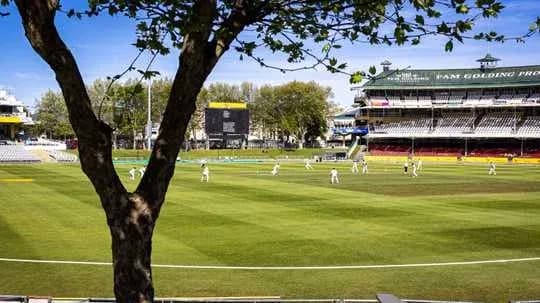
The new first-class season in South Africa crept into life at Newlands under a restless wind and almost empty stands. It looked quiet. It wasn’t.
A sharp north-westerly tore at shirts and flags, the outfield shimmered that too-bright early-spring green, and Western Province Cobras – newly rebranded, old name restored – were in trouble. Chasing the Warriors’ 347, they had slumped to 57 for 3 when Kyle Verreynne walked in, bat tapping with the certainty of a man who has seen most of what this game can throw at him.
He and Daniel Smith steadied things with clean, uncomplicated batting. The slide slowed. For a few overs, the game seemed to flatten out.
Then Senuran Muthusamy took the ball and changed the temperature.
His introduction sharpened the contest immediately. The left-arm spinner found bite and rhythm, and the Cobras never recovered. Sparks flew through his spell; wickets followed. He ripped out 3 for 17, the innings collapsed to 143, and with it any realistic hope of forcing a result.
Muthusamy’s work with the ball capped an allround performance that framed the match. He had already made 61 in the Warriors’ only innings, a vital contribution in a total that would anchor a game ultimately strangled by bad light and rain. Saturday disappeared to the weather, and with it any chance of a finish.
Tristan Stubbs used the time he did have well. He batted with a measured urgency, 46 from 116 balls with seven boundaries, then 11 from the same number of deliveries in the second hit. Not spectacular, but instructive: the kind of patient positivity that will not have gone unnoticed.
If Cape Town offered a slow-burn opening, the real jolt to the national radar came 1,400 kilometres away.
An 18-year-old and a record book
At the other end of the country, the Lions and Boland played out another draw that felt anything but dull. Temba Bavuma, back in the middle for the first time since June and in whites for the first time since the Guwahati Test last November, batted like a man reacquainting himself with an old language he still speaks fluently. He faced 146 balls for 91, a reassuringly substantial return.
Ryan Rickelton used the game to stretch his own legs. After falling for 49 in the first innings, he cashed in with 127 in the second. Lehan Botha went harder still: 170 off 189 balls, laced with 20 fours and five sixes, in just his 13th first-class innings. It was the kind of knock that usually owns the headlines.
Not this time.
The spotlight settled instead on JJ Basson, an 18-year-old left-arm seamer still in his final year of high school, playing his very first first-class match and promptly rewriting the record book. Given the new ball in both innings, he responded with 7 for 62 and 4 for 37. Match figures of 11 for 99: the best by a South African debutant.
Stand back and consider that. In a country where fast bowlers grow almost as a natural resource, it takes something extraordinary for a teenager to cut through the noise. Basson just did.
The timing is impossible to ignore. Kagiso Rabada, Ottneil Baartman, Nandré Burger and Lutho Sipamla are all injured. Between October and January, South Africa face eight home Tests against Australia, Bangladesh and England. That schedule will force selectors to turn over every stone in the seam-bowling stocks.
Basson has just rolled his name into that conversation with a brand-new ball and a school timetable to juggle. The wise move now is simple: let him finish his exams while the adults argue about how quickly to fast-track him.
Titans flex, Dolphins flounder
Elsewhere, results came with more bite.
In Bloemfontein, North West brushed aside the Knights by 135 runs. Diego Rosier’s 130 and Gihahn Cloete’s 118 powered the win, while the bowling card read like a shared effort. Dane Piedt, Daryn Dupavillon, Onke Nyaku and Malusi Siboto each grabbed four wickets in an innings; Siboto added three more in the other to close with 7 for 92.
The most brutal margin of the round, though, belonged to the Titans in Centurion. They hammered the Dolphins by an innings and 60 runs, a statement victory built on pace, depth and one blazing innings.
The Dolphins’ first effort of 157 never looked enough once Beyers Swanepoel, Dayyaan Galiem and Marco Jansen shared nine wickets between them. The Titans’ reply was emphatic: 421, with Donovan Ferreira punching 163 off 180 balls, an innings that tore at the opposition and gave the bowlers a luxury cushion.
Tristan Luus joined the season’s growing queue of fast-bowling talking points with 7 for 110 in the match. Jansen added 7 for 100 across the two innings, while Swanepoel and Jansen combined again in the second dig to knock over the Dolphins for 204 when they needed 264 just to make the home side bat again.
One line on the scorecard will draw a different kind of scrutiny. Keshav Maharaj, the Dolphins’ spearhead and South Africa’s premier Test spinner, bowled 32 overs for figures of 1 for 111. On a surface where seamers thrived and the game raced away from his side, it was a long, unrewarding slog that will invite questions rather than applause.
Swanepoel, at least, stayed until the end this time. In March, playing for the Lions in the One-Day Cup final at the Wanderers, he slipped away before the job was done, leaving early to catch a flight to England and a Worcestershire contract. The Lions responded by sacking him. The Titans, who have now benefited from his full commitment, signed him.
On this evidence, they knew exactly what they were doing.
Early days, big clues
Across one weather-hit round, the themes are already emerging. Muthusamy’s control, Stubbs’ maturity, Bavuma’s return, Rickelton and Botha’s weight of runs, Luus and Jansen’s relentless seam – and, above all, Basson’s extraordinary debut.
In a season that will feed directly into a demanding Test summer, the quiet days of September are already shaping the arguments. How long before an 18-year-old with 11 for 99 to his name swaps school corridors for a Test dressing room?





