.svg&w=384&q=75 "logo")
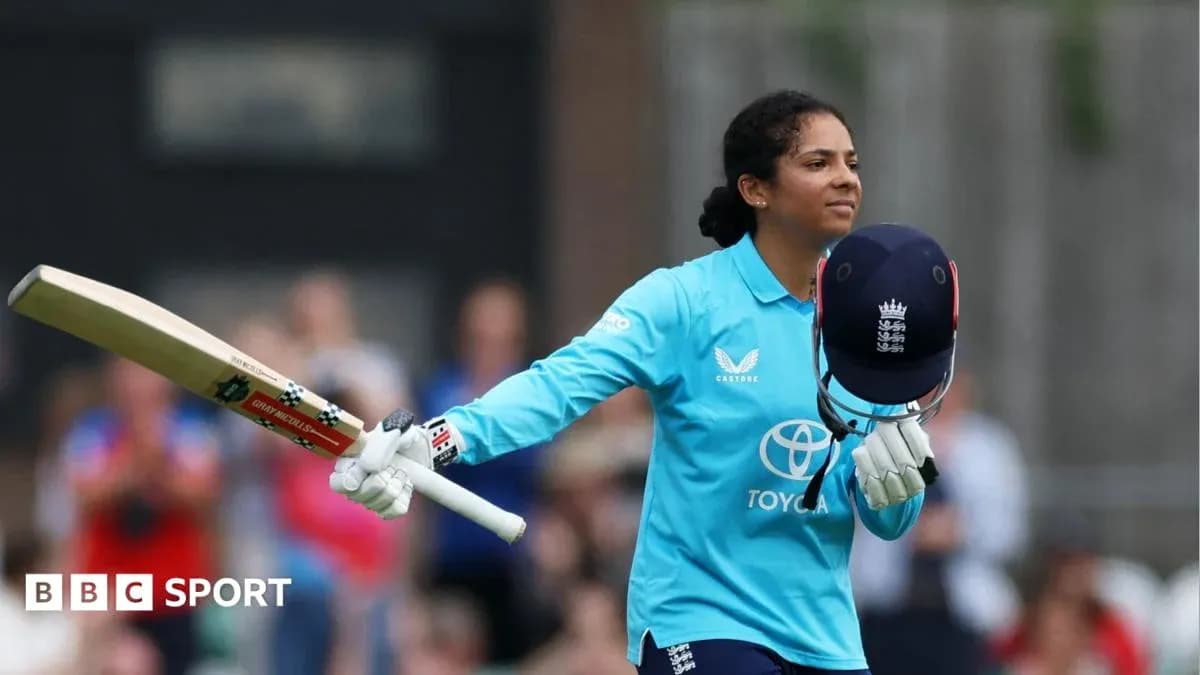
Sophia Dunkley seals England summer with century and 3-0 series win
On a grey Worcester afternoon that never quite dulled the white ball, Sophia Dunkley lit up New Road and, with it, England’s summer.
Her run-a-ball 119 powered England to 291 and broke Ireland’s resistance before a ball of their chase had been bowled. By the time Lauren Filer and Mady Villiers had finished with them, Ireland were 177 all out in 44.2 overs. A 114‑run win. A 3-0 series sweep. Job done, emphatically.
Dunkley answers the opening question
This has been a curious series for England: key names parked on the sidelines, an uncertain calendar ahead, and a format they barely get to play. But there was one glaring issue to sort out – who partners Maia Bouchier at the top now Tammy Beaumont has walked away from ODIs?
Dunkley’s answer came with the kind of clarity selectors crave.
She had threatened in the first two games – 73 at Leicester, then run out in farcical fashion at Derby after Bouchier’s misjudgement – but this time she batted as if determined to close the debate. The 28-year-old began quietly, letting Bouchier dictate the early tempo, and moved to fifty from 63 balls. Then she shifted gear. The next fifty took just 37.
What stood out was not just the tempo, but the method. Dunkley has long been tagged a leg-side bully. Here, she carved and drove through the off-side with authority, her scoring almost perfectly split either side of the wicket. Ireland probed with the short ball, pushed fielders back to the sweepers, tried to drag her into a mistake. For most of the afternoon, she simply worked them around, then punished anything even fractionally off line.
Her eventual dismissal – a superb catch by Orla Prendergast at deep square leg in the 36th over – finally checked England’s charge. By then she had faced 119 balls and hit England into a position that should have delivered a record total.
Runs at the top, stumbles at the end
Before the wobble came the promise. Dunkley and Bouchier stitched together 73 for the first wicket, Bouchier continuing her rich vein of form with 39. She looked set for another big one before departing, another player who “got in” but didn’t quite cash in.
Jodi Grewcock followed a similar path. Promoted into this experimental line-up, she again hinted at something more, only to fall for 35, caught and bowled just as she looked settled. Alice Capsey’s exit was harsher: backing up, stranded by a deflection, gone for 10.
At 260-4, with Freya Kemp and Dani Gibson at the crease, England were eyeing something monstrous. 300 felt a minimum. The record books were in play.
Then the innings buckled.
Kemp, who had started to swing with intent, holed out to long-on for 23. That wicket cracked the door open for Ireland. They barged straight through it. A run of single-figure scores followed as England’s middle and lower order collapsed, six wickets tumbling for 31 runs. Gibson, almost alone, held her nerve to an ODI-best 41, but she ran out of partners and overs. England were all out for 291 with seven balls left unused.
Cara Murray deserved much of the credit for dragging the total back into the realms of respectability. The leg-spinner finished with 4-56, Ireland’s standout bowler across the series, and she was central to the late squeeze that restricted England to just seven boundaries after Dunkley’s dismissal.
It still wasn’t close to enough.
Ireland strangled by the rate
On a surface that offered just enough for the seamers and rewarded control, 292 to win against this England attack always looked a stretch for Ireland. It quickly became a climb they never looked equipped to make.
Amy Hunter top-scored with 39 from 58 balls, battling hard to hold the innings together. The problem was all around her. No one else managed to score at a strike-rate above 100. Singles came, the odd boundary too, but the chase never found its stride. The asking rate crept up, then surged away.
Once the pressure bit, England’s bowlers went to work. Villiers, given a proper role in this reshaped side, struck three times and choked the middle overs. Filer, bristling with pace and hostility, matched her with 3-27, too quick and too direct for a batting line-up that never looked comfortable forcing the pace.
By the closing stages it felt less like a chase and more like a slow, inevitable slide. Ireland, who had fought so admirably with the ball, simply could not land the same blows with the bat.
Experimentation, and a hint of stability
Strip away the margin and this series has been about something deeper for England. Rested were Lauren Bell, Sophie Ecclestone, Nat Sciver-Brunt – the spine of the side. In came fringe names such as Grewcock and Tilly Corteen-Coleman. The message was clear: this was a laboratory as much as a series.
The complication is that ODIs are rare currency for this team. The autumn schedule is still not nailed down, the Champions Trophy in February looms as the next confirmed assignment, and their next home ODI does not arrive until the Ashes next summer. They have been forced to experiment and search for stability at the same time.
At the top of the order, at least, the picture has sharpened. Dunkley has a century. Bouchier has a century. Both have banked runs and time in the middle. Yes, Ireland’s attack is a world away from what awaits against Australia, and no one inside the England camp will pretend this is like-for-like Ashes preparation. They can only play what’s in front of them. They’ve done that ruthlessly.
Questions remain. Sciver-Brunt will walk straight back into number three. How England balance the rest of the top six, and whether Capsey keeps the gloves ahead of Amy Jones, will keep coach Charlotte Edwards and her staff busy in the coming months.
But as the international summer closes and the lights go out at New Road, one thing feels settled. In the search for a new opening act, England may just have found a partnership ready to walk out first when the Ashes music starts next year.