.svg&w=384&q=75 "logo")
Sonal Dinusha's Unbeaten 133 Saves Sri Lanka from Whitewash
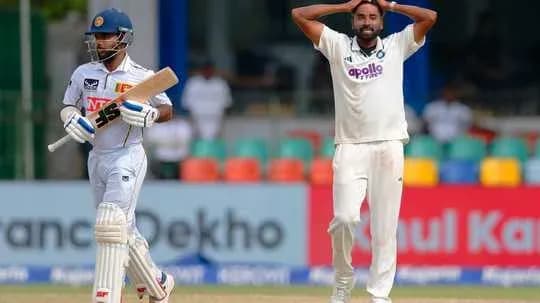
Sonal Dinusha walked off the SSC outfield with his bat raised and his shirt soaked, not in triumph, but in something just as valuable for Sri Lanka right now: survival.
Across seven draining hours in Colombo, the left-hander batted like a man barricading a door in a storm, finishing unbeaten on 133 and dragging Sri Lanka to safety after India had enforced the follow-on. A 2-0 whitewash beckoned. He shut the door on it.
This was the ninth time India had asked Sri Lanka to follow on. For the first time, they didn’t win.
A day that began with inevitability
India arrived on the final morning needing only four wickets. The script felt familiar. A weary home side, a wearing pitch, a high-class attack with a new ball in hand. The chase, everyone assumed, was a matter of when, not if.
The surface did offer turn, but not the treachery captains dream of on day five. The bounce stayed honest, the pace predictable. That meant one thing: if Sri Lanka could find someone with the patience and technique to last, a draw was still on the table.
Dinusha and his overnight partner Keshara Nuwantha took that thought and clung to it. India took the second new ball within half an hour, Rohit Sharma rotated his quicks and spinners, the close catchers prowled and chirped. Nothing moved Dinusha.
Ball after ball, over after over, the pair chipped away at India’s lead. They didn’t just block; they rebuilt. The seventh-wicket stand stretched to 88 runs and soaked up more than 40 overs, long enough for Sri Lanka to erase the first-innings deficit and force India to start thinking again.
India finally break through
The pressure eventually told, but only after lunch. Manav Suthar, who had been searching for sharper bite from the surface, finally found it. One turned sharply, gripped, and kissed the outside edge of Nuwantha’s bat. Second slip did the rest.
India celebrated with the urgency of a side that knew time, not just wickets, was now an opponent.
Prabath Jayasuriya walked in and did exactly what his team needed: he refused to budge. For 28 balls he dead-batted, left, and smothered. His resistance ended when he pushed at one from Ravindra Jadeja, the outside edge flying to Dhruv Jurel at second slip.
Sri Lanka were still not safe. The lead had moved beyond 150, and there was almost a session and a half left. Two wickets remained. India could smell a chase. The field stayed attacking, the spinners hunted for rough patches, and every play-and-miss drew a collective gasp.
Kumara joins the fight
Enter Lahiru Kumara, a man better known for hostile spells with the ball than stonewalling with the bat. He brought something else: stubbornness.
Dinusha, now the axis around which the entire match turned, found in Kumara a partner willing to suffer. The left-hander leaned on the sweep, using it as both shield and release shot, upsetting the spinners’ rhythm and blunting the turn. When the ball was full, he went down on one knee. When it was short, he rode the bounce and rolled his wrists.
Together they staged the kind of attritional stand that drains bowlers and frays tempers. Forty-seven runs. One hundred and sixty-nine deliveries. Almost nothing flashy, everything calculated.
Somewhere in that grind, Dinusha reached his century. No wild celebration, just a quiet acknowledgement, a brief lift of the bat. His job was not done.
Kumara did offer India a glimmer. Soon after Dinusha’s hundred, he went for a slog sweep that ballooned towards deep midwicket. Jurel came in, dived, and the ball dropped in front of him. A half-chance at best, but on a day like this, it felt huge.
It would not be repeated.
Time, not wickets, beats India
Kumara eventually fell for 12, an inside edge snapping up to short leg where Yashasvi Jaiswal reacted sharply. Another roar from India, another door creaking open.
But by then, the clock had become Sri Lanka’s ally. Overs slipped away. The new ball had lost its sheen, the pitch its menace. Dinusha, still there, still unflustered, guided the tail through the final passages with the composure of a veteran.
He left anything he didn’t need to play, smothered the ones that threatened the stumps, and picked off the rare loose delivery. The Indian close fielders edged closer. The bowlers tried one last burst. Nothing dislodged him.
When the players finally walked off, India had been denied the win they expected, and Sri Lanka had avoided a whitewash that once looked inevitable.
On a day when every mistake could have ended the fight, Sonal Dinusha made none that mattered. In a series dominated by India, it was his lonely, unbeaten vigil that rewrote the ending.