.svg&w=384&q=75 "logo")
Sonal Dinusha: Rising Star of Sri Lankan Cricket
Sonal Dinusha was running out of room. And out of time.
Darwin, July 2025. Sri Lanka A’s left-hander, barely taller than the bat he grips, found himself fenced in by an Australian firing squad. Mitchell Perry, Liam Scott, Henry Thornton – all tall, all quick, all unrelenting. The short ball kept coming. So did the doubt.
He was struggling. Everyone could see it.
Avishka Gunawardene, then Sri Lanka A coach, stepped in. Not with a grand intervention, but with something simpler, sharper.
They walked away. Threw a few balls. Talked. Tightened the plan.
No drama. No fuss. Just problem, solution, execution.
By stumps, the same batter who had been pinned down by bouncers was the one dictating terms. Dinusha peeled off a 145-ball 105 in the first unofficial Test, then followed it with 88 off 191 in the second. First time batting in Australia. First time facing that kind of sustained hostility.
To those who knew him, it felt familiar. This is what Sonal Dinusha does: identify the crack, seal it, move on.
Built in the schools, hardened in the grind
Dinusha is not a miracle plucked from nowhere. He is a product of Sri Lanka’s oldest, most reliable assembly line: school cricket.
He began at De La Salle College in Colombo, a modest starting point. The talent was obvious early. So was the attitude.
At 12, he came under the eye of a young coach with almost the same name and a very different story. Sonal Dulshan Elwalage, an SLC Level 2 coach, had seen his own playing career stall under the weight of family hardship. Coaching became his way of staying in the game. Dinusha became his project.
“I was drawn to the enthusiasm he showed at such a young age,” Dulshan would recall. Over time, that enthusiasm turned into something stronger: a shared mission. One man trying to stay in the sport, another trying to climb through it.
The next move was decisive. Dinusha shifted to Mahanama College, one of Colombo’s cricket powerhouses, the same school that produced his current Test captain, Dhananjaya de Silva. Bigger fixtures. Tougher attacks. Higher expectations.
He did not shrink.
Dulshan watched him compile innings that stitched together temperament and technique, but one knock in particular refuses to fade.
Under-19 Division 1, February 2020, against Richmond College, Galle. Two-day game. Mahanama 20 for 3 in the eighth over. A 19-year-old walks in and refuses to walk out.
Dinusha batted through. Unbeaten 159 off 227 balls. Fifteen fours. Four sixes. First-innings win sealed in the 82nd over.
He didn’t just score; he managed. He marshalled the chase, shielded partners, and when it came down to the last wicket, he showed the kind of game awareness that Test sides crave. With Colombo Cricket Club’s Nisal Akash at No.11, Dinusha controlled the strike so ruthlessly that Akash faced only 11 balls across a last-wicket stand that stretched 7.3 overs.
The ability to bat time that has stunned India over the last fortnight didn’t appear out of thin air. It was forged on days like that, with nothing more glamorous at stake than a school result and a coach’s quiet belief.
A club remembers his first day
While still at Mahanama, Dinusha stepped into the senior world. First-class debut for Colombo Cricket Club in 2018. New dressing room, new hierarchy, new pressure.
Ashan Priyanjan, former Sri Lanka international and a CCC mainstay as player, captain and coach, still goes back to that first outing.
He remembers a compromise. Dinusha is, by nature, a No.6. The engine room. The firefighter. But for the team’s balance he walked in at No.3, right into the teeth of the new ball against a strong attack.
He made a half-century.
That innings did not make headlines, but it told the people who mattered what they needed to know. This was a player who would bend his comfort zone for the team, then make that new space his own.
Around him, a line of mentors formed over the years: Kalum Gangodawila, Felix Dias, Alan Rodrigo, Tharanga Dhamika. Different voices, same verdict.
He works. Hard. And he works smart.
Gunawardene saw it up close with Sri Lanka A.
“He was very organised. Very methodical. He knows exactly what he wants. He knows what areas he needs to work on. If there’s any doubt, he’ll ask. If not, he just gets on with it.”
The word that keeps coming back from those who’ve coached him is “smart”. Not flashy. Not flamboyant. Smart.
The sweep that won a series – and took years to build
Over two Tests against India, one shot has come to define Sonal Dinusha in the public eye: the sweep.
India’s spinners kept dragging him across the crease. He kept answering with that same stroke, again and again. By the end of the series, he had scored 173 runs from the sweep alone.
When asked about it after Day 4, he shrugged it off with the bluntness of someone who has already done the hard work.
“I am good at sweep shot, so I play it. That’s all.”
That is not all, of course.
At CCC, Priyanjan watched him obsess over that one shot. Long after a regular net session ended, when teammates had drifted off, Dinusha stayed back. Throwdowns. One ball after another. Same movement. Same contact point. Same finish.
He loved the sweep, so he built it into a weapon.
That habit – of isolating a skill and drilling it into muscle memory – has become a theme of his career. It is how he handled the bouncer barrage in Darwin. It is how he has turned a high-risk stroke into a scoring option that unsettles even world-class spin.
Kirsten’s endorsement and a place in history
The arrival of Gary Kirsten as Sri Lanka’s head coach brought a fresh, experienced eye to a young dressing room. It didn’t take him long to circle one name.
His first real look at Dinusha came in the West Indies. Sri Lanka 110 for 5, trouble brewing. Dinusha walked in at No.7 and, with his captain, stitched together a stand worth 99. He followed it with 92 in the second match.
Kirsten’s reaction was instinctive: this guy can play.
What impressed him wasn’t just the numbers. It was the thought behind them.
“I love the way he plays Test cricket. He thinks about it. He plays to his strengths. He understands what the bowlers are trying to do to him. And then he uses his skillsets to communicate that.”
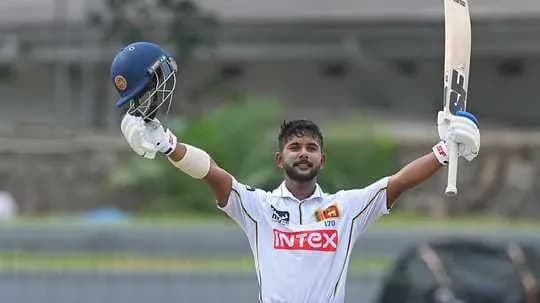
Then came the innings that has already been marked out as something more than a good day at the office: 133 off 264 balls, an epic rearguard that Kirsten believes will sit in Sri Lanka’s Test history “as one of the great saves.”
Runs under pressure. Time soaked up. Hope restored.
For a player still at the start of his international journey, that is a heavy line to carry. Dinusha wears it lightly.
No time for laurels
The temptation, after three centuries in four innings and the kind of praise that usually arrives much later in a career, would be to pause. To soak it in. To breathe.
Dinusha is wired differently.
Even before the ink had dried on his latest hundred, his mind had already moved. Next tournament. Next net. Next adjustment.
That is the rhythm of his rise. No shortcuts. No illusions.
Sri Lanka Cricket now finds itself holding something rare: a young batter with the technique to survive, the temperament to resist, and the appetite to do the unseen work when nobody is watching. A gem, yes. But an unfinished one.
The system that shaped him – from De La Salle’s dusty fields to Mahanama’s pressure cooker, from CCC’s first-class grind to A-team tours and Test cauldrons – has done its part.
The question now sits squarely with SLC.
Will they give Sonal Dinusha the space, backing and continuity to let that methodical mind and stubborn bat define an era, not just a series?