.svg&w=384&q=75 "logo")
Sonal Dinusha's Dominance in India Series: A Breakthrough Performance
Sonal Dinusha walked into this India series with just three Tests behind him and no safety net. Four innings, four crises. Each time he appeared, the game was already snarling.
He left it having scored 420 runs, three centuries, and a message carved into the series: this is a batter who does not flinch.
A young player in an old examination
At home in Sri Lanka, young batters sometimes get eased in. Not this time. India arrived with a spin attack that was not just better than Sri Lanka’s, but operating on an entirely different plane. Most of the hosts’ top order discovered that gap the hard way.
Dinusha used it as an audition.
In Sri Lankan conditions, spinners live and die by that 3‑5m good-length band. It’s where batters are trapped on indecision: forward or back, commit or wait. How you handle that strip of turf usually decides how long you last.
Dinusha didn’t just survive there. He dominated it.
He scored 182 runs off good-length balls from spinners, averaging 91 at a strike rate of 58.89. The series baseline sat miles lower at 26.42 and 45.36. No batter from either side scored more runs off that length. Only Niroshan Dickwella, in a much smaller sample, scored faster. Even Devdutt Padikkal, Player of the Series, trailed him on both average (69.50) and strike rate (49.82) against that length.
This was not a kid hanging on. This was a kid dictating.
Meeting the ball on his own terms
The secret lay in where Dinusha chose to meet the ball.
His average interception point against good-length spin was 2.64m from the stumps – the furthest of any batter in the series. Padikkal, who often preferred to sit deep, clocked in at 2.02m. That gap is not just a number; it’s a philosophy.
Only 43.4% of good-length balls to Dinusha were met in the danger zone between 1.5m and 3.5m – the area where batters get pinned, neither fully forward nor safely back. Among Sri Lankans, no one did better. Across both teams, only Padikkal, Rishabh Pant and Ravindra Jadeja had a lower share.
Dinusha decided early: if the ball was in that length, he would either smother it or get so far down that it no longer behaved like a good-length delivery at all.
Among batters who faced at least ten overs of spin, he played 73.6% of balls off the front foot, including when he advanced. Only India captain Shubman Gill, at 77.3%, went forward more often.
Gill can do that with his reach. Dinusha, listed at just five foot six, had to manufacture it.
So he did.
He kept charging. And he kept sweeping.
The sweep as a weapon, not a release
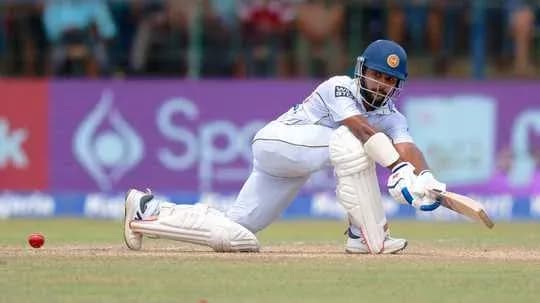
Dinusha stepped down the wicket to 12% of the balls he faced, second only to Pant’s 13.3%. His sweep percentage was even more striking: 21.6%, the highest of any batter in the series.
This wasn’t a cameo trend. It was a full-blown method.
He attempted 120 sweeps – including reverse and slog-sweeps – and scored 173 runs from them. Both marks are now the highest ever recorded in a series of any length, eclipsing Joe Root’s famed sweeping clinic in Sri Lanka in 2021. Against all four of India’s frontline spinners, he scored at better than a run a ball through that shot alone.
The 4‑5m band, the most unsettling length of the series, claimed 27 wickets at 21.14. Dinusha faced 212 balls there and lost his wicket once. He scored 125 runs in that space, and he did it by refusing to let the bowlers settle.
He swept 53 of those balls for 87 runs. He advanced to 32 of them. Good length became his canvas, not his cage.
Taking on Jadeja at full pace
Doing this against Ravindra Jadeja took it to another level.
Jadeja’s pace, skid and relentless trajectory usually bully batters out of their options. Dinusha refused to give any up. He attempted 34 sweeps against Jadeja – the most by any batter off him in a subcontinental series. He also came down the track to 36 deliveries, a number that sits just two short of Michael Clarke’s tally across five innings in India in 2013.
This was not slogging. It was targeted disruption.
Eighteen of Dinusha’s 30 boundaries against spin came from sweeps or their variants, most of them in front of square on the leg side. He mixed in paddles and reverse sweeps, and on four separate occasions he opened a new session with a slog sweep to the mid-wicket boundary.
Those shots did more than just decorate the scorecard. They ripped up the spinners’ plans, forced field changes, and dragged the length map away from the comfort zone India’s attack usually occupies.
Once he had that, he went to work.
Runs between the fireworks
With fields scattered and lengths altered, Dinusha settled into the quieter part of his craft. He nudged, pushed, swept softly and worked the ball into gaps for singles and twos. The scoreboard never stalled.
His innings were not built on a blaze of boundaries. Only 4.98% of the balls he faced went to the rope – the second-lowest boundary rate among specialist batters who faced a significant volume in the series, ahead of only Jadeja.
That low boundary percentage, set against his weight of runs, tells its own story. This was sustained control, not a hot streak.
Perhaps the most revealing detail of all is what he refused to attempt. Across pace and spin, he did not hit a single boundary through the front-of-square off-side. The classic cover drive, so often a young player’s vanity stroke, never appeared as a scoring option.
He cut it out. Completely.
In a series where India’s spinners asked every question they could, a 23-year-old answered with something coaches dream about and selectors crave: a method that holds under fire.