.svg&w=384&q=75 "logo")
Sonal Dinusha's Heroics Deny India Clean Sweep
India took the series. Sri Lanka took the final day.
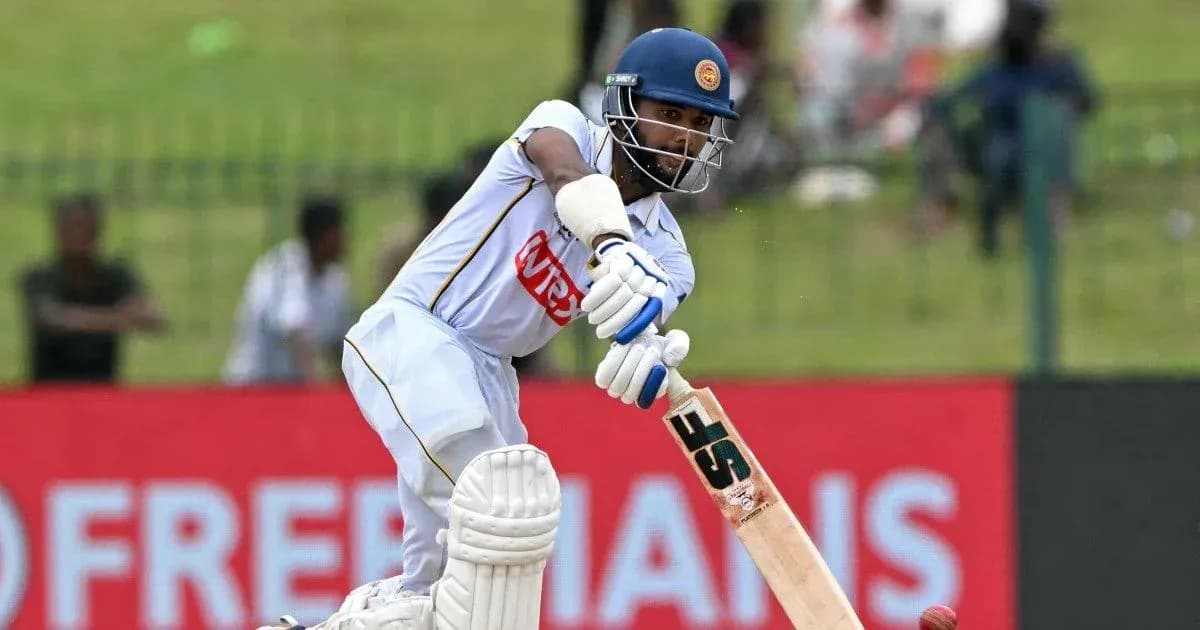
In a match that looked destined to end in a routine Indian win, Sonal Dinusha turned a fading contest at the Sinhalese Sports Club Ground into a statement of resolve, batting through the final day to secure a draw and prevent a 2-0 sweep.
Following on, under clouds and pressure, Dinusha crafted a magnificent 133 not out – his second century of the match and his third in four Test innings – as Sri Lanka battled their way to 429-9 before hands were shaken late on the fifth evening in Colombo.
India walked away with a 1-0 series victory. Sri Lanka walked away with something less tangible, but no less important: belief.
A final day built on defiance
The equation at the start of play was stark. Sri Lanka resumed the rain-hit second Test with only four wickets in hand and a lead of just 16. One good Indian spell, one loose hour, and the series would be wrapped with a ruthless 2-0 scoreline.
Instead, the hosts dug in.
Dinusha, 25 and playing with the calm of a veteran, resumed as the linchpin. His maiden Test hundred had underpinned Sri Lanka’s first-innings 290. Now he was asked to do it all over again, with the follow-on enforced and India scenting blood.
He found the partner he needed in Keshara Nuwantha. Together, they turned a fragile position into a stubborn blockade.
Nuwantha made 46, but the value of his innings went far beyond the numbers. He left well, defended late, and trusted his technique. Twice he survived on review, including in the final over before lunch when an lbw verdict against him was overturned. Each escape deepened India’s frustration and stiffened Sri Lanka’s resolve.
The pair stitched together a 112-run stand that slowly shifted the mood. What had looked like a formality began to feel like a contest again. The ball softened, the pitch flattened, and India’s bowlers, so menacing earlier in the match, were forced into long, thankless spells.
India finally break through – but too late
The pressure eventually cracked, just not in the way India had hoped.
Manav Suthar, the left-arm spinner, finally broke the partnership in the first over after lunch. He drew extra bounce, the ball brushed the shoulder of Nuwantha’s bat, and Dhruv Jurel did the rest at slip. India had their opening.
Jurel struck again soon after, pouching another catch to remove Prabath Jayasuriya for two. Two quick wickets, a new batter at the crease, and Sri Lanka’s lower order exposed – the familiar script of a collapse beckoned.
Dinusha refused to read it.
Unmoved by the churn at the other end, he tightened his defence and expanded his scoring options. On a surface offering little for the seamers, he met length with a straight bat, and anything drifting into his pads or outside off was swept, nudged, or steered with authority. His shot selection was crisp, his judgement of length almost flawless.
Dinusha and the tail shut the door
Lahiru Kumara’s contribution will not leap off the scorecard – 12 runs from 90 balls – but it was precisely what Dinusha needed. Kumara blocked, left, and absorbed time, blunting India’s last surge.
Every over survived felt heavier than the last. Shubman Gill shuffled his resources, rotating his quicks and spinners, tweaking fields, searching for a crack in Dinusha’s concentration. None appeared.
The right-hander’s discipline never dipped. Having already logged his first-innings hundred, he moved methodically to yet another landmark – a fourth consecutive score of fifty or more – and then beyond, to a commanding second-innings century that anchored the entire resistance.
By the final hour, it was India chasing possibilities and Sri Lanka dictating terms. The bowlers probed, the fielders circled, but the chance never quite came. When the players finally shook hands with Sri Lanka nine down, Dinusha still unbeaten on 133, it felt less like a let-off and more like a line in the sand.
India had their series win. Sri Lanka, thanks to a young middle-order batter with an old head and an iron will, had proof they could stand up to one of the game’s modern powerhouses.
For Dinusha, whose last four innings now read like a statement of intent, this was more than a rescue act. It was the kind of performance around which careers – and batting line-ups – are built.