.svg&w=384&q=75 "logo")
Smriti Mandhana Shines as India Defeats Hong Kong to Reach Asia Cup Semifinals
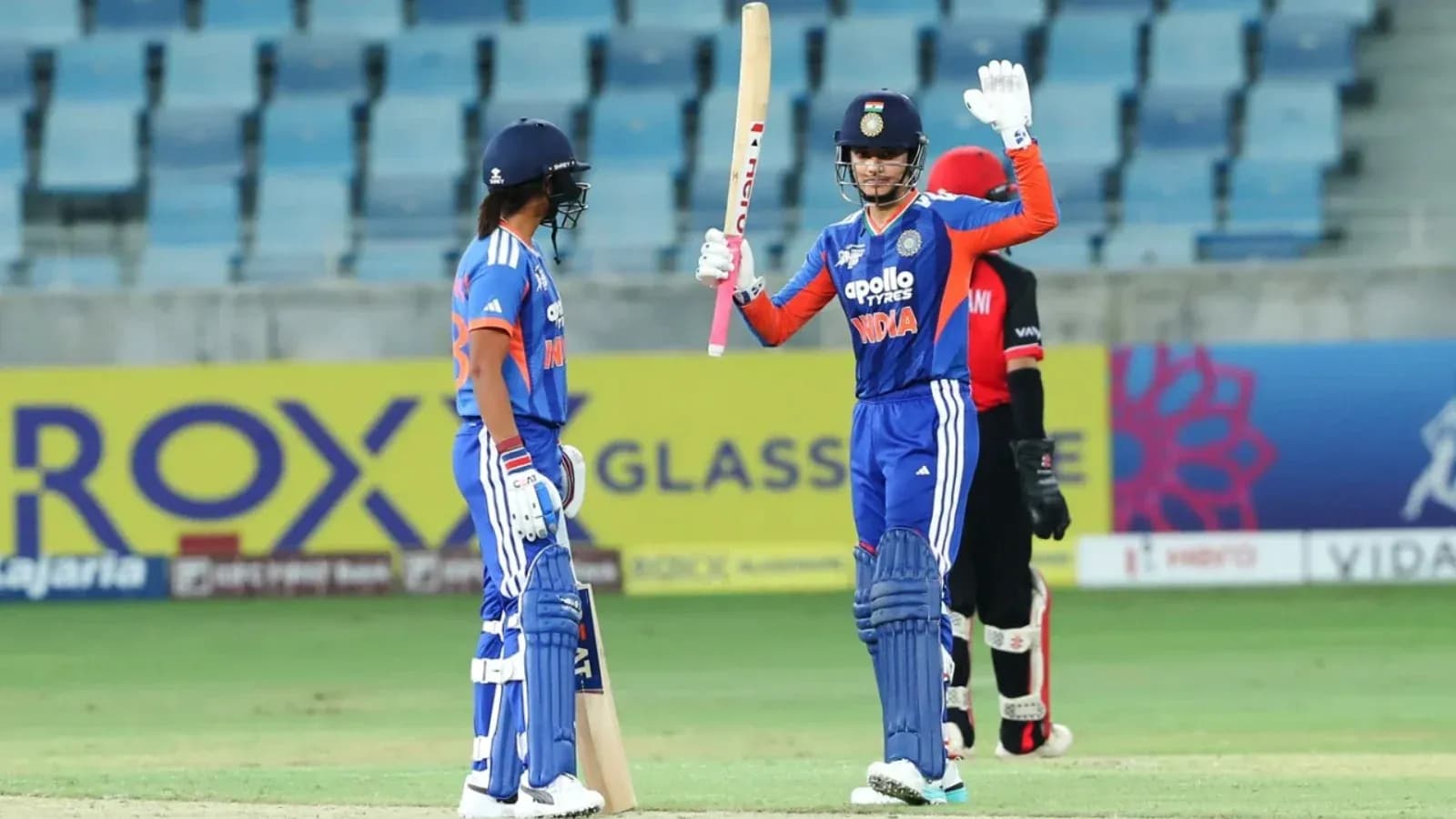
Smriti Mandhana walked off to a standing ovation, bat raised, Dubai lights bouncing off her helmet. By the time she left, run out in the final over for 124, the contest was already over in everything but name. India had monstered their way to 193 for 5. Hong Kong never came close.
A 137‑run win, a place in the Asia Cup semifinals secured, and a record book rewritten in the space of an evening.
Mandhana’s night of records
This was billed as a routine group game. Mandhana turned it into a landmark.
Sent in after Hong Kong China won the toss and chose to bowl, India’s stand‑in spearhead settled in with a measured first over, then began to pick apart the attack. The first real statement came in the second over, when she slog‑swept Kary Chan to the vacant deep midwicket fence. From there, the boundaries kept coming, almost methodically.
She drove, swept and carved her way through the powerplay, targeting the unguarded leg side against Marina Lamplough and Maryam Bibi. One over from Maryam went four, dot, four, four as Mandhana read the length early and punished anything remotely loose. By the end of the fifth, India were 38 without loss and Hong Kong were already chasing shadows.
Shafali Verma played the perfect foil. After a quiet start, she exploded in the sixth over, shuffling across to flick Lamplough fine, then launching the first six of the match high over the leg side. Another cut for four, another towering maximum; 60 without loss at the end of the powerplay and India were galloping.
Hong Kong finally broke the opening stand on 65 when Shafali, on 28 off 17, holed out in the deep off Ruchitha Venkatesh. It barely slowed Mandhana. She threaded back‑to‑back boundaries through extra cover and long‑off in the same over, reading the field as if she had a map in her hand.
By the halfway stage, Mandhana sat on 48, India on 85 for 1, and the innings was hers to shape. Iqra Sahar’s fourth over brought the landmark: a clean swing over the leg side for six to bring up a 50, then a boundary to close the over and take India to 100 for 1 after 11. The gears had shifted.
Pratika Rawal, in for the injured Jemimah Rodrigues, came and went for 10, caught at point off Joyleen Kaur. Mandhana barely blinked. She moved into that dangerous territory where every misstep from the bowler felt like a gift. A shuffle across and a soaring six, a crunch down the ground, a drag over square leg – the stroke‑play grew more audacious as the innings wore on.
The 14th over from Maryam was brutal. Single to Richa Ghosh, then Mandhana went to work: a lofted blow over the ropes, a brace over extra cover, then another six over square leg. India were 129 for 2 and Mandhana was racing towards three figures.
The 15th and 16th overs were about control as much as aggression. She picked her moments, nudged when she had to, then lashed Joyleen and Alison Siu when they erred in length. By the end of the 16th, India were 147 for 2 and Mandhana was within touching distance of a hundred.
Lamplough returned and found brief respite by dismissing Ghosh, who miscued after an early boundary. Mandhana responded with a late cut to reach her century, a hundred crafted with timing, placement and an increasingly ruthless eye for gaps.
The real history came in the 18th over. Ruchitha Venkatesh ran in; Mandhana stepped out. One disdainful six, then another. With those blows she surged past Mithali Raj to become the highest run‑scorer in women’s international cricket across formats. She went past her own previous best in the process, turning a group game into a career milestone.
Harmanpreet Kaur tried to add a final flourish with a 10‑off‑9 cameo before falling to Lamplough in the 19th over. The last act belonged, fittingly, to Mandhana again – a boundary to start the 20th, then a mix‑up that ended her on 124. Anti‑climactic dismissal, emphatic statement. India closed on 193 for 5, a total that loomed like a mountain over a tentative Hong Kong batting unit.
Hong Kong buried under the weight of the chase
If Hong Kong harboured any hope, it had to come in the powerplay. Kranti Gaud and Nandni Sharma snuffed that out almost immediately.
Kranti opened with a miserly over, just a single to Natasha Miles. Nandni followed with a probing spell, beating the bat, finding edges, then finally knocking over Mariko Hill for a four‑ball duck. Hong Kong were 3 for 1 after three overs, already falling behind the rate and pinned by India’s discipline.
Kranti backed it up with a maiden to Yasmin Daswani. Nandni’s second over cost only three. After four overs, Hong Kong sat on 4 for 1. This was a strangling, not a contest.
The fifth and sixth overs brought only a trickle of runs – four in each – as Shafali and Shree Charani kept things tight. A boundary for Daswani and four byes at the end of the powerplay lifted Hong Kong to 16 for 1, but the asking rate had already ballooned.
Deepti Sharma entered the attack with the sort of control that has defined her career. Miles survived a big heave that somehow missed the stumps, then finally found a four, but there was no momentum, no release. Singles, dots, rising pressure.
It told in the eighth over. Deepti drew Daswani into a release shot and Bharti Fulmali pouched the catch. Hong Kong slipped to 26 for 2, the required rate now well beyond 13 an over.
Prema Rawat then tightened the noose. Hong Kong had not found a boundary since the seventh over when she removed Miles, feathering a cut through to Richa Ghosh for 15 off 27. The score: 32 for 3 in the 10th, the chase effectively broken.
Chan lasted just six balls before picking out Shafali in the deep off Prema. At 36 for 4 after 11, survival became the only realistic aim.
Lamplough offered brief resistance, muscling two boundaries off Charani and later clearing long‑on. Maryam Bibi chipped in with a few runs. It never threatened India. Nandni returned to remove Maryam, caught by Shafali for 7, and the innings sagged again.
Charani produced a smart, turning delivery to outfox Lamplough for 14, Nandni diving forward to complete the catch. Hong Kong’s middle order had been picked apart, the scoreboard stuck in slow motion.
Then came Deepti’s moment.
Deepti’s record, India’s statement
Brought back into the attack with Hong Kong already reeling, Deepti needed only a few balls to carve her name into the record books. She first knocked back Alison Siu’s stumps, a classic off‑spinner’s dismissal. In the same over, she drew an edge from Iqra Sahar, Richa Ghosh taking a straightforward catch.
With that wicket, Deepti became the highest wicket‑taker in women’s T20I history. No celebration was over the top; the numbers justified every fist pump.
There was still time for one more clinical piece of work. Joyleen Kaur was run out for 1 after sharp work between Smriti Mandhana and Ghosh. Finally, Shanzeen Shahzad’s trailing leg hung in the air for a fraction too long; Ghosh whipped off the bails, the third umpire confirmed what everyone already knew.
All out. A 137‑run defeat. India, the first team into the semifinals, barely breaking stride.
Mandhana left with records, Deepti with another milestone, and India with a performance that sent a clear message to the rest of the continent: this is a side not just chasing trophies, but redefining standards. The question now is simple — who can stop them when their stars burn this bright?