.svg&w=384&q=75 "logo")
Sanju Samson's Journey: From World Cup Hero to Uncertainty
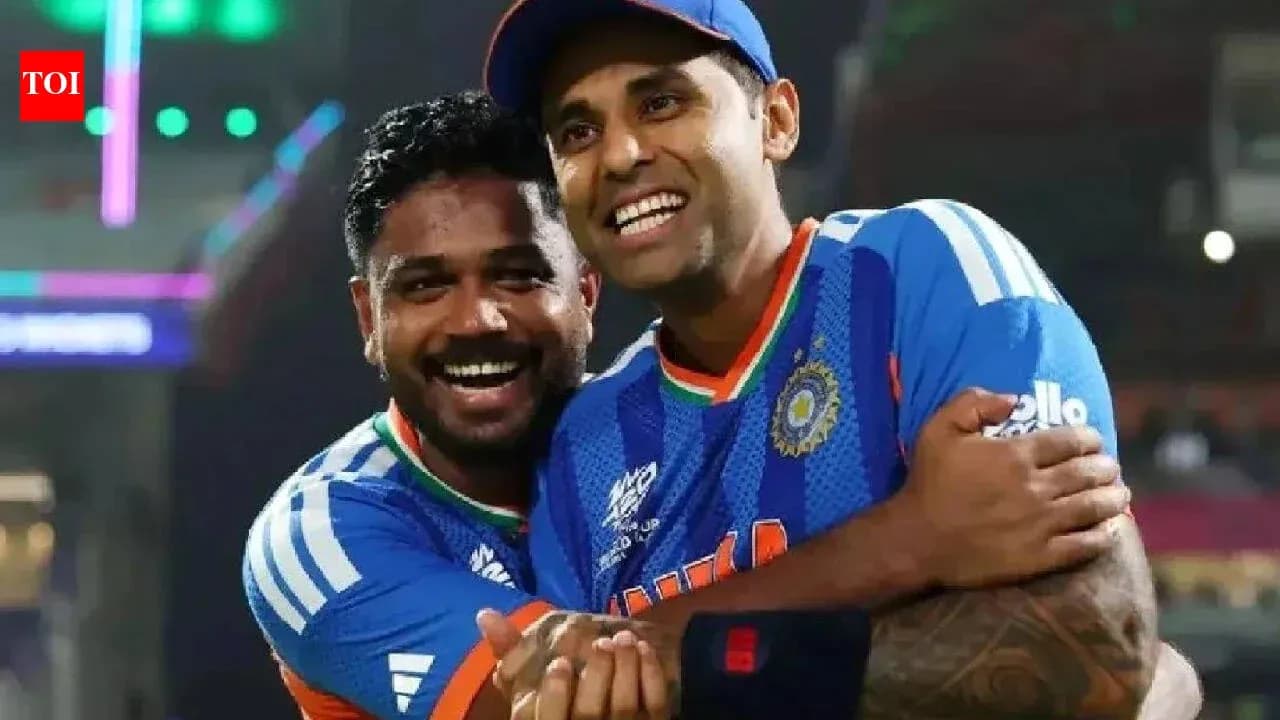
The image of Sanju Samson lifting the T20 World Cup trophy in 2026 sits awkwardly beside his current reality. Player of the Tournament. Central to India’s surge through the knockouts. And yet, once again, fighting for his place in the national side.
This is not a straight-line career. It never has been.
The toughest call on a champion side
Suryakumar Yadav has now lifted the lid on what he calls the toughest decision of his captaincy during that title-winning campaign. It did not happen in a team meeting or in a dressing room huddle. It happened on a bus.
Samson had come into the tournament short of runs and short of rhythm. Ishan Kishan had seized his chance at the top of the order in the New Zealand series and walked into the World Cup as the preferred option. Abhishek Sharma was in the mix too, at least on paper. Samson, for all his talent, sat outside the XI, waiting.
India started slowly. The batting looked scratchy. Off-spin troubled the middle order. Abhishek was not fully fit. Pressure built, not just from outside but inside the dressing room, where players could feel the campaign drifting.
That is when the captain had to make a call.
Suryakumar remembers leaning across to Samson on the bus and telling him the truth: it was going to be difficult for him to get into the side, given how things were shaping up. It was the kind of conversation that can sour a dressing room, especially with a player who had already spent years on the fringes.
Samson’s response changed the mood.
He told his captain to do whatever he felt was right to win the World Cup. No sulking. No conditions. No passive-aggressive questions about “what more do I need to do?” Samson simply promised he would prepare as if he were playing, stay ready, and be there whenever the team needed him.
For Suryakumar, that single exchange did more than ease his conscience. It gave him confidence. It reminded him what sort of character he had in his squad. “Aise bhi log hote hain life mein,” he said later on Aakash Chopra’s YouTube channel. There are people like this too.
The words mattered. But what followed mattered more.
From bench to centerpiece
Circumstances shifted. India’s early stumbles, Abhishek’s fitness issues, and the team’s clear discomfort against off-spin opened a door that had been firmly shut at the start of the tournament.
Samson walked through it.
Once in the XI, the wicketkeeper-batter did not just justify his selection. He redefined his tournament. In the knockout stages, when careers are often made or broken, Samson delivered back-to-back defining innings that turned India’s World Cup from a nervous campaign into a title charge.
The numbers tell you how brutal he was: 321 runs in five innings. An average of 80.25. A strike rate of 199.38 that did not merely decorate the scorecard, it broke games open.
He became the heartbeat of India’s batting at the very moment the pressure peaked. By the end of the tournament, the man who had started outside the playing XI walked away with the Player of the Tournament award and a medal that will follow him for the rest of his life.
For Suryakumar, it was a vindication of faith that had been building for years.
A promise made in Anantapur
The captain’s dilemma in 2026 did not appear out of nowhere. It traced back to a different tour, a different Samson, and a very different mood.
In 2024, India toured Sri Lanka. Samson struggled. The runs did not come, and the noise around his inconsistency grew louder. For a player whose career had already been marked by sporadic chances and quick judgments, it felt like a familiar and dangerous pattern.
During the Duleep Trophy in Anantapur, Samson went to Suryakumar for answers. What now? What should he do? Was this another window closing?
Suryakumar, then too in a leadership role, did something players often crave but rarely receive. He gave him a clear promise. He told Samson that he and the coach backed him, that the faith was real, not just a press-conference line.
The guarantee was stark: he would play the next seven matches. Even if he scored seven ducks, he would still play the eighth.
For a batter living on the edge of selection, that kind of security is priceless. It allowed Samson to breathe, to bat, to fail if necessary, without looking over his shoulder at the next replacement.
Two years later, with a World Cup on the line, that earlier promise made the decision to drop him at the start of the tournament even harder for Suryakumar. This was not just about form or match-ups. It was about a player he knew well, a “good person,” as he put it, who had trusted his word.
The captain still went with Kishan. The team needed a specific balance at the top, and recent form was on Kishan’s side. It was, by Suryakumar’s own admission, the toughest call he made.
Samson’s eventual explosion in the knockouts, on the biggest stage of all, felt like the long arc of that faith finally paying off.
IPL runs, international questions
You would think that a World Cup like that, followed by a strong IPL, would settle the debate. It has not.
After the T20 World Cup, Samson rolled into the IPL and produced another impressive season. Across 13 innings, he piled up 477 runs at an average of 47.7. The numbers reinforced the sense that he was not just a sporadic match-winner anymore; he was putting together consistent campaigns.
Yet his place in India’s T20I setup remains anything but secure.
On the tours of Ireland and England, three failures were enough to push him out of the playing XI again. From Player of the Tournament to watching from the sidelines in a matter of months. He did make it back for the fifth and final T20I against England, but by then the message was clear: his spot was not locked.
When the squad for the Zimbabwe tour came out, his name was missing. Another jolt. Another reminder that in Indian cricket’s crowded talent pool, even a World Cup medal and a standout IPL season do not guarantee continuity.
There is, at least, a door still open. Samson has been included in India’s squad for the upcoming Asian Games. It is an opportunity, but also a test. A different stage, a different format of pressure, but the same old question hanging over him.
Can a player who has already dragged India through knockout pressure in a World Cup finally secure something he has never truly had — a stable, unquestioned place in the national side?