Rio's Journey to Gold: From Illness to Black Belt Triumph
The black belt final in Japan should have broken Rio before it even began.
He arrived on the back of a brutal winter illness that had stripped his energy and wrecked his preparation. A month out, he lost his coach, the man who had shaped his game and his mindset. The build-up, he admitted, was the worst he’d ever experienced.
Then the referee called them to the mat, and all of that noise disappeared.
From sickness to submissions
This was a tournament split along the familiar lines of modern grappling: Gi and No-Gi, men and women, belts, ages, weights. In one corner, heavy cotton jackets and belts that tell a story at a glance; in the other, tight synthetic rash guards and board shorts that leave nowhere to hide and nothing to grab.
In Gi, the fabric becomes a weapon. Competitors dig for collars, sleeves and lapels, hunting chokes and control. In No-Gi, there’s no cloth to cling to, just skin, sweat and timing. Underhooks, wrist ties, body locks – the grips change, but the intent never does.
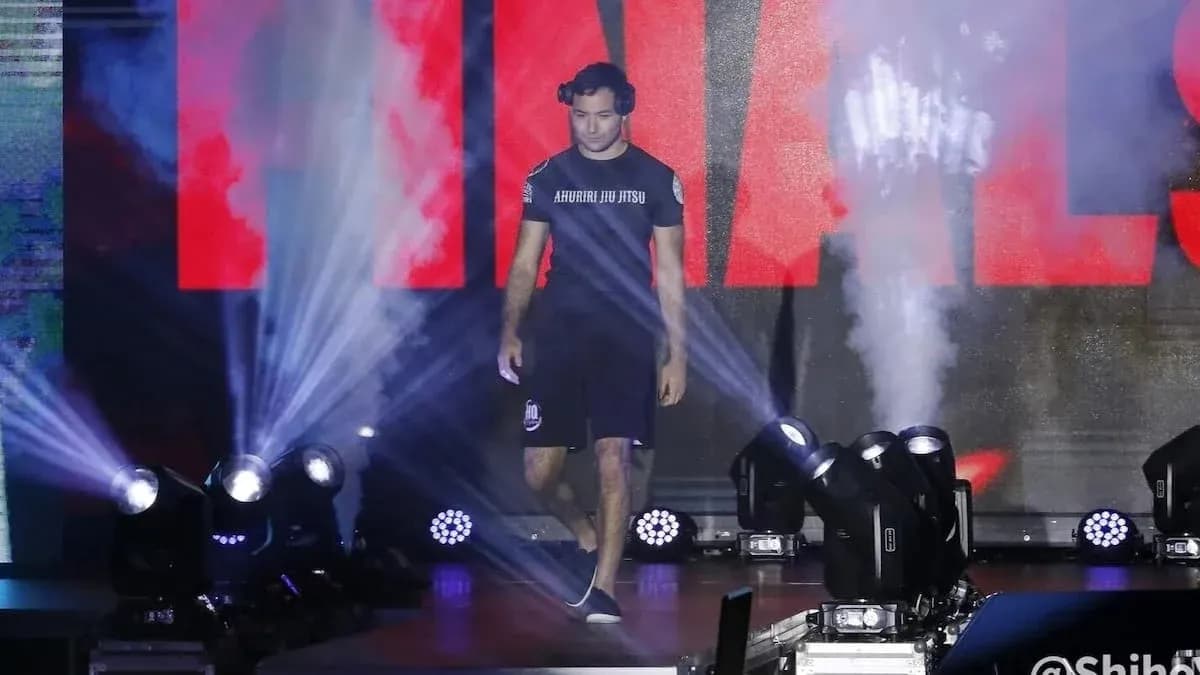
Into that world stepped Rio, chasing his first international medal at black belt level.
He didn’t waste time. In his opening bout, he tore through his opponent from Mongolia, finishing the contest inside the first minute with an Aoki lock – a vicious footlock that leaves no room for hesitation. One mistake, one exposed leg, and it was over.
The second fight, against a competitor from Mexico, demanded something different. This time he climbed into a triangle choke, locking his opponent’s head and arm between his legs and squeezing until the tap came. Another submission, another statement.
Gold secured.
A coach in every triangle
For most athletes, that first international black belt medal would be the headline. For Rio, it wasn’t.
He spoke about the fun of it, how once he stepped onto the mats the tournament felt like any other. The pressure, the illness, the grief over his coach – all of it pushed to the edges the moment he bowed in.
The medal, he said, didn’t mean a lot on its own.
What mattered was the way he closed the show.
His coach, Damian Smith, had been a triangle specialist, the man who had drilled those angles and set-ups into him over countless sessions and tournaments. So when Rio felt the opening in the final and snapped on the triangle, his mind went straight to Damian and those long days of coaching and correction.
Winning gold with that submission, in that moment, felt like the perfect ending to a brutal campaign and a quiet tribute on the biggest stage he’d reached so far.
Built by a tight-knit bay
Rio didn’t talk about his success as a solo act.
He pointed to Gracie Allegiance Ahuriri, Gracie Allegiance Team New Zealand and the wider Brazilian Jiu-Jitsu community across Hawke’s Bay. Training partners, friends, other gyms – all part of the same engine.
“You get nowhere in martial arts without good teammates and training partners,” he said, and in Hawke’s Bay that isn’t just a polite nod. The BJJ scene there is tight-knit, the kind of community where, if you stay long enough, you end up knowing most of the gyms and the people on their mats.
Those rounds, those shared sessions, those nights where everyone is exhausted and still finds one more roll – that’s where medals like this are really built.
More mats, more miles
Rio is not rushing home to sit with his achievement.
He and his partner, fellow coach Yukako Mori, are staying on in Japan for a few more weeks, catching up with friends and chasing more training in both Brazilian Jiu-Jitsu and Judo. The gold medal becomes just another checkpoint, not a finish line.
When they return to Hawke’s Bay, the plan is simple: back to the mats in Ahuriri, back to coaching, back to “having fun with Jiu-Jitsu”.
For Rio, the sport still starts with the basics. It’s self-defence that actually works. It’s a way to stay active without it feeling like a grind. It’s a place where strangers turn into training partners and training partners turn into lifelong friends.
The door, he insists, stays open.
Anyone is welcome.