Protect College Sports Act Advances in Senate
The fight over the future of college sports left the courtroom and marched straight onto the Senate floor on Tuesday — and the NCAA got the decisive first break.
By a 74-24 vote, senators advanced the Protect College Sports Act, a sweeping, NCAA-backed bill that would impose federal rules on a system that has been reshaped almost overnight by court rulings, state laws and athlete empowerment. It needed 60 votes. It cleared that mark with room to spare.
What comes next is murkier. A timeline for a final Senate vote is still undefined, and even if it passes there, the bill must survive the House. But for the NCAA, which has spent years pleading for a national framework, this was the most significant political win it has seen in a generation.
Washington steps into the chaos
College sports have been operating in a kind of controlled chaos. Long-standing NCAA rules — once treated as untouchable — have been shredded by decisions and injunctions in state courts. Athletes can now move from school to school with unprecedented freedom. Schools can pay players directly. Name, image and likeness money has exploded. The old order is gone.
The Protect College Sports Act is designed to slam on the brakes and draw new, federal lines.
The bill targets the core levers of roster and program building: years of eligibility, the frequency and conditions of transfers, and the ways players can be compensated. It would create a single national standard instead of the current patchwork of state laws and court rulings that have forced the NCAA into a reactive crouch.
Just as important for the NCAA, the legislation would hand the association something it has long coveted: an antitrust exemption.
That protection would shield the NCAA from a wave of future legal challenges over its rules, giving it the power to regulate eligibility, transfers and compensation without constantly looking over its shoulder at the next lawsuit. Professional leagues like the NFL and NBA already enjoy antitrust protections, but their rules are hammered out through collective bargaining with players’ unions. College athletes have no such formal bargaining power.
Cruz, Cantwell and an unlikely coalition
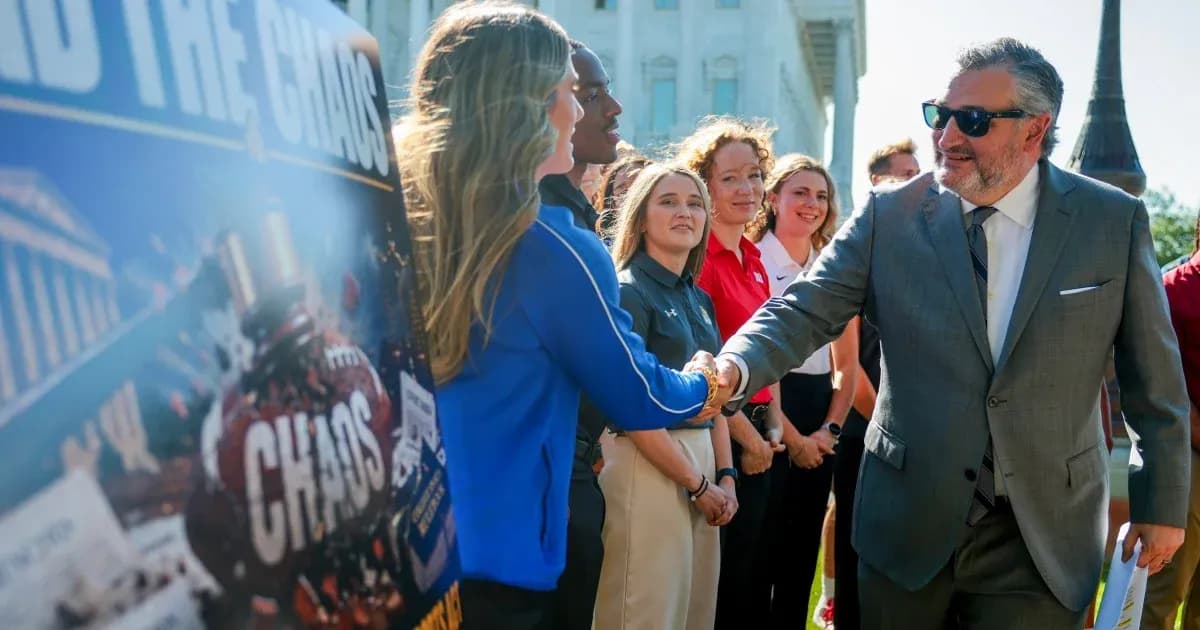
The bill arrives with rare bipartisan muscle behind it. Introduced this year by Sen. Ted Cruz, R-Texas, and Sen. Maria Cantwell, D-Wash., it drew support from both parties as it moved through Tuesday’s vote.
The NCAA has been working toward this moment for years, lobbying Congress as court decisions and state legislatures chipped away at its authority, especially in the money-making engines of football and men’s and women’s basketball. The association has argued that without a national law, competitive balance erodes, rules become impossible to enforce, and the entire model of college sports risks splintering.
That message has resonated with many inside the sport. Gonzaga men’s basketball coach Mark Few, speaking Monday alongside Cruz and Cantwell, did not pretend the bill was flawless but framed it as the only realistic path out of the current mess.
“This bill might not be perfect, but it’s far, far away the best thing we got out there right now,” Few said.
For coaches and administrators staring at constant roster churn and an open legal front, “best thing we got” may be good enough.
A sharp backlash
Not everyone sees it that way.
The Protect College Sports Act has drawn fierce opposition from the Congressional Black Caucus and the NAACP, groups deeply attuned to the realities of who generates the money in college sports and who has historically seen the smallest share of it.
One of the loudest critics inside the Senate has been Sen. Chris Murphy, D-Conn., who has repeatedly cast the bill as a shield for entrenched power rather than a blueprint for fairness.
“This bill protects the billions of dollars that coaches and sports industry executives are making over the suppression of compensation for some of the most highly valued athletes in the world,” Murphy told reporters Monday. “What we’re being asked to do is to basically allow colleges and conferences and the NCAA to illegally collude.”
That word — collude — cuts to the heart of the antitrust exemption debate. To opponents, granting the NCAA legal cover while athletes still lack collective bargaining rights locks in an imbalance: schools and conferences at the table, players on the menu.
The battle moves to the airwaves
The argument has not stayed confined to hearing rooms and press gaggles. It has spilled into the media spaces where college sports actually live.
Cruz recently took his pitch directly to fans on ESPN’s “College GameDay,” using one of the sport’s biggest stages to sell the bill as a necessary correction to a system spinning out of control. It was a clear signal: this isn’t just legislative fine print; it’s about the future shape of the Saturdays and March nights fans care about.
Murphy answered on different turf, laying out his case on Stephen A. Smith’s “Straight Shooter” podcast. There, he framed the bill as a protection racket for the existing money flow, not a reform.
Both sides know what’s at stake. This is not a niche policy fight. It’s about who controls a multibillion-dollar industry and how much of that money ever reaches the athletes whose performances drive it.
For now, the NCAA has the momentum after Tuesday’s vote. The real question is whether that surge carries through the Senate, survives the House, and ultimately locks in a new era where federal law, not court injunctions, dictates the rules of the college game.