.svg&w=384&q=75 "logo")
Percy Fender's Record-Breaking 35-Minute Century in 1920
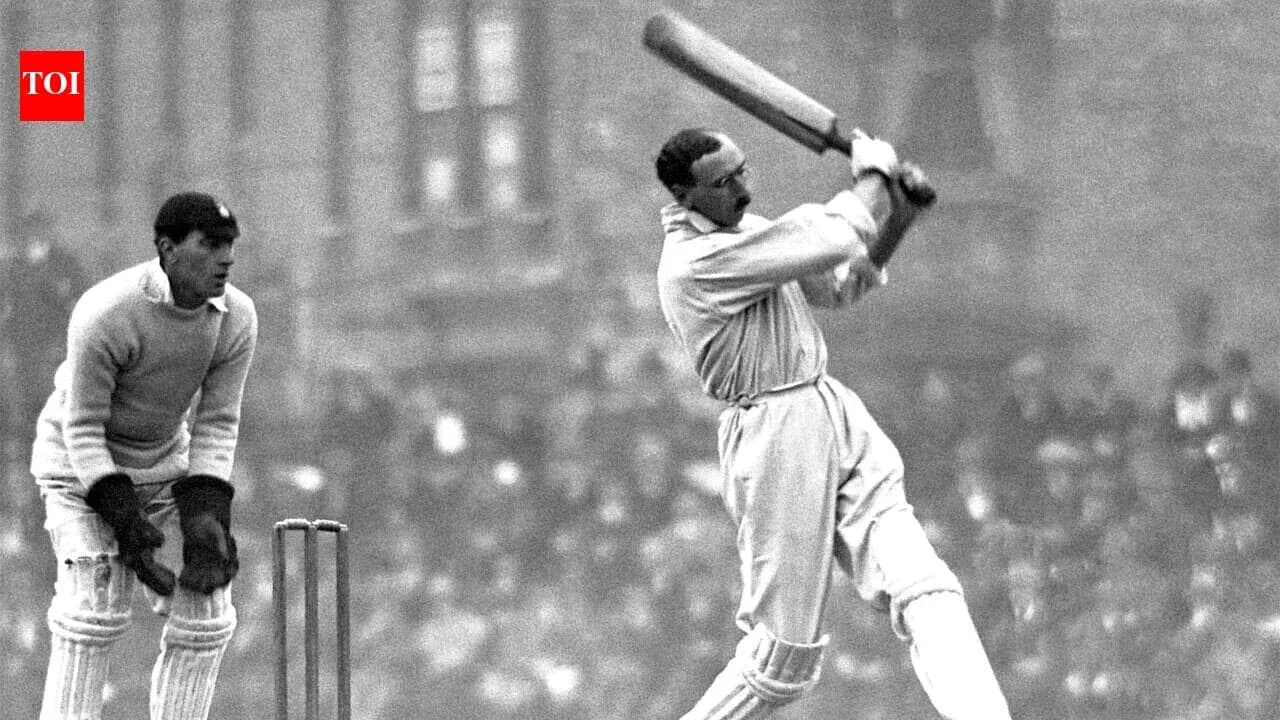
On a late August afternoon in 1920, with the war still a recent scar and county cricket feeling its way back to normality, Percy Fender walked out at Northampton and tore up the script.
Thirty-five minutes later, he had written his name into cricket’s permanent record.
This was Surrey against Northamptonshire, a routine County Championship fixture that turned into something else entirely. Northamptonshire had done the early work, posting 306 in their first innings, anchored by a polished 128 from Fanny Walden. Fender had already made a mark with the ball, taking three wickets, but nothing hinted at the carnage to come.
Surrey’s reply began in more familiar fashion. Andy Sandham stroked his way to 92, yet when he fell the visitors sat at 160 for four and the innings needed rescuing. Andy Ducat and Alan Peach obliged, turning consolidation into dominance. Their stand of 288 in just 135 minutes ripped the initiative away from Northamptonshire and set the stage.
Ducat finally departed for 149. Out strode Fender.
What followed belonged to another dimension. From almost his first swing, he went after the bowling with an audacity that would not look out of place in a modern T20. Booming drives down the ground. Savage cuts. Pulls and the slashing strokes that became his signature. Northamptonshire’s attack, so solid earlier in the day, suddenly had no answers.
Fender’s fifty arrived in 19 minutes. Nineteen. In an era of uncovered pitches and orthodox fields, he was batting at a tempo that defied context as much as it defied the bowlers.
Gilbert Jessop had long been the benchmark. His 40-minute hundred for Gloucestershire against Yorkshire at Harrogate in 1897 had stood as the fastest first-class century by time at the crease. It carried a mythical status, the stuff of bar-room debates and old men’s tales.
Fender went past it by five minutes.
He reached his century in 35 minutes, a blur of boundaries and disbelief. The assault did not ease once the landmark came and went. He kept swinging, kept clearing the infield, kept dragging the game away from Northamptonshire at a pace few could even process.
By the time Surrey declared, Fender was still there, unbeaten on 113 made in 42 minutes. Sixteen fours. Five sixes. Of his 113 runs, 94 came in boundaries – more than 83 per cent of his innings carved in fours and sixes. Beside him, Peach had marched to a double-century, finishing 203 not out. Their sixth-wicket partnership added 171 in only 42 minutes, a rate that would light up any modern scoreboard.
Even judged by today’s frenetic standards, Fender’s spree feels outrageous. But the record he set that day is not about balls faced or strike-rate. It is about the clock.
Cricket once measured batting speed by time spent at the crease, not by deliveries received. That older metric sits at the heart of Fender’s legend. The stopwatch, not the scorebook columns, is what matters here.
For 63 years, no one touched him.
Then, in 1983, Steve O’Shaughnessy of Lancashire appeared to haul Fender back into company. Against Leicestershire, he also raced to a century in 35 minutes. On paper, the record had been matched.
The reality was very different.
Bad weather had mangled the match. Time was short, and both captains needed to manufacture a result. After Leicestershire declared, O’Shaughnessy and Graeme Fowler walked out to face an attack that bore little resemblance to a serious bowling unit. David Gower and James Whitaker, both primarily batsmen, took the ball. What followed was described as farce: full tosses, long hops, and a short boundary begging to be cleared.
Fowler hammered 100, peppering the stands with 10 sixes. O’Shaughnessy joined the fun, racing to three figures in those same 35 minutes that had defined Fender. The crowd enjoyed the spectacle. The statisticians did not.
The innings, while officially recorded, unfolded under contrived conditions. The bowling had been deliberately softened, the game situation carefully engineered to squeeze a result from a truncated contest. It was cricket, but not in the spirit of a genuine contest between bat and ball.
O’Shaughnessy’s name went into the books. His hundred did not go into the conversation as a true equal to Fender’s.
He was not alone. Glen Chapple, another Lancashire man, blasted a century in 21 minutes against Glamorgan in 1993. Mark Pettini did it in 24 minutes for Essex against Leicestershire in 2006. Michael Goodwin and Tom Moody produced their own whirlwind hundreds in 25 and 26 minutes respectively.
On the surface, those numbers obliterate Fender’s 35. Look closer and the pattern returns. These were the product of manufactured declarations, contrived run-chases, and captains desperate to force a result over three days. Part-time bowlers rolled in, serving up hittable fare. Fielders drifted to the rope. The integrity of the contest bent under the weight of circumstance.
The runs counted. The records, in the purest sense, did not.
That is why cricket’s historians and statisticians draw a firm line. They separate the staged from the authentic, the contrived from the genuinely competitive. Fender’s hundred in 1920 came in the thick of a proper Championship battle, against a full-strength attack, without any hint of manipulation.
It remains the benchmark for a time-based century.
The debate grows more layered when you change the definition of “fastest”. Switch from minutes to balls, and another cast of characters takes over. In first-class cricket, David Hookes sits on top: 102 from just 34 balls for South Australia against Victoria in 1982, a brutal exhibition of clean hitting in Adelaide.
In Test cricket, the crown belongs to Brendon McCullum. His 54-ball hundred against Australia in Christchurch in 2016 rewrote the modern record, a farewell statement from a captain who had built a career on aggression.
Those feats live in the language of strike-rates and deliveries faced. They belong to the modern era’s obsession with ball-by-ball data.
Fender’s record lives on a different axis. It is about elapsed time, about the sheer, unrelenting pace at which he scored in a match that was being played straight. More than a century after that extraordinary afternoon at Northampton, no legitimate first-class innings has beaten his 35-minute mark.
Scorecards have filled up with faster-looking hundreds. Timers and statisticians have clocked ever more absurd bursts of hitting. Yet when the stopwatch standard is applied and the staging stripped away, the game still points back to Percy Fender in 1920.
The gold standard remains a man in a cloth cap, walking out at 28 years old and turning Northamptonshire’s attack into a blur – all in the time it takes to boil a kettle.