
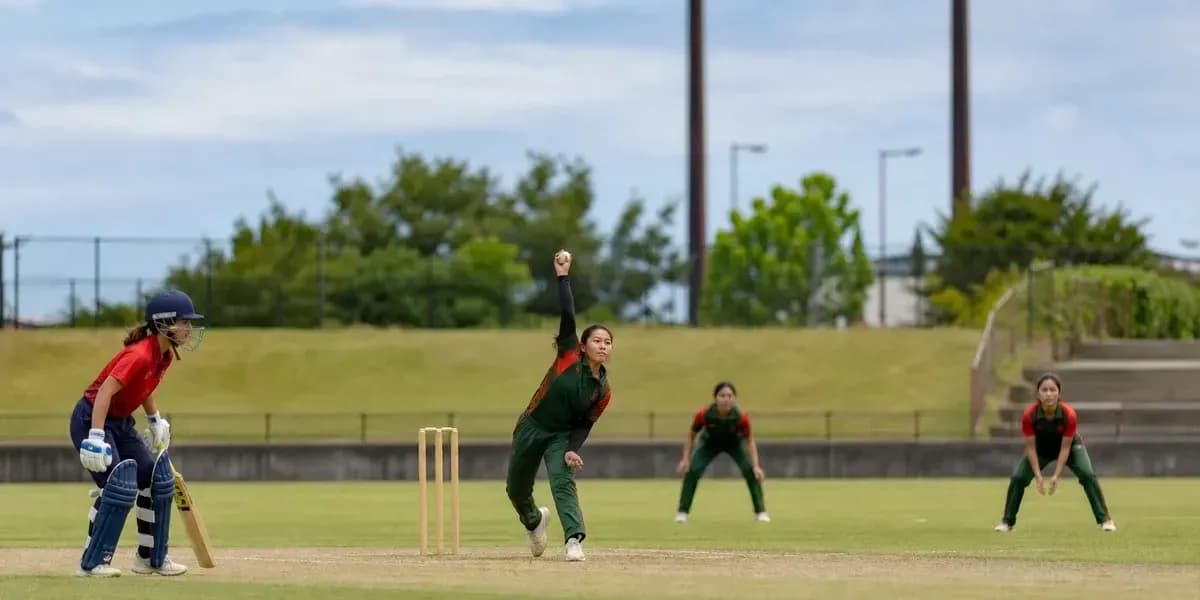
Pakistan Wins Bronze at Asian Games with Victory Over Bangladesh
In Nisshin, under a cool Japanese sky, Pakistan’s women’s team dug deep, absorbed the pressure and walked away with a statement win — a 31‑run victory over Bangladesh and bronze at the Asian Games.
It was not a flawless innings. It did not need to be.
Fatima Sana turns crisis into platform
Pakistan’s 145 for eight looked a long way off when the scoreboard showed 67 for five. The innings had stalled, Bangladesh’s bowlers had their tails up, and the contest threatened to slip away.
Fatima Sana refused to let it.
The captain strode in and batted like a player determined to drag her side to a medal. She cracked 45 from just 30 balls, lacing three fours and launching three sixes, changing the mood and the tempo in a handful of overs. Every time Bangladesh thought they had the game under control, Sana stepped out, cleared her front leg and hit through the line.
At the other end, Aliya Riaz played the perfect foil. Her 25 off 22 didn’t dominate the highlights reel, but it gave Pakistan something they desperately needed: stability. Together they stitched a 67‑run stand off 43 balls, turning 67 for five into a total with real weight in a pressure match.
By the time the partnership was broken, Pakistan had a total to defend and a captain who had already stamped her authority on the day.
Early strikes choke Bangladesh chase
With 145 on the board, Pakistan came out with the new ball as if defending 20 fewer. The intent was obvious from the first over.
Umm-e-Hani and Tasmia Rubab ripped into Bangladesh’s top order, and the chase never truly recovered. Inside five overs, Bangladesh were reeling at 20 for three. The tone was set: this would be a scrap, not a stroll.
Umm-e-Hani was relentless. She hit her lengths, varied her pace, and squeezed the life out of the innings. Her final figures — three for 10 from four overs, including a wicket maiden — marked the best performance of her Twenty20 international career. On a day when Pakistan needed nerve and precision, she delivered both.
The pressure finally told on the middle order. Boundaries dried up, dot balls piled on, and the required rate climbed out of reach.
Resistance, but no rescue for Bangladesh
Bangladesh did not go quietly. Sharmin Akhter anchored the chase with an unbeaten 46 from 45 balls, refusing to surrender her wicket even as partners came and went. Captain Nigar Sultana joined her to mount a counterattack, adding 25 of her own and helping build a 47‑run stand for the fourth wicket.
For a brief spell, the game flickered.
If that partnership had exploded, Pakistan might have been dragged into a frantic finish. Instead, the chase never quite caught fire. Singles and twos kept the board moving, but the big overs never came. Pakistan’s bowlers held their lines, their fielders backed them, and the asking rate kept creeping away.
Fatima Sana returned to strike again, removing Ritu Moni and adding to her growing Twenty20 international tally, which now stands at 31 wickets in 2026. It was a fitting contribution from a captain who had already shaped the match with the bat.
Bangladesh closed on 114 for seven. Respectable. Nowhere near enough.
Pakistan’s podium pedigree restored
This bronze carries more weight than the colour of the medal suggests.
For Pakistan, it is a return to the podium at a tournament where they have real history. Gold in 2010. Gold again in 2014. Then the sting of 2022 in Hangzhou, when Bangladesh beat them in the bronze-medal match.
That wound has been cleaned up in Nisshin.
The route to this medal had its bumps. Pakistan edged past Thailand by three wickets in the quarterfinals, then ran into a ruthless Sri Lanka side in the semifinals and lost by eight wickets. At that point, the campaign stood on a knife-edge: leave with nothing, or fight for a place on the podium.
They chose the latter.
India, who thrashed Sri Lanka by 147 runs in a one-sided final — 216 for three against 69 — took the gold. Pakistan leave Japan with bronze, a rebuilt sense of momentum, and a captain in Fatima Sana who looks increasingly like the heartbeat of a team determined to climb back to the very top of Asia.





