.svg&w=384&q=75 "logo")
Pakistan's 200th T20I Ends in Disappointment as India Skittles Them for 55
DUBAI: A landmark day for Pakistan cricket disintegrated into a harsh reminder of the gap between these two rivals, as India’s bowlers shredded Pakistan for just 55 in their Women’s Asia Cup 2026 clash on Saturday — the lowest total in Pakistan’s T20I history.
They had wanted to set a target, apply pressure, make India think. Instead, after choosing to bat, Pakistan walked off after 18.1 overs with a scoreline that will sting for a long time.
Bright start, brutal reality
For a brief spell, it looked promising. Muneeba Ali and Shawaal Zulfiqar moved Pakistan to 27 without loss, nudging and driving with enough assurance to suggest a platform was forming. The ball wasn’t doing anything outrageous. India’s fielders were busy but not frantic. Pakistan’s dressing room could breathe.
Then the innings fell off a cliff.
Muneeba, who had already survived a couple of early alarms, finally lost her battle when Shafali Verma knocked her over for 13 off 15. One wicket. A small crack. What followed was a collapse of stunning speed and scale.
Sree Charani stepped in and, in the final over of the powerplay, ripped out two wickets. In the space of a few deliveries, Pakistan’s calm start turned into panic. From 27/0, they lurched to 35/6 as India’s spinners, sensing vulnerability, went for the throat.
The pressure told. Footwork froze. Shots lost conviction. Pakistan’s batters, unable to stitch together even one meaningful partnership after the opening stand, kept filing back to the pavilion.
Charani and Rawat lead the demolition
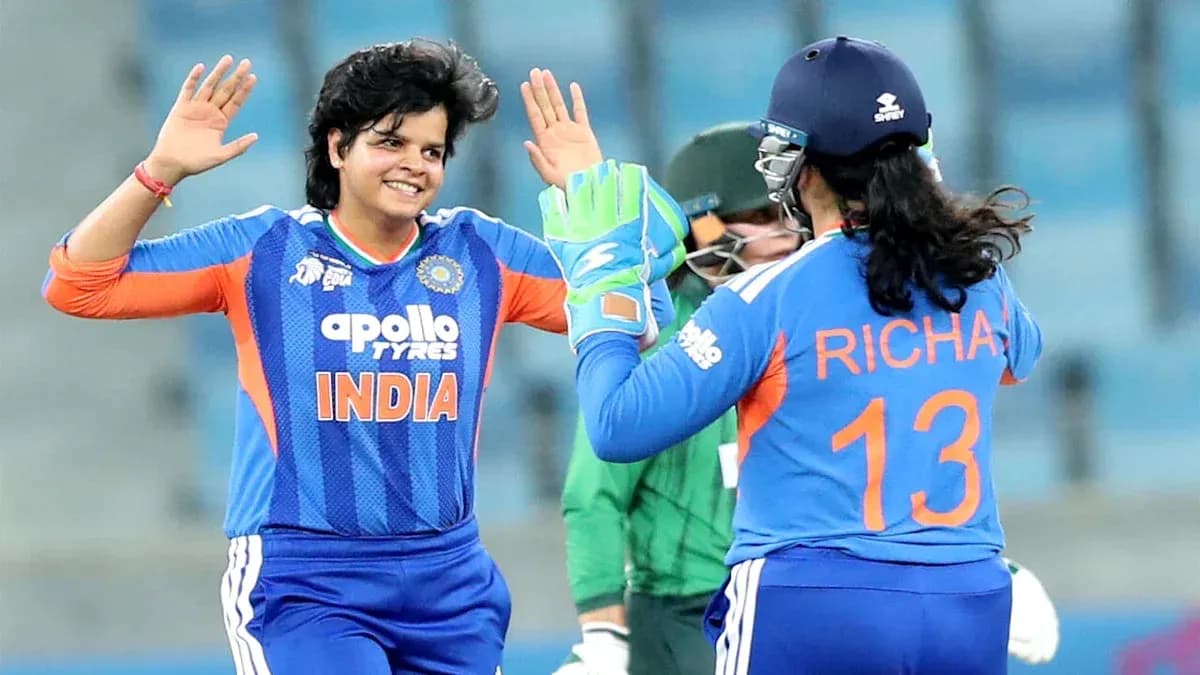
Charani was the heartbeat of the collapse. She finished with extraordinary figures of 3 for 7, suffocating Pakistan with relentless accuracy and clever variation.
Her method was refreshingly simple. At the innings break she spoke of bowling to her strengths, echoing the message from India’s coaches to their spinners: trust your skills, put more revs on the ball, and keep honing the arm ball and yorker for precision.
On the other end, Prema Rawat matched the intensity. She claimed 3 for 9, piling on the misery as Pakistan’s middle and lower order crumbled. Deepti Sharma added 2 for 5, and Shafali’s opening strike gave India the early incision that set the tone.
Every over felt like a trial Pakistan were failing. Dot balls mounted, the scoreboard stalled, and when the risks finally came, they brought only more wickets. The innings ended at 55, all out in 18.1 overs, with only the two openers reaching double figures — Shawaal’s 14 off 14 the top score in a card that will make grim reading.
For India, it was ruthless. For Pakistan, it was a collapse that turned a milestone into a statistic they never wanted.
A record day for all the wrong reasons
This was Pakistan’s 200th T20I, a landmark that should have carried a sense of celebration, of history. Instead, it delivered an unwanted record.
The 55 all out undercut their previous lowest T20I total — 56, also in Dubai, against New Zealand in 2024. It joins an uncomfortable list: 60 against England in Taunton in 2009, 63 against India in Guangzhou in 2012, 65 against West Indies in St Andrew’s in 2011. Another entry, but this one on a stage and against an opponent that magnifies everything.
India, by contrast, added another chapter to a dominant recent run in this rivalry. They had already secured their place in the semi-finals with wins over Thailand and Hong Kong, and came into this game with nine victories in their previous 10 T20Is against Pakistan. The only blemish in that stretch: the 2022 Asia Cup.
This performance showed exactly why their confidence with the ball has grown. They didn’t just restrict Pakistan. They dismantled them.
Harmanpreet’s landmark, India’s statement
All of it played out on another historic note: Harmanpreet Kaur’s 150th match as a T20I captain. No one, male or female, has led more games in the format. On a day built for milestones, her team delivered the kind of bowling display that underlines why India trust this attack so deeply.
The numbers will be remembered — 55 all out, 3 for 7 for Charani, 3 for 9 for Rawat, Pakistan’s lowest total, India’s fifth-lowest total conceded in women’s T20Is. But the real imprint lies in how it felt: a contest that promised tension, turned one-sided by a spell of ruthless, disciplined, high-pressure bowling.
For Pakistan, the question now is not how they reached 200 T20Is, but how quickly they can recover from the most bruising of milestones.