.svg&w=384&q=75 "logo")
NBA Offseason Shakeup: Key Rotations to Watch
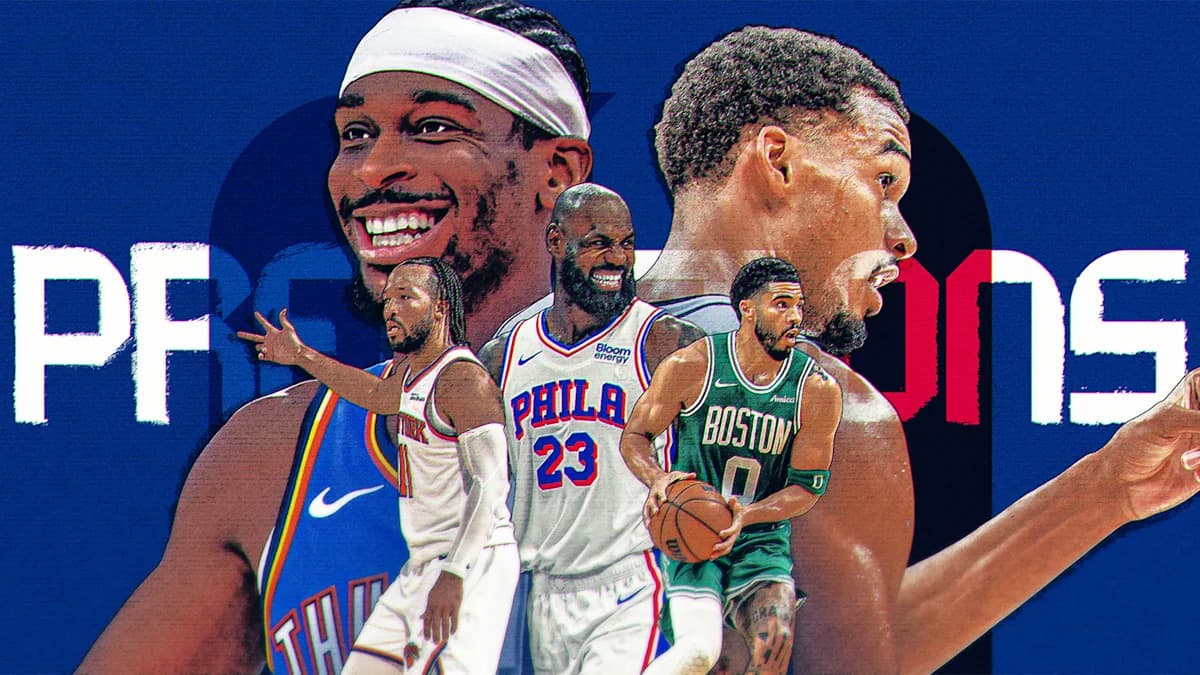
The NBA just redrew its own map.
Giannis Antetokounmpo in Miami.
LeBron James in Philadelphia.
LaMelo Ball in Minnesota.
Franchises have been flipped, timelines reset and depth charts ripped apart. What’s left is a league full of unanswered questions — and five rotations that could decide both seasons and fantasy titles in High Score formats.
Milwaukee Bucks: A New Backcourt, A New Identity
Milwaukee didn’t just trade a superstar. It traded its entire way of life.
Antetokounmpo is gone, Miami’s problem now. In his place: a package built for tomorrow, with just enough present-day punch to keep things interesting. Tyler Herro arrives as the headliner and, make no mistake, the ball will find him. He’s the clear favorite to lead the Bucks in usage and should lock down the starting shooting guard spot.
Next to him, Ryan Rollins is the quiet engine of the rebuild. Last season he went from footnote to revelation: 17.3 points, 4.6 rebounds, 5.6 assists, 1.5 steals and 2.5 threes per game. At 24, he fits the new timeline perfectly and walks into camp as the likely starting point guard.
Behind that duo, the backcourt turns into an open audition — the kind fantasy managers love.
Kevin Porter Jr. brings volatility and volume. His 24.3% usage rate last season tells you exactly what he is: a player who wants the ball and isn’t shy when he gets it. That profile can wreck a real coach’s blood pressure, but in a High Score format, it’s gold. One 30-point eruption can swing a week.
Then come the kids. Brayden Burries, taken 10th in the draft, is the kind of player rebuilding teams usually clear a runway for. He’ll be allowed to make mistakes, and he’ll be allowed to play through them. Kasparas Jakučionis, the 20th pick a year ago and part of the Heat haul, brings his own upside to the mix.
The hierarchy behind Rollins and Herro will take months to settle. For fantasy, that uncertainty is opportunity. Burries is the late-round ticket you circle first on a roster clearly invested in his future. Porter is the wild swing — the kind of ceiling play you stash, waiting for that one week when everything falls through the net.
Milwaukee’s backcourt won’t be tidy. It will be busy. And in this format, busy is exactly what you want.
Boston Celtics: Two Big Men, One Crucial Balance
Boston spent last season trying to stitch its identity back together with Jayson Tatum working his way back from a torn Achilles. Center was a question, not a priority. Neemias Queta answered it anyway.
Queta seized the starting role and justified it, anchoring a team that unexpectedly climbed near the top of the East. At the deadline, the Celtics tried to supercharge the position with Nikola Vučević. The partnership never really clicked in that short window, and Vučević is already out of the frame.
Now comes Mitchell Robinson.
Signed away from the Knicks, Robinson brings elite rebounding and rim protection, along with a reputation that’s already carved in stone. New York finally cracked the code with him: keep his minutes under 20 per game, and he stays bouncy, disruptive and healthy enough to matter. Boston has every reason to borrow that blueprint, possibly using him as a high-impact reserve to manage his body across the grind.
Even with managed minutes, the math works. Something closer to 25 minutes a night feels realistic in this setup, and that’s plenty. A typical Robinson line — 14 rebounds, three blocks — translates to 23 High Score fantasy points before he even scores. That’s one of the cleaner value plays on the board.
Queta doesn’t disappear in this scenario. He remains part of the core, a big who’s already shown he can handle starter’s responsibility. In ten-man fantasy rosters, you can live with one of them locked into a starting slot and the other rotating through your Utility spot, riding matchups and hot streaks.
Boston’s center rotation won’t be about volume. It’ll be about sharp, efficient bursts. For a team with title ambitions and a fantasy format that rewards spike nights, that’s the sweet spot.
Charlotte Hornets: A Crowded Paint After a Bold Tear-Down
Charlotte surprised people last season. A young core of LaMelo Ball, Brandon Miller and Kon Knueppel pushed the Hornets into the Play-In, hinting at a future worth building around.
The front office chose a different route. Ball is gone to Minnesota. Miles Bridges is off to Phoenix. This is no longer a gentle build. It’s a reset.
In the middle of that reset stands Moussa Diabaté, who turned last season into his own personal statement. His energy never dipped, his rebounding popped, and he gave Charlotte a relentless presence at center. It still wasn’t enough scoring for what the Hornets wanted up front.
So they went shopping and came back with Naz Reid in the Ball trade.
Reid is the modern big they craved: a player who can toggle between power forward and center, step out to the three-point line and punish mismatches. He’s going to play — a lot. Pencil him in as the likely starter at power forward, with plenty of minutes sliding to center in smaller lineups. For fantasy purposes, he’s a straightforward frontcourt starter, no caveats required.
The Hornets didn’t stop there. With the 14th pick, they grabbed Hannes Steinbach, fresh off a monster college season at Washington: 18.5 points, 11.8 rebounds and 1.2 blocks per game. Ryan Kalkbrenner, a 2025 second-rounder, lingers in the background, still very much in the mix.
Diabaté now lives in a more complicated ecosystem. His minutes may swing as Charlotte experiments with combinations, searching for the right blend of size, shooting and defense. Steinbach, by contrast, has the long runway that comes with his draft status and production. If he climbs above 20 minutes a night, he becomes a problem for opponents and a bargain in 12-team and deeper fantasy leagues. His best game in any given week could easily mirror a starter’s line.
Reid is the sure thing. Diabaté is the heartbeat whose role may wobble. Steinbach is the long-term bet with short-term upside. On a team that just tore down its old core, those are exactly the kinds of frontcourt questions that will define the next era in Charlotte.
Memphis Grizzlies: Life After Ja in a Wide-Open Backcourt
Ja Morant’s time in Memphis is over. Portland gets the star. The Grizzlies get a reset and some much-needed structure.
Jerami Grant and Kris Murray arrive to stabilize the frontcourt, adding a proven scorer and a versatile young forward. The real future, though, now sits on the shoulders of Cameron Boozer, the third pick in the 2026 Draft and the new face of the franchise.
Up front, the direction is clear: Boozer and Zach Edey form the foundation. In the backcourt, everything is up for grabs.
Scotty Pippen Jr. and Ty Jerome headline the point guard battle. Pippen’s season was wrecked by injuries that limited him to just 10 games, opening the door for Cam Spencer to show what he could do with the ball in his hands. Spencer responded with 11.1 points and 5.6 assists in only 24 minutes per game, proving he can steer an NBA offense.
At shooting guard, the competition stretches out. Jerome can slide over. Cedric Coward and Walter Clayton Jr. are firmly in the frame. Spencer’s versatility keeps him in every conversation.
Coward carries the draft capital edge. Memphis took him 11th in 2025, and teams rarely invest that kind of pick just to park a player on the bench. Expect him to get every chance to claim the starting shooting guard job. Pippen should walk back into the starting point guard role, with Jerome serving as the primary backup across both guard spots.
That leaves a five-man rotation fighting for minutes. In a standard fantasy league, that’s a headache. No one gets to 30 minutes, everyone’s value gets capped and managers are left guessing.
High Score changes the equation. You’re not chasing steady volume; you’re hunting for one big night. With this much talent cycling through the guard spots, someone in that group is going to pop most weeks. Spencer alone turned those 5.6 assists into more than 11 High Score points per game last season, and that was without a full starter’s workload.
All five guards become late-round targets. Not safe, not stable — but dangerous in the best way for a format that rewards spikes over steadiness.
New Orleans Pelicans: Three Centers, One Big Decision
New Orleans staggered through a difficult 2025-26 season and then chose continuity over chaos. The Pelicans largely ran it back, reportedly adding Bennedict Mathurin and banking on a fully healthy Dejounte Murray to steady the backcourt.
In the middle, they doubled down on experience, re-signing DeAndre Jordan on a two-year, $7.9 million deal. His value now is measured less in box scores and more in the locker room, where a young frontcourt still gropes for an identity.
On the court, the choices at center are anything but simple.
Derik Queen flashed real promise when injuries and circumstance opened the door last season. Yves Missi remains in the thick of the competition. Herbert Jones, the defensive heartbeat of this team, ended last season as the starting center and proved he can handle the assignment in smaller lineups.
Jones doesn’t fill up scoring columns, but he bends games defensively. Nearly two steals and a block per night translate to nine High Score points from defense alone. That’s a rare floor built almost entirely on grit and anticipation.
For the franchise’s long-term health, starting Queen next to Zion Williamson makes a lot of sense. New Orleans needs to know whether that pairing can grow together, whether Queen’s skill set can complement Zion’s force and drag this team back toward the postseason. It’s a test they can’t keep postponing.
Jones, though, still looms as a very real option to open at center again, especially if the coaching staff leans on what worked late last year. Missi should carve out minutes regardless, giving the Pelicans three viable options and fantasy managers three intriguing late-round swings.
Queen is the upside play, the one you target first. Jones offers that rare defensive baseline that can quietly win a week. Missi is the wildcard who can crash the rotation and steal value if the minutes tilt his way.
New Orleans has the bodies. What it decides to do with them will say a lot about how urgently this team wants to push back into relevance — and which big man becomes the surprise engine of both their season and yours.