.svg&w=384&q=75 "logo")
Namibia Cricket Ground: A New Era for Southern African T20I
The lavender gives it away.
Step outside the hard lines of the Namibia Cricket Ground in Windhoek and the scent cuts through the dry air, a soft border to a brutal landscape. In a sport where grass is usually the only greenery that counts, this splash of purple feels like a quiet rebellion. A ground that smells this good is clearly ready for its close-up.
It will get it now.
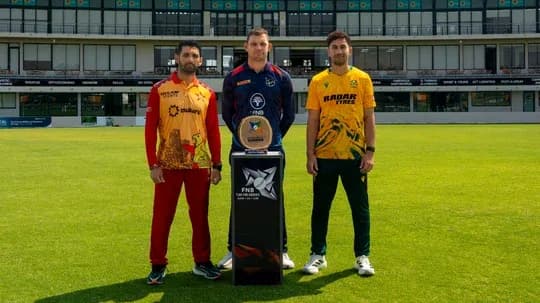
From Friday through September 6, Namibia, South Africa and Zimbabwe will cram a T20I tri-series into ten days that could reshape how southern African cricket sees itself. The NCG has hosted internationals before — 17 completed men’s white-ball games, as many women’s T20Is, and eight men’s under-19 ODIs since March last year — but never anything like this. For the first time, two ICC Full Members arrive together. For the first time, this place becomes a stage, not just a venue.
South Africa know the road here. They also know the sting.
In October last year, they walked into Windhoek for a T20I that looked, on paper, like a gentle outing against the neighbours. They walked out beaten on the last ball, four wickets down, and with a new respect for a Namibian side that refused to be the plucky associate in someone else’s story. No South African who watched that game thought Namibia were lucky. They were better. They proved it over 40 overs, not four deliveries.
Namibia have been living off that night ever since. The locals still toast it. Often. This is a part of the world where beer is less a drink and more a shared language. Namibians, South Africans, Zimbabweans — nobody here needs an excuse to raise a glass. Over the next week and a half, plenty will be emptied regardless of who takes the trophy. The series could easily have been christened the Thirsty Cup.
The comparison with England’s recent off-field headlines writes itself. While Brydon Carse found himself in police handcuffs outside a Derby bar on Saturday night, yet another entry in English cricket’s after-hours dossier, southern Africa’s cricketers are preparing for something a little more straightforward: bat, ball, and a late-night drink that ends without a cell door clanging shut.
David Gower, never exactly a teetotaler in his own playing days, summed up England’s latest mess on BBC Radio 4 with the kind of clipped honesty only a former captain can muster: “I don’t think the side does. I think the odd individual does, and in this case I think it’s largely a stupidity problem.” Down south, the stupidity tends to stay inside the boundary rope. Off it, most go home intact, unarrested and ready for the next game.
They can play, too.
Gerhard Erasmus, Namibia’s captain and heartbeat, has been fielding the same question for years: how do associate teams bridge the gap? His answer is disarmingly simple — you beat the teams on the other side of the gap. T20, he argues, gives you that chance. One or two players catch fire, the game bends. “If you have two star performers on the day you could swing the result your way,” he says. Last October, Namibia did exactly that.
Bjorn Fortuin, now leading South Africa in this series, felt the full weight of that swing. “It wasn’t a fun experience,” he said on Thursday, remembering that night. No talk of scars, no excuses. “The reality was we got beaten by the better team on the day.” He will walk out again in Windhoek knowing that the badge on his chest guarantees nothing.
This tournament will not dawdle. Only three days in the entire schedule are free of cricket. Each team must handle back-to-back fixtures, a test of depth, conditioning and nerve. That compressed calendar might just distil something we have long suspected but rarely seen sustained: a distinctly southern African brand of T20 cricket.
Picture it: bristling pace from young quicks who grew up bowling on hard, unforgiving pitches; fielders cutting angles like knife blades; batters who hit with flint in their eyes and little interest in reputations. Teams that do not go away even when the scorecard says they should. A refusal to accept that the script is already written.
The surface will play its part. In 13 men’s T20Is here, totals of 200 or more have been reached only three times. Two centuries have lit up the place, eight fifties have decorated it, but the bowlers have had their say. Six four-wicket hauls have been recorded, four by seamers who liked what they saw in the deck. With sunshine and temperatures in the mid to upper 20s Celsius expected at 2pm local time — the same for South Africa and Zimbabwe, 5.30pm in India — this is not a graveyard for bowlers. It’s a negotiation.
Namibia step into that negotiation with something close to a full hand and a familiar face in the dugout. Justin Kemp, once the hulking allrounder in South African colours, now works as assistant coach to the hosts. Michael van Lingen, who last played a T20I at the 2024 World Cup, has come out of retirement, another sign that Namibia sense opportunity rather than obligation in this series.
Their likely XI has a settled spine: Jan-Nicol Loftie-Eaton and Junior Taanyanda at the top, Erasmus at three, Alex Busing-Volschenk and Zane Green to follow, JC Balt and Jan Frylinck offering all-round ballast, then Max Heingo, Bernard Scholtz, Waldo Smith and Jack Brassell to round out a side that knows its roles and its conditions.
South Africa, by contrast, arrive with a squad that screams experiment. Jason Smith has been ruled out with an inner thigh strain, removing one of the more experienced hands. Eathan Bosch is uncapped in T20Is, Duan Jansen has yet to play for his country in any format. This is not the A-list. It is the audition.
Their possible XI is raw but intriguing: Tony de Zorzi and Lhuan-dré Pretorius could open, Connor Esterhuizen and Dewald Brevis bring the promise of fireworks in the middle, Rubin Hermann and Prenelan Subrayen add stability and spin. Then the seam battery: Jansen, Fortuin, Kwena Maphaka, Lutho Sipamla and Nqobani Mokoena. A captain in Fortuin who knows the ground, a teenage prodigy in Maphaka who wants to own it, and a group of players who understand that one good week here might change their careers.
Zimbabwe sit somewhere between the two, neither experimental nor fully settled. The return of Graeme Cremer from an arm injury that kept him out for more than 17 months is a significant boost, a reminder of a time when he was their craftiest operator. Yet the glow of that comeback is dulled by the absence of Richard Ngarava, sidelined with a lower back problem, and the dropping of Brendon Taylor, a name that has long been stitched into Zimbabwe’s white-ball story.
Their likely XI mixes familiar and fresh: Brian Bennett and Ben Curran at the top, Dion Myers, Sikandar Raza and Wessly Madhevere in the engine room, Tadiwanashe Marumani and Brad Evans offering depth, Newman Nyamhuri, Cremer, Wellington Masakadza and Blessing Muzarabani with the ball. Raza, as captain, will again carry more than his share — leader, run-maker, bowler, conscience.
The stakes are not World Cup high, but they are real. For Namibia, this is a chance to prove that last year’s win over South Africa was not a one-off surge but part of an upward curve. For Zimbabwe, it is about reasserting their status in a region where the old hierarchies are creaking. For South Africa’s fringe, it is about forcing their way into bigger conversations, using a lavender-ringed ground in Windhoek as a launchpad.
And for the NCG itself, this is an audition in front of the global game. The stands, the sightlines, the outfield, the pitch, the atmosphere — all under scrutiny. A young venue, already praised as one of the most attractive and well-appointed in the world, now has to prove it can carry the weight of expectation.
No one will complain if a non-South African side lifts the trophy. The experimental nature of the visitors’ squad almost invites it. The jeopardy is part of the draw. So is the sense that, in this format, on this ground, the gap between Full Members and ambitious associates can be reduced to a couple of inspired spells or one fearless innings.
The lavender will still be there when it’s over, softening the edges of a hard game in a hard land. The question is simple: when the scent drifts across Windhoek on September 6, who will have left the strongest mark on southern Africa’s newest stage?