
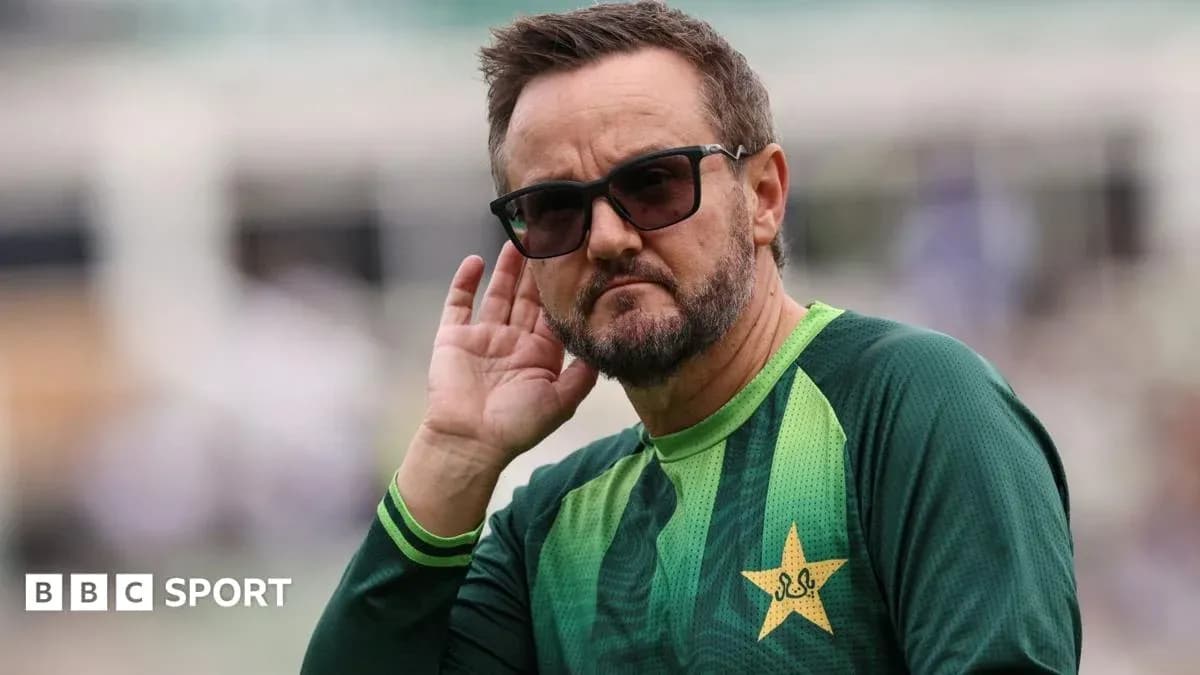
Mike Hesson's Ambition for Pakistan Test Role
Mike Hesson has made it clear: he wants the Pakistan Test job, and he wants it for the long haul.
The 51-year-old New Zealander, parachuted in as interim coach for the third Test at Edgbaston, has barely had time to unpack in the Pakistan dressing room. Yet he is already talking about a project, not a stop-gap.
“I’ll be open to it, for sure. I love Test cricket,” Hesson said, laying out his intent with the calm certainty that marked his time in charge of New Zealand.
A Kiwi at the crossroads
Hesson arrived in Birmingham under a cloud not of his own making. Pakistan had been hammered at Headingley and Lord’s, and Sarfaraz Ahmed was removed from his Test role as the PCB scrambled for a response.
Drafted in for the Edgbaston Test, Hesson watched his new side lose by eight wickets to England. On the scoreboard, it was another clear defeat. Inside the camp, he saw something different.
“I think there's enough talent around the system in Pakistan that if we can provide some good direction, we can make some strides forward,” he said. The message was deliberate: this is not a broken team, just an underused one.
He did not pretend there was a quick fix. “It's certainly not going to happen in a game or two, but I think there is some skill there I'd certainly be considering looking after.” That last phrase hung in the air – a coach gently nudging the door open to a permanent Test role.
Hesson already holds the white-ball brief, appointed as Pakistan’s limited-overs coach in May 2025. Extending his reach to the red-ball side would give the PCB something it has often lacked: a single, coherent voice across formats.
England came calling
Hesson’s stock remains high well beyond Pakistan. Between 2012 and 2018 he turned New Zealand into one of the most organised and resilient outfits in world cricket, steering them to a World Cup final and reshaping their identity.
So when England sacked Brendon McCullum as Test coach in July, Hesson’s name inevitably surfaced. The England and Wales Cricket Board did more than just whisper it.
“I was contacted by my agent to say there had been an approach to have a discussion around my availability, as I'm sure many people were,” Hesson revealed.
England eventually went for another New Zealander, Stephen Fleming, but not because Hesson lacked interest from their side. He simply chose his current path.
“I made it pretty clear I had committed to Pakistan,” he said. That line will please the PCB hierarchy as much as it reassures a dressing room that has lived with too much flux.
Hesson also hinted at how he sees his career: long arcs, not short stints. “Most of the positions I've been in, I've been in for five or six years. I see it through, then you have a break, then you refresh and try for something else.” For a Pakistan Test set-up craving stability, that is an attractive promise.
Pakistan’s red-ball dilemma
While Hesson talks about direction and long-term plans, the reality of Pakistan’s Test cricket is more uncomfortable. Former captain Ramiz Raja, watching the Edgbaston defeat, saw spirit but not structure.
Pakistan “put up a fight” in the eight-wicket loss, Ramiz said on BBC Test Match Special, but he did not sugar-coat the broader picture.
“It's time to revisit Test match cricket,” he insisted. “It's back to the drawing board because in the sub-continent not a lot of emphasis is put on Test match cricket.”
That criticism cuts deep. Pakistan’s white-ball talent continues to churn through the system, but their red-ball game has often felt like an afterthought: undercooked preparation, unstable leadership, and a revolving door of coaches.
Ramiz pointed to the chaos surrounding Sarfaraz’s removal and the late change of coach. “Obviously there was mayhem around the team and that may have hurt the dressing room environment. But Pakistan were also a little underdone, undercooked with preparation.”
The word “mayhem” captures it. Hesson has walked into a storm, not a settled operation.
A coach built for the long game
All of which makes his interest in the permanent Test role more intriguing. Hesson is not a short-term firefighter by nature. He builds cultures, systems, and habits over years. That is his record from New Zealand, and that is the pitch he is effectively making to Pakistan.
He sees talent. Ramiz sees a lack of emphasis and structure. The PCB sees a team that has just been outplayed in England. Somewhere in that triangle lies Pakistan’s next move.
If they hand Hesson the red-ball reins to go with his white-ball job, they are not just choosing a coach. They are choosing a philosophy: patience, continuity, and a belief that Test cricket still matters enough in Pakistan to be rebuilt properly.
If they don’t, they risk exactly what Ramiz warned about – another trip back to the drawing board, with no one holding the pencil for long enough.
The decision now is not whether Pakistan have the players. It is whether they are ready to let one man shape their Test future and live with the time it takes.





