
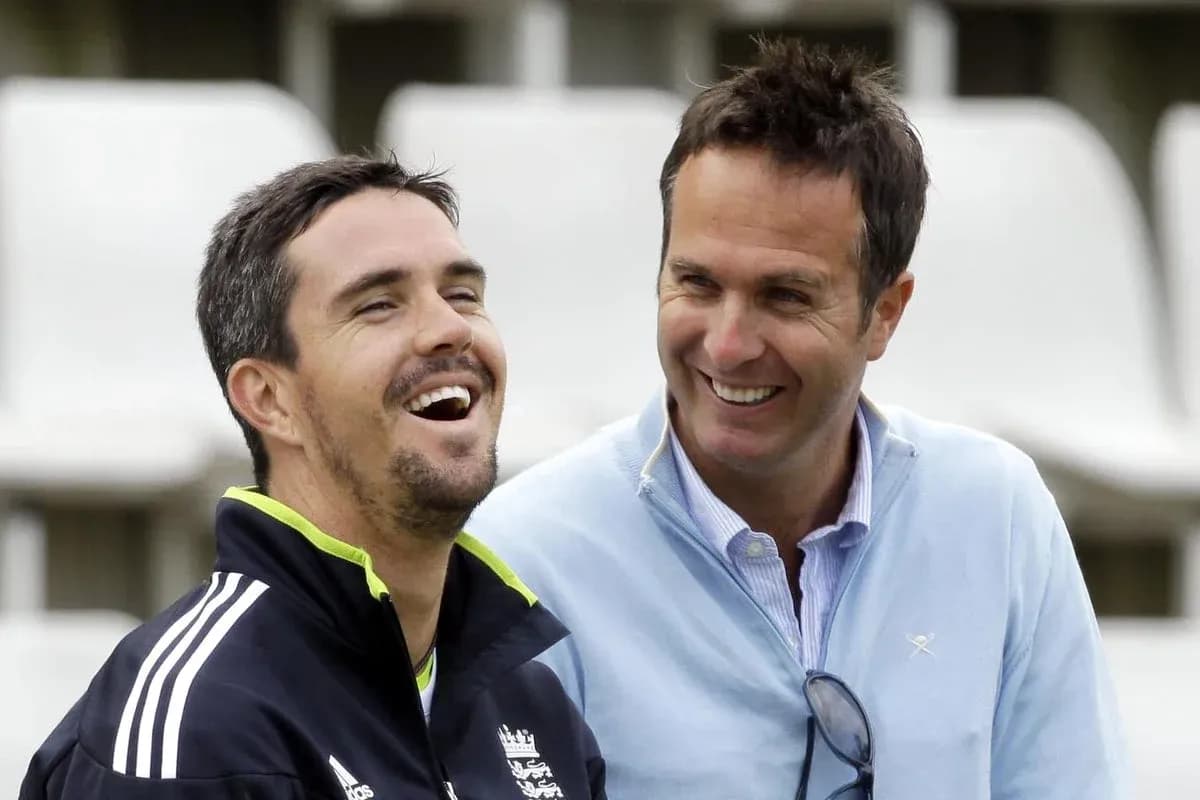
Michael Vaughan on Pietersen's Risky Return to England Cricket
Michael Vaughan calls Kevin Pietersen’s return to the England set-up a risk. He also thinks it is exactly the kind of risk worth taking.
Twelve years after being frozen out of the national side in the wake of a spectacular fall-out with management, Pietersen is back in an England tracksuit, this time as a specialist mentor with the ODI and T20 teams. For a figure whose England career ended in acrimony in 2014, it is a striking twist.
Vaughan, who captained Pietersen during the 2005 Ashes and knows both his brilliance and volatility as well as anyone, did not pretend this was a safe appointment.
“I like it, it’s quirky,” he said. “It’s a risk, it has to be a risk because you’re not too sure what you’re going to get because Kev’s not done a great deal of coaching.”
That uncertainty is the point. Pietersen has never been a company man, never inclined to smooth edges or soften opinions. Even this current white-ball group have felt the sting of his tongue: in January last year he publicly accused England’s limited-overs side of inadequate preparation on tour in India. Now he is walking into their dressing room.
What England get in return is a mind steeped in high-stakes batting. Vaughan was emphatic on that front.
“His knowledge of batting, his knowledge of winning, his knowledge of playing at the right intensity at the right moments, there’s no-one been better in my time playing for England,” he said.
For Vaughan, Pietersen’s re-emergence is also a correction of sorts. The manner of his exit still jars.
“I’m happy he’s back in English cricket because (in) 2014, I always felt that Kev was dealt an iffy hand,” Vaughan reflected. “Kev brings a lot of things on himself but there are many others who have done equally silly things and have been allowed back into English cricket.”
The selection of Pietersen is not without baggage. His only notable coaching stint came with Delhi Capitals in the Indian Premier League, where his work was overshadowed when he disappeared to the Maldives for a holiday midway through the 2025 tournament. Since retiring in 2018, he has largely lived in the commentary box, not the nets.
Vaughan could not resist a jab.
“I’ve seen him at Delhi doing a few coaching gigs – I believe he hasn’t got two weeks in the Maldives in his contract, which is good, I believe he has to stay and coach,” he chuckled.
On Sunday, Pietersen was already in place at the Utilita Bowl, bedding in ahead of England’s T20 series against Sri Lanka, which starts on Tuesday. His role will run through to next year’s ODI World Cup, a tournament that will unfold largely in his native South Africa. For a player who once dominated those conditions in England colours, the symbolism is obvious.
Yet Vaughan admitted the appointment caught him off guard – not because Pietersen is back, but because of where he has been deployed.
“I was actually surprised they’ve brought him into the white-ball set-up. I thought the Test team would have approached him,” he said. “The white-ball team over the last year have been doing quite well.”
That surprise carries a clear subtext: Pietersen’s mentality, his combative streak and his obsession with seizing big moments, feel tailor-made for the long game. Still, even in the shorter formats, his reach could extend beyond the immediate brief.
“I would think that the batters in the white-ball team who play Test cricket, he’ll be having an influence on them,” Vaughan noted.
The stakes are obvious. England’s white-ball revolution, once the envy of the world, has stalled. Investment in coaching, backroom staff and new ideas has soared. The return on that investment has not.
“Winning will be the key,” Vaughan said bluntly. “They’ve got to start winning trophies, to justify all these decisions and, let’s be honest, a huge amount of money being spent. England have to start winning trophies.”
Vaughan was speaking during a week that also showcased a very different side of the game’s future. At Lord’s, the inaugural winners of the Barclays Knight-Stokes Cup were crowned, with boys’ and girls’ state-school teams playing their finals at the home of cricket.
The competition, a national hardball tournament for state schools, is already vast. An estimated 15,744 students and 1,100 teams are expected to take part in the 2025 edition, with applications for next year’s event now open. Vaughan, who has thrown his weight behind the project, sees only upward movement.
“This will go from strength to strength,” he said. “I’m hoping next year that we’ll have more than 2,000 teams enter, that’s the goal.”
On one side, then, English cricket is gambling on the maverick genius it once cast aside, hoping Pietersen can jolt a talented white-ball squad back into trophy-winning mode. On the other, it is opening the gates at Lord’s to thousands of state-school cricketers chasing a first taste of the big stage.
If Pietersen’s return helps turn those dreams into a pathway, not just a one-off day out, the risk Vaughan talks about will look less like a gamble and more like a statement of intent.





