.svg&w=384&q=75 "logo")
Mavericks' Clutch Struggles: The Impact of Kyrie Irving
There’s one number that cuts straight through the noise of the Mavericks’ 26-win season.
Forty-five.
Dallas played 45 clutch games in 2025-26 — tied for the most in the league. Clutch, by the book, means the score is within five points in the final five minutes. The Mavericks went 17-28 in those moments. Twenty-eight times, the game sat on a knife’s edge. Twenty-eight times, it tilted the wrong way.
For a 56-loss team, that’s not a horror story. It’s a roadmap.
Dallas didn’t spend the year getting run off the floor. The Mavericks were there, deep into the fourth quarter, over and over again. They just couldn’t land the plane. Closing is a skill. It can be taught, sharpened, trusted.
Last season, they were trying to do it without the one thing you absolutely need when the game slows down and every possession feels like a verdict: a closer.
A Young Team Without a Finisher
The explanation isn’t complicated. Dallas rolled out one of the youngest rosters in the NBA and asked it to solve the league’s hardest puzzle in real time.
Cooper Flagg, still a teenager, was learning under the harshest lights the league can offer — final minutes, tight scores, veterans across from him who have seen every coverage and every trick. Around him, a supporting cast that had never been the one making those decisions, never been the player the ball finds when everything tightens.
Experience doesn’t matter equally across 48 minutes. It spikes in value in the last five. Those possessions are different: the crowd louder, the floor smaller, the margin for error gone. Dallas walked into that crucible most nights with almost none of it.
So they competed. They pushed good teams, hung around bad ones, and then, in those final five minutes, they flinched just enough.
This year, the equation changes with one name.
When the Game Shrinks, Irving Grows
Irving’s résumé in these situations is etched into league history.
The Game 7 dagger over Stephen Curry in the 2016 Finals is one of the defining shots of the modern NBA — isolation, a switch, a step-back three that turned a tied game into a championship for Cleveland. In 2024, he broke Denver’s heart with a left-handed floater from the free-throw line that seemed to bend physics on its way down. These are not just highlights; they’re case studies in late-game nerve.
His track record when everything is on the line is almost absurd. Irving owns a 15-1 record in career postseason closeout games, averaging 23.5 points in those contests. When a series needs to end, he usually helps write the final sentence.
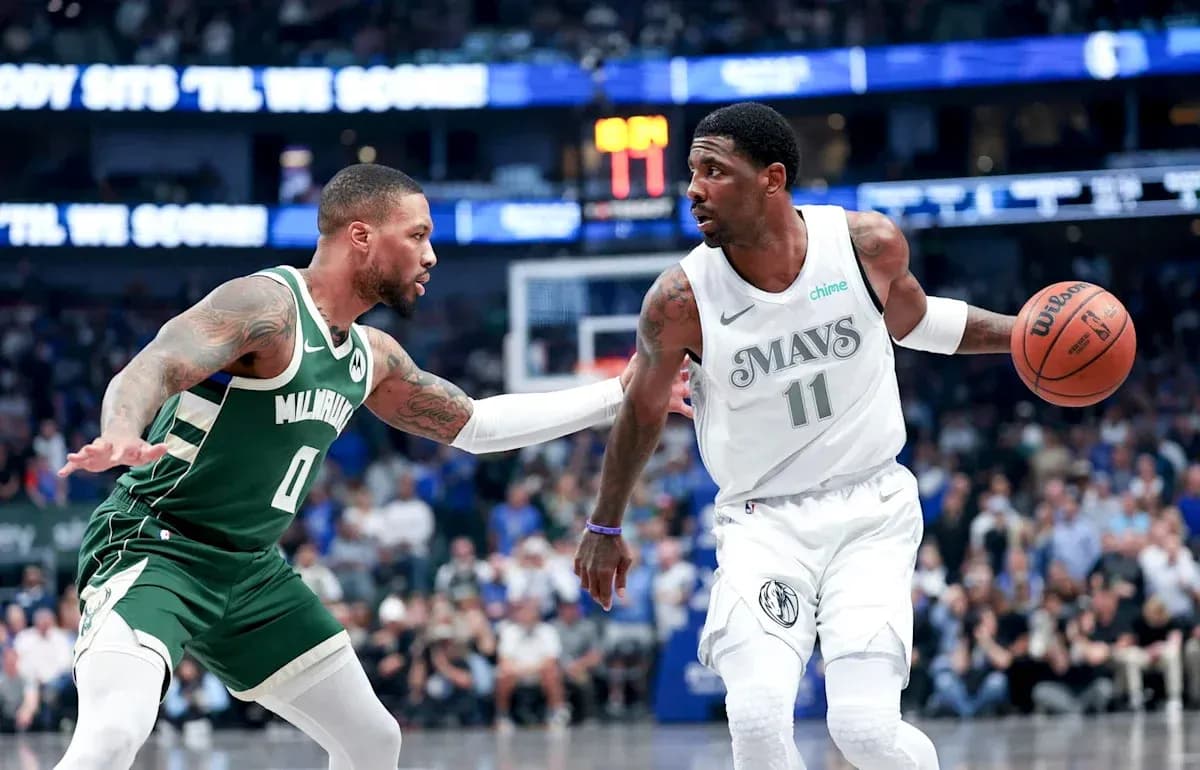
Dallas has already seen what that looks like in its own colors. In 2023-24, with Irving on the floor, the Mavericks went 16-4 in clutch games, one of the best records in the league. He ranked among the NBA’s top 10 in clutch scoring at 4.2 points per game, drilling 60% of his shots from the field and 42% from beyond the arc in those pressure minutes.
That’s not just “good under pressure.” That’s a weapon.
Late in games, offenses tend to strip down to their most basic form: isolation against a set defense, with everyone else spaced and watching. Most players get worse in that environment. The defense knows what’s coming, help is ready, the angles shrink.
Irving thrives there. He still finds clean looks, or at least makeable ones, when the defense has no excuses left. And when defenses bend toward him — which they have to — the game suddenly becomes much simpler for everyone else. Young players aren’t asked to create something from nothing; they’re asked to read one rotation, make one cut, hit one shot.
That’s a different level of difficulty.
Lessons in Losing, Value in the Pain
There’s another layer to last season’s struggles that matters now.
Those 28 clutch losses weren’t empty. Flagg and the rest of the young core spent an entire year logging high-pressure reps. They saw what it feels like when a five-point lead disappears in 90 seconds. They felt the weight of a single turnover or missed box-out. They learned, possession by possession, what not to do.
Players don’t only grow from the games they finish off. They grow from the ones that slip away and keep them up at night.
Now, Dallas pairs that scar tissue with a veteran who has built a career on finishing. The kids have lived the chaos. Irving has mastered it. That combination is exactly what last season was missing.
The Mavericks don’t need to transform overnight into a juggernaut to change their trajectory. They simply need to be the team their record hinted they already were: competitive most nights, dangerous in the last five minutes.
Turn a fraction of those 28 clutch losses into wins, and the standings look very different. With Irving back in that role, and a young core that’s already felt the sting of failure, those final possessions in Dallas might start to feel a lot less like a coin flip — and a lot more like a script they finally know how to finish.