.svg&w=384&q=75 "logo")
Matt Hauser: Australia's Triathlon Champion
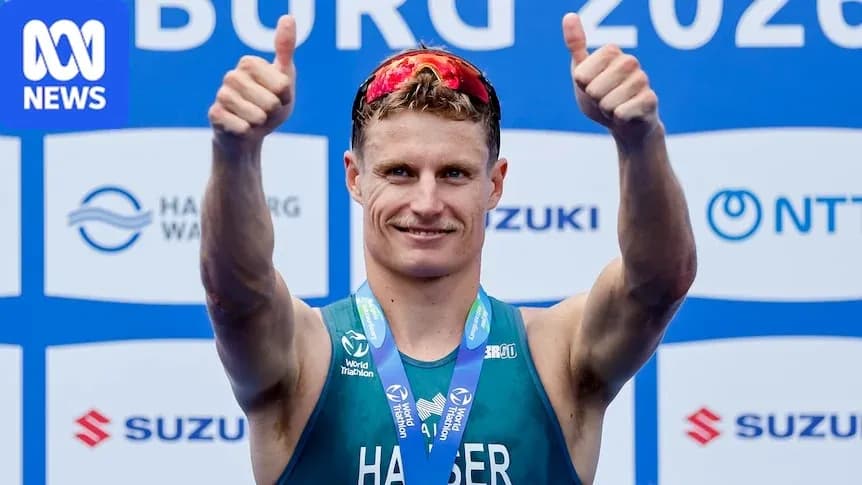
Matt Hauser stood on the Wollongong pontoon with 15 years of Australian frustration sitting on his shoulders and did what no one in green and gold had managed since. He won. Emphatically. On home soil, in front of a sport that had been waiting more than a decade for a new standard-bearer, he dragged Australia back to the top of world triathlon.
It felt like a breakthrough moment. It wasn’t.
This has been a slow burn, built session by session on the Gold Coast, not some overnight revelation. Wollongong was the eruption everyone could see. The work had been buried in years of grind.
From “pinch me” to hunted man
Right now, Hauser is the man everyone is chasing.
Three World Triathlon Championship Series starts in 2024. Three wins: Yokohama, Hamburg, London. That perfect record has him sitting third in the overall standings heading into Weihai on August 29, behind Brazil’s Miguel Hidalgo and Portugal’s Vasco Vilaça, who have both raced one more round than he has.
He’s the form athlete of the series, and he knows it. He just isn’t entirely used to the label.
“It’s a bit of a pinch me moment, honestly,” he told ABC Sport at the AusTriathlon Performance Hub in Miami on Queensland’s Gold Coast, still adjusting to life as the man with the target on his back. The surreal part for him is not the wins themselves, but the realisation that, right now, he belongs in the conversation as the best in the world.
That mindset shift has been as important as any interval set. Accepting that this is his level. Accepting that it won’t last forever, so it has to be cashed in now.
A decade in the making
The story, though, is not of a prodigy who simply arrived. It is of a 10-year project.
Hauser points directly to his long-standing partnership with coach Dan Atkins and the high-performance bubble they have built on the Gold Coast. Ten years under the same coach is an eternity in modern elite sport. For Hauser, it has meant continuity, trust and an environment that has quietly produced daily standards long before the medals came.
“It doesn’t feel like a big sudden jump,” he said. “It feels like a lot of smaller goals and processes have added up.”
Those small steps have now created something bigger than personal success. They have given Australian triathlon something it has been craving: a visible, winning figurehead at the very top of the men’s game.
A new Australian standard
For the next wave, the impact is immediate and obvious.
“Looking back at Australia’s history in triathlon, it’s so rich, and now we’re definitely stepping up our game,” said 19-year-old Aspen Anderson, one of the brightest of the rising crop. She sees Hauser not as an outlier, but as a path.
“Matt’s definitely led the way in that aspect. And I think it’s really cool to see him paving the way for some of us.”
That matters. For a long time, the roll call of Australian Olympic triathlon medallists has been dominated by women: Emma Snowsill’s gold in Beijing, podium finishes for Michellie Jones, Loretta Harrop, Emma Moffatt and Erin Densham. On the men’s side, the ledger is stark. No Australian man has ever stood on an Olympic triathlon podium.
Hauser is now the best chance in a generation to change that.
While others experiment, Hauser doubles down
The men who shared the Paris Olympic podium with him have taken different paths since.
Gold medallist Alex Yee has turned his attention to the marathon, clocking 2:06:38 and becoming the second fastest British man in history behind Mo Farah. Silver medallist Hayden Wilde has tested himself over longer distances in the T100 series.
On the women’s side, Olympic champion Cassandre Beaugrand has been rewriting French athletics records, setting national marks in the 3,000m, 5,000m and over 10km on the road, and lining up in the Diamond League.
Hauser watches all of it with admiration. He understands what their exploits do for triathlon’s credibility — proof that its stars are world-class across the individual disciplines. He just isn’t tempted to follow them. Not yet.
For him, this is a window. While others explore, he is doubling down on the World Triathlon Championship Series, sharpening race craft, learning how to control fields, learning how to win in different ways. The sport has evolved quickly since the Tokyo and Paris cycles, and Hauser has chosen to evolve with it from inside the cauldron.
Redrawing the race script
For years, short-course triathlon seemed to be drifting towards a runner’s game. Packs would form in the swim and bike, the front group would swell, and the real damage would be done only when the shoes went on. Strong runners like Mario Mola and Australia’s Jake Birtwhistle would slice through the field from behind and turn the run into a shootout.
Hauser is disrupting that script.
He has started to race like the Brownlee brothers in their pomp — aggressive from the gun, ruthless in the water, uncompromising on the bike. He forces splits early, leans into swim-bike breakaways and tries to strip the advantage from the pure runners before they ever get the chance to open their stride.
“The dynamics change from year to year,” he said. Right now, those dynamics suit him perfectly.
Front packs are back. Breakaways are sticking again. Hauser is often the one doing the damage at the front, driving the tempo, asking questions of everyone behind. He has proved that you don’t need to be the out-and-out best runner to win if you can shape the race before the run even starts.
That tactical clarity has turned him from a contender into a closer.
The constant balancing act
Underpinning all of this is the eternal triathlon puzzle: how to be good enough at three very different sports without letting one undermine the others.
Go too heavy in the pool and the added upper-body bulk punishes you on the bike and run. Chase too much run speed and you risk losing the sharpness in the water that keeps you in the front group. Every triathlete grows up hearing the same mantra: you can’t win the race in the swim, but you can definitely lose it there.
Hauser has found a balance that works for him. Strong enough in the swim to make the front, powerful enough on the bike to hurt people, composed enough on the run to finish the job. That mix is fragile, constantly under review, but it is the foundation of his current dominance.
LA 2028 always in view
For all the trophies and tape-breaking this season, one date and one city sit quietly behind everything: Los Angeles, 2028.
“The Olympics is always in the back of my mind,” Hauser admitted. Every world championship race, every training block on the Gold Coast, every tactical decision is viewed through a four-year lens.
He remembers the version of himself from a few seasons ago — capable of big days, but not often enough to be considered a genuine front runner. That inconsistency has gone. Now, he is repeatedly at the sharp end, repeatedly in control. The challenge is to make that level feel normal, to make the extraordinary routine.
If he can do that, then when he walks onto the pontoon in LA, he will not be chasing a once-in-a-lifetime performance. He will simply be trying to reproduce what he has been doing for years.
The plan is simple, if not easy: collect experience, stack “notches in the belt”, learn to handle both excellent and merely average days at a consistently high standard. Peak for one race every four years, but respect the grind that leads there.
The next test
The grind continues in Weihai, China, on August 29, with the World Triathlon Championship Series finale waiting in Pontevedra, Spain, on September 23. Hauser arrives as the man in form, the man with three wins from three, the man everyone else is plotting against in team meetings and hotel lobbies.
Australia has waited a long time for a male triathlete to stand on an Olympic podium. Hauser has already ended one 15-year drought. The question now is whether this surge of form is the crest of a wave — or just the start of something that finally carries Australian men’s triathlon all the way to gold in Los Angeles.