
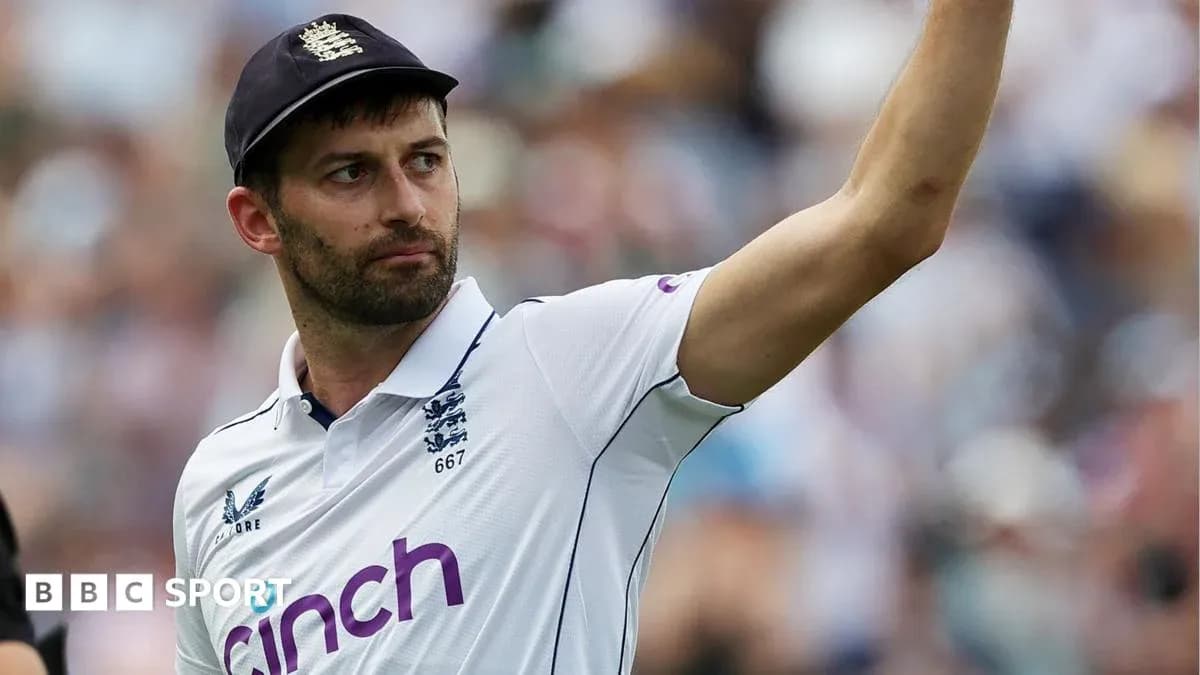
Mark Wood Retires from International Cricket at 36
Mark Wood, one of the fastest bowlers ever to pull on an England shirt, has called time on his international career with immediate effect at the age of 36.
The Durham quick, a tearaway whose body never quite matched his heart, walks away after years of pushing himself through pain, surgery and rehab in pursuit of one more spell, one more series, one more shot at the England dream.
Body finally says no
Wood had only just fought his way back into the Test side, returning in the first Ashes Test in Perth last November after 15 months out. An elbow injury, then knee surgery, had kept him on the sidelines. The comeback lasted 11 overs.
Swelling in his left knee flared up again. The same problem. The same frustration. He flew home for treatment and never made it back into an England shirt.
This time, the battle was lost.
"Although this may not come as a surprise given the past year, it just feels like a natural time at the end of my contract," Wood said in a statement on social media. He spoke of resilience, of always trying to come back and prove people wrong, then admitted that on medical advice, Test and 50-over cricket are no longer possible. Over the past year, he said, the England dream had been “slowly ground out” of him.
For a man who lived for that dream, the words cut deep: "Playing for England has been the greatest honour I could have ever wished for and a dream come true."
He still hopes to play cricket in some capacity, but the international chapter is closed.
A career of extremes
Wood’s numbers tell one story. His body tells another.
He took 119 wickets in 38 Tests after debuting in 2015, and that first summer he helped England win back the Ashes on home soil. He finished his white-ball career with 80 wickets in 70 one-day internationals and 54 in 38 T20s, making him England’s sixth-highest wicket-taker in men’s T20 internationals.
Those figures came in bursts, carved out between a string of ankle, knee and elbow injuries that repeatedly stalled his momentum. Every time he gathered speed, something gave way.
In 2018, searching for a way to stay on the park, he lengthened his run-up to ease the strain on his body. It looked like a gamble. It worked. The pace stayed. The impact grew.
That adjustment helped him play a central role in some of England’s greatest modern triumphs. He was part of the side that lifted the 2019 50-over World Cup, taking 18 wickets in the tournament. He was in the squad that won the T20 World Cup in 2022, though a calf problem cruelly ruled him out of the closing stages.
The point of difference
At full tilt, Wood was a spectacle. He didn’t just bowl fast; he changed matches, changed atmospheres, changed plans.
Rob Key, managing director of England men’s cricket, captured that sense of rarity. "It's been a privilege to watch the latter part of a great career," he said, highlighting Wood as a “point of difference” in Ashes wins and World Cup triumphs, a player who thrilled crowds every time he had the ball in hand. Few can say that. Wood can.
His 2023 Ashes contribution underlined it. England were 2-0 down and clinging on. Wood returned to the side and detonated the series. His blistering spells, raw pace and relentless aggression helped England fight back to level 2-2, transforming not just the scoreboard but the mood of the summer.
Those surges of energy, those spells that felt like events in themselves, defined him as much as any statistic.
Pride, pain and what comes next
Wood retires with medals, memories and scars in equal measure. The medals say world champion twice over. The scars explain why it couldn’t last longer.
He leaves as one of England’s quickest ever, a bowler whose career was constantly interrupted yet never dulled by doubt. Every comeback carried the same intent: run in hard, bowl fast, make something happen.
He has been told his body will not let him do that for England again. He accepts it. He doesn’t have to like it.
What remains is a career “very well spent”, as Key put it, and the lingering question that always follows players like Mark Wood: if his body had held together, just how far could that pace have taken him?





