
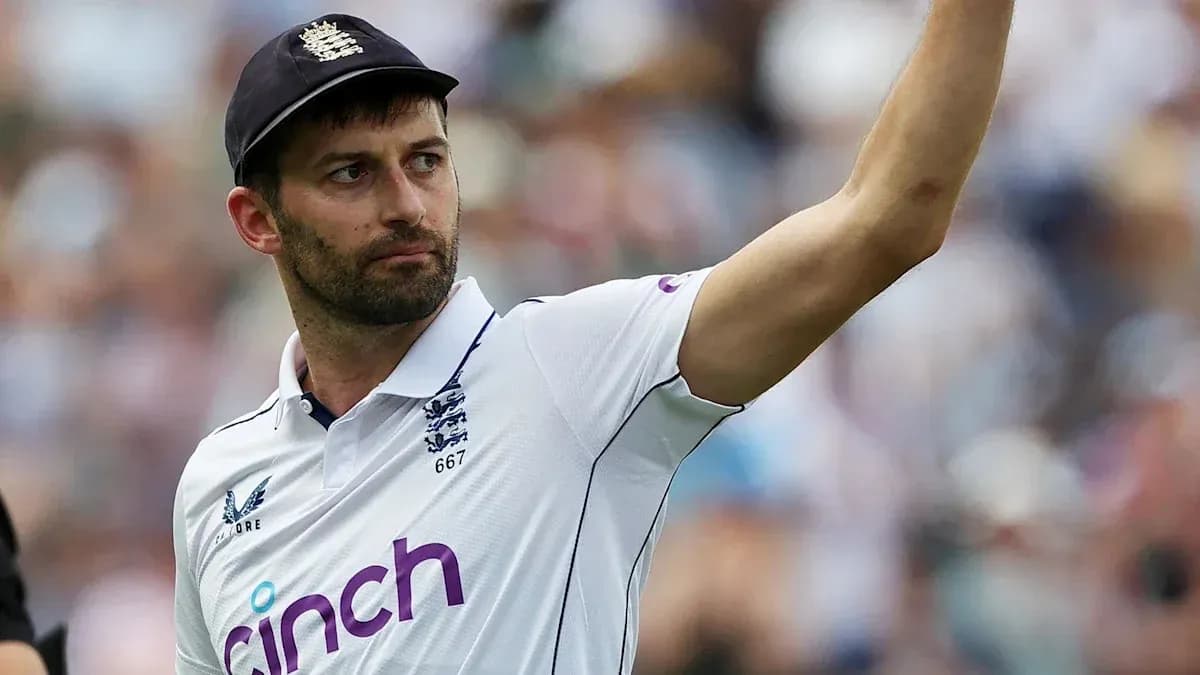
Mark Wood Retires: A Fast Bowler's Thrilling Journey
Mark Wood, England’s whirling dervish of pace, has bowled his last ball in international cricket.
The 36-year-old Durham fast bowler confirmed his retirement with immediate effect, drawing a line under a career that mixed raw speed, World Cup glory and Ashes drama with a relentless battle against his own body.
“It just feels like a natural time at the end of my contract,” Wood said in a statement on social media, admitting that after a year of setbacks, “this time I lost the battle.” On medical advice, Test and 50-over cricket are no longer possible. The England dream, as he put it, has been “slowly ground out” of him.
A career lived in the fast lane
For a decade, Wood represented the purest version of a fast bowler’s fantasy. Short run, explosive leap, ball screaming through at 90mph-plus, batters hopping, stumps cartwheeling. Anyone who has ever tried to bowl quickly knows the feeling they were chasing. Wood actually got there.
He debuted in 2015 and finished with 119 wickets from 38 Tests, his first summer capped by helping England regain the Ashes on home soil. That alone would have secured him a place in the modern story of English cricket. What followed turned him into something more memorable: a cult figure with world-class pace and a body held together, at times, by stubbornness and tape.
The injuries never stopped. Ankles. Elbow. Knee. Again and again. Each comeback felt like a minor miracle. Each spell at full tilt felt borrowed from the future.
In 2018, he lengthened his run-up to ease the stress on his body. It was a gamble. The pace stayed. The impact grew.
World champion, twice over
The remodelled Wood became central to England’s white-ball revolution. He was part of the side that lifted the 2019 World Cup at Lord’s, taking 18 wickets in the tournament and hobbling out to bat alongside Ben Stokes on that unforgettable final day, already carrying an injury but refusing to disappear from the story.
Three years later, he was again in the squad as England won the T20 World Cup in 2022, his role curtailed only by a calf problem that ruled him out of the closing stages. Even so, he walks away as England’s sixth-highest wicket-taker in men’s T20 internationals, with 54 wickets from 38 matches, and 80 wickets in 70 ODIs.
He is part of a tiny club: World Cup winner in both 50-over and T20 formats, and an Ashes winner. With his retirement, Joe Root is now the only current England Test cricketer to have experienced lifting the urn.
Ashes thunderbolts and Headingley chaos
For all the medals, Wood’s legend will always be tied to the Ashes and to a handful of ferocious spells that felt like events in themselves.
There was the demolition of West Indies in St Lucia in 2019, his new, longer run-up unleashed in full, a glimpse of what he might be able to sustain if his body finally played along.
There was the miserable 2021-22 Ashes tour in Australia, where England were humiliated but Wood emerged with credit, pounding away on unforgiving pitches, still hitting speeds others could only dream of.
Then came 2023 and the series that crystallised his appeal. Held back until the third Test at Headingley with England 2-0 down, Wood arrived like a storm. He bowled at “the speed of light”, as those in the ground described it, and produced one of the great Ashes spells, blasting out Usman Khawaja with a 95mph rocket that seemed to carry all the pent-up frustration of his injury years.
When the tension peaked in the final-innings run chase, Wood was still there, this time with the bat. He and his close friend Chris Woakes, another late arrival to the series, dragged England over the line. Without that pair, England’s fightback to level the series simply doesn’t happen.
Rob Key, England men’s managing director, called it “a privilege to watch the latter part of a great career,” praising Wood as a “point of difference” in Ashes wins and World Cup triumphs, a bowler who thrilled crowds every time he took the ball.
The body says no
The end, when it came, was brutal in its simplicity. After 15 months out with an elbow injury and knee surgery, Wood returned for the first Ashes Test in Perth in November. It was supposed to be the start of one last push.
He lasted 11 overs.
Swelling in the same left knee forced him off, then onto a plane home. He has not played for England since. Last month, he spoke of feeling “ashamed” of what happened in Australia, a harsh self-judgement for a player whose greatest opponent has always been his own physiology.
On medical advice, the verdict was clear. Test cricket and 50-over internationals were no longer realistic. The dream had run out of road.
Wood still hopes to play cricket in some capacity, but the international chapter is closed.
End of an era
His numbers tell one story. The atmosphere he created tells another.
The sight of Wood tearing in, often bowling himself off his feet, was one of the most exhilarating in the modern game. He played with visible joy, engaged with supporters, and never took himself too seriously. He seemed to understand, instinctively, that cricket is meant to be fun, even when the stakes are enormous.
Yet the what-ifs will linger. What might his career have looked like without the constant interruptions? How many more Tests, how many more spells like Headingley, how many more days when batters simply had no answer?
His departure also underlines a wider shift. Stuart Broad has gone. James Anderson has followed. Chris Woakes has stepped away. Now Wood joins them. Between them, with Ben Stokes’ all-round contribution included, England have lost 1,871 Test wickets in under three years.
An era of English pace has closed, and with it one of the most thrilling, fragile, human stories of them all: Mark Wood, the fast bowler who refused to slow down until his body finally called time.





