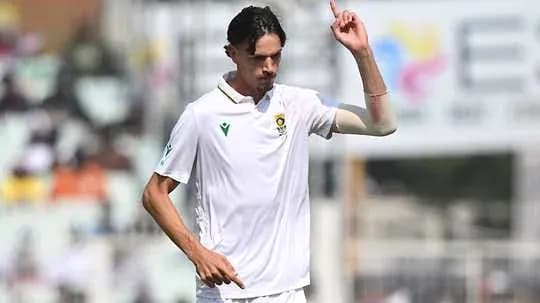
Marco Jansen Steps Up as South Africa's Lead Bowler Against Australia
Marco Jansen has spent most of his international life running in with a new ball that belonged, in spirit if not in law, to Kagiso Rabada or Lungi Ngidi. On Thursday at Kingsmead, it’s his.
No Rabada. No Ngidi. No safety net.
South Africa’s one-day series against Australia opens in Durban with Jansen, still only 24, suddenly the senior fast bowler in a squad stripped bare by injury. The familiar giants of the attack are in the stands; the kid who used to follow their lead is now expected to set the tone.
“Their not being part of the squad is a loss,” Jansen said on Monday. “They’re world-class bowlers, especially in South Africa. They know how to bowl in these conditions, and they know how to get the most out of the ball on a particular day. It feels like I’m going to have to take that leadership role and lead from the front for the first time.”
He’s right about the loss. He’s wrong about the “first time”.
A career built next to giants
Strip away the perception and the numbers tell a different story. Jansen has already led attacks, just not with the label attached.
He took the new ball in each of his last four Test innings – in Kolkata and Guwahati last November – when Rabada was sidelined with a rib injury. Those are the only occasions he has bowled the first over of a Test innings, but he has shared the new ball 16 times, every one of them with Rabada.
In ODIs he has opened the bowling 14 times. Eight of those spells came alongside Ngidi, three with Rabada. Across 12 ODIs where he has shared the new ball, Ngidi has taken the first over seven times, Rabada three.
T20Is underline the same pattern. Jansen has been trusted with the new ball in 18 matches. Rabada has followed him in the second over in seven of those games, Ngidi in two, Gerald Coetzee and Aiden Markram three each. In the 10 T20Is where Jansen has bowled the second over, Ngidi has taken the new ball six times and Rabada twice.
Add it all up: across formats, Jansen has bowled the first or second over of an innings 74 times. On 54 of those occasions – almost 73% – his partner was Rabada or Ngidi. His new-ball story is braided into theirs.
Now the braid has been cut. The habits, the comfort, the quiet glances between overs – gone. What remains is what he learned.
“I base what I think leadership looks like on playing with KG and Lungi,” he said. “When things go sideways or it’s tough, especially when we’re in the field, they have a way of calming and slowing things down. That’s what I’ll be trying to do.
“Because the last thing you want when you’re struggling in an over or at the death when the ball is flying around is someone just giving solutions and saying do this or do that. It’s important to pick up on the moments when a bowler needs time to slow things down and ask simple questions; things like what’s the plan here or how are we going to get this guy off strike.
“We do all the work before the game. We know what plans we want to put into action, what balls we want to bowl, and which fields we want to set. On game day it’s all about how to get the guys in a mental space where they can execute their gameplans. It’s about getting the best out of them.”
That’s not a youngster guessing at leadership. That’s someone who has been paying attention.
A bruised fast-bowling stable
South Africa’s quick-bowling cupboard has taken a beating. Rabada and Ngidi are out of the Australia ODIs. An entire generation of left-arm pace options has already been lost to injury or circumstance. The fact Jansen is upright, fit and available almost feels like an achievement in itself.
The depth chart is being redrawn on the fly. Alongside Jansen stand Corbin Bosch, Gerald Coetzee and Kwena Maphaka in the ODI squad, with Duan Jansen – who launched his international white-ball career in Namibia last month – also in the mix.
Look a little further down the road and the picture becomes even more intriguing. The three-Test series against Australia starts in Durban on October 9. There’s Bangladesh at the Wanderers and Centurion from November 15 to 27. Then England arrive for three Tests in Johannesburg, Centurion and Cape Town from December 26 to January 7.
Without wishing misfortune on anyone, it would be quite a sight if Keshav Maharaj, a left-arm spinner by trade, walked out in one of those series flanked by a battery of left-arm quicks – the Jansens, Maphaka, perhaps even Jitesh Basson – in the same XI. A left-arm seam revolution in South African whites, years in the making, suddenly fully formed.
That’s for another day. Jansen doesn’t have the time, or the inclination, to indulge in that kind of what-if.
Running in on fumes
Even his presence in this window of fixtures is not something to be taken for granted. His recent build-up has been scruffy, stitched together between illness and niggles.
“My build-up to that game didn’t go as planned,” he said of his first-class outing for the Titans against the Dolphins in Centurion from September 10 to 12. “I planned to bowl two or three weeks before but then I got sick. I was on antibiotics for a week-and-a-half, two weeks. That cut my preparation short, so I only had three days of prep and felt heavily undercooked going into the match. I also saw two physios as well for small stuff. Coming back from after The Hundred I had to sort out stiffness in the body.”
On the field, you wouldn’t have known. Jansen pushed through nine overs in the Dolphins’ first innings, taking 3 for 39. Then he walked out with the bat and cracked seven fours in a 45-ball 37. When the Dolphins batted again, he cranked up through 17 overs, finishing with 4 for 61 as the Titans won by an innings and 60 runs.
Underprepared, on antibiotics not long before, and still dictating terms. That’s the version of Jansen South Africa need against Australia.
From apprentice to axis
For years, Jansen has been the long, loping apprentice – the left-armer learning in the slipstream of Rabada and Ngidi, feeling his way into international cricket with giants at the other end.
Those giants are missing now. The numbers say he’s already shared their load. The schedule says there’s no time to ease into anything. Australia at Kingsmead on Thursday, a home summer bristling with Tests beyond that, and a new-ball role that no longer comes with training wheels.
He has the ball. He has the memory of how KG and Lungi handled the fire.
Now we find out what happens when the apprentice is the one everyone else looks at when things start to go sideways.