.svg&w=384&q=75 "logo")
Maia Bouchier's Century Leads England to Record ODI Chase Against Ireland
England did not so much chase Ireland’s total as dismantle it.
Set 282 for victory, they cruised home to their highest successful ODI run-chase with 11 overs to spare, driven by a ruthless century from Maia Bouchier that turned a potentially tricky target into little more than a training exercise at Grace Road in Leicester.
Ireland build, then burst into life
For a long stretch of the afternoon, Ireland had every reason to believe they had posted something substantial.
After the early loss of a wicket, Amy Hunter and Gaby Lewis settled in and then quietly took control. Their second-wicket stand of 136 from 152 balls gave the innings a calm, composed backbone. Both passed fifty, both finished in the 60s, and between them they threaded 13 fours through England’s fields, picking gaps rather than swinging wildly.
The platform looked ideal. Then came the wobble.
Three wickets fell in just over seven overs from the 30th, and suddenly a total north of 250 looked under threat. The tempo stalled, the risk of a limp finish loomed.
Leah Paul and Rebecca Stokell refused to let it happen. They counter-attacked, not recklessly but with clear intent, adding 84 off only 71 balls. Singles turned into hard-run twos, anything fractionally short or overpitched went. Ireland rattled up 77 from the last 10 overs, closing on 281 for 5 and walking off with momentum and belief that they had given their bowlers a genuine score to defend.
That belief lasted about half an hour.
Bouchier and Dunkley rip up the script
Maia Bouchier arrived with a different script in mind.
Her start was brisk rather than frantic, but in the sixth over she tore into Jane Maguire and the tone of the chase changed instantly. Four consecutive boundaries off the 23-year-old seamer ripped a hole in Ireland’s plans and announced that England were not in the mood for a gentle Sunday pursuit.
From there, the assault became relentless.
Bouchier and Sophia Dunkley surged to 72 without loss after 10 overs, the required rate already reduced to a formality. The pair drove, cut and pulled with authority, rarely allowing a dot ball, never allowing the bowlers to settle. The pressure that Ireland had built with the bat evaporated under a tide of clean striking.
Dunkley reached a 40-ball fifty in the 15th over, busy and fluent, while Bouchier’s half-century arrived off 53 deliveries in the 17th. By then, England were scoring at more than seven an over, the chase reduced to a numbers exercise.
The partnership, 143 off 118 balls, felt decisive long before it was broken.
Cara Murray, to her credit, refused to disappear into the background. She finally prised out Dunkley for 73 from 61 balls in the 20th over, a much-needed breakthrough that briefly lifted Ireland. When she then removed Jodi Grewcock in the very next over, there was at least a hint of a contest.
It didn’t last.
Capsey, Kemp and the finishing flourish
Alice Capsey joined Bouchier and ensured the tempo barely dipped. Where others might have taken a few overs to assess conditions, Capsey slipped straight into rhythm, rotating strike and punishing anything loose. The pair added 50 brisk runs, keeping the fielders chasing shadows.
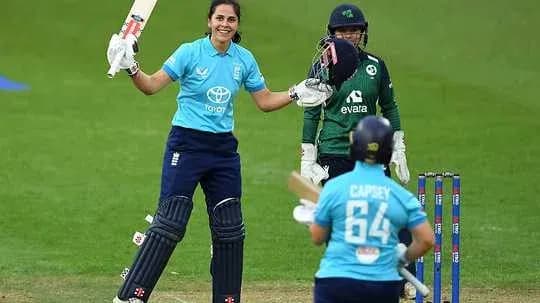
In Capsey’s company, Bouchier moved serenely towards three figures. She brought up her century from 91 balls in the 31st over, an innings built on timing and placement as much as power, punctuated by 11 fours. It was a statement knock, the kind that anchors a record chase and drains the fight from a fielding side.
She fell in the 32nd over for 104 from 95 balls, but by then the job was almost done.
If Ireland hoped that wicket might slow England, Freya Kemp quickly disabused them. The left-hander strode out and swung with intent from the outset. She thumped Louise Little for two boundaries in an over, then went after Arlene Kelly with even greater ferocity, peeling four fours off the seamer as England hurtled past 250 in just the 34th over.
Murray, Ireland’s standout with the ball, struck again to remove Kemp for a blistering 36 from 22 balls, completing a deserved three-wicket haul. It was a personal reward on a punishing day, but the contest had long gone.
Capsey, calm amid the chaos, simply finished the job. A final boundary in the 39th over sealed the chase, her unbeaten 41 from 40 deliveries the neat full stop on a performance that had been anything but gentle.
Ireland’s batters had done their part. Their finish, their partnerships, their 281 for 5 — all of it would win plenty of one-day games.
Against this England side, on this day, it wasn’t close to enough.