
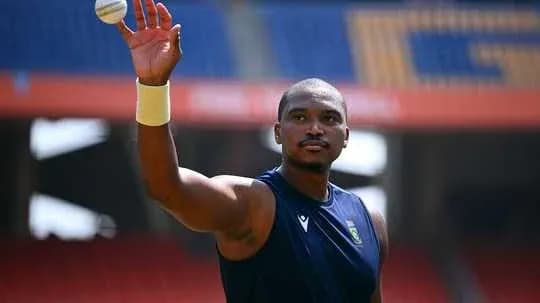
Lungi Ngidi's Hamstring Injury: A Pattern of Misfortune for South Africa
Lungi Ngidi has limped into a club no fast bowler wants membership of, its roll call growing, its entrance fee paid in torn muscle and stalled momentum.
He is the fifth South African quick to go down, four of them for the same reason. Hamstring. Again.
Cricket South Africa confirmed on Friday that Ngidi has been ruled out of the ODI series against Australia, which starts at Kingsmead on Thursday. He joins Kagiso Rabada, Ottneil Baartman and Lutho Sipamla on the sidelines with hamstring injuries. Nandré Burger is the outlier, his back trouble flaring up once more.
For a while it has felt like bad luck. Now it feels like a pattern.
A familiar diagnosis
“What is it with all the hamstrung hamstrings?” is the obvious question. The answer, according to Shuaib Manjra, is timing.
“It’s not surprising, because if you look at any sport there are two peaks in hamstring injuries — the beginning of the season and the end of the season,” CSA’s former chief medical officer and national men’s team doctor told Cricbuzz.
At the start of a campaign, players go from rest to full tilt. The workload spikes, the body scrambles to catch up, and something gives. At the back end, fatigue does the damage. Tired muscles don’t respond, don’t protect, don’t survive.
“So it’s not surprising,” Manjra said. The medical logic is cold. The consequences are anything but.
Ngidi’s latest setback came in Centurion last Friday, in the opening round of first-class matches for the Titans against the Dolphins. One round into the season, one frontline quick down. Again.
CSA have declined to guess whether he, like Rabada, will be ready for the Test series against Australia, which starts in Durban on October 9. That silence says enough.
Tests, not ODIs, at the heart of it all
On paper, this is an ODI series against Australia. In reality, everything is framed by what comes next.
South Africa are defending World Test Championship winners, their only senior global title, secured by beating Australia in the final at Lord’s in June last year. Eight Tests pack the coming season. Those games, not a “relatively random” ODI rubber, sit at the centre of their plans.
That’s why a five-second social media clip of Rabada this week — a gentle run-up, a smooth action, the ball released without apparent discomfort — has been seized on as a shard of optimism. He hasn’t played any cricket since May. Burger has been out since June. Sipamla only bowled competitively again last month after a break stretching back to July. Baartman, before last week, had also been missing since July.
They are not just injured. They are undercooked.
To bring them back, South Africa’s medical and coaching staff must ramp up workloads carefully. Overs need to go back into legs that have been idle. Rhythm must be rebuilt without tripping the same wire twice.
And that, as Manjra points out, is the trap.
“The other risk for a hamstring injury is a previous injury,” he said. “You’re more likely to pick up another injury if you go back too early.
“Doctors have a saying that the highest risk of an injury is a previous unrehabilitated injury. So we have to ensure that the player is fully rehabilitated, otherwise they are vulnerable.”
Ngidi’s different path
Ngidi’s story this time looks different on the surface. He has not been sitting still.
From August 27 to September 6, he played six ETPL games for Glasgow Cosmic, sending down 120 of a possible 144 deliveries. A solid, sensible workload. Not excessive, not negligible. Enough to harden the body, you’d think, without breaking it.
Yet he broke anyway.
That opens the door to a harsher reading: that his commitment to franchise cricket cut across the ideal preparation for a South African season loaded with eight Tests and a marquee home series against Australia. Should he have been managing his build-up more conservatively rather than chasing overs — and income — abroad?
It’s an easy argument to make from the outside. Harder when the question becomes personal. Would those critics have covered the money he would have lost by skipping the ETPL? Ngidi is a professional. This is his livelihood, not a hobby.
The reality is messier than a simple right-or-wrong call. The calendar is crowded. The financial pull is real. The physical toll is obvious.
A patched-up attack
On the selection sheet, the changes look brisk and businesslike.
Nqobani Mokoena comes in for Ngidi. Gerald Coetzee replaces Rabada. Duan Jansen steps up for Baartman. Sipamla and Burger were not in the original ODI squad, but if they had been fit, the dominoes of injury above them would have dragged them closer to the action.
Instead, South Africa’s attack for this ODI series will be led by Marco Jansen, with Corbin Bosch and Kwena Maphaka also in the frame. It is a group with promise, but also with a very different feel from the snarling, seasoned pace cartel that carried them to the WTC title.
The hamstring epidemic has stripped away experience and left the selectors juggling risk, recovery and readiness. Every decision now carries a Test-shaped shadow.
The ODIs against Australia will go ahead, as they always do. The shirts will be pressed, the anthem sung, the first ball bowled. But in South African minds, the real question lingers behind the physio-room door.
When the Australians return in whites at Kingsmead in October, how many of South Africa’s fast bowlers will be fit enough — and hardened enough — to defend the crown they fought so hard to win?





