.svg&w=384&q=75 "logo")
Kevin Durant's Legacy: Impact Beyond Basketball in Houston
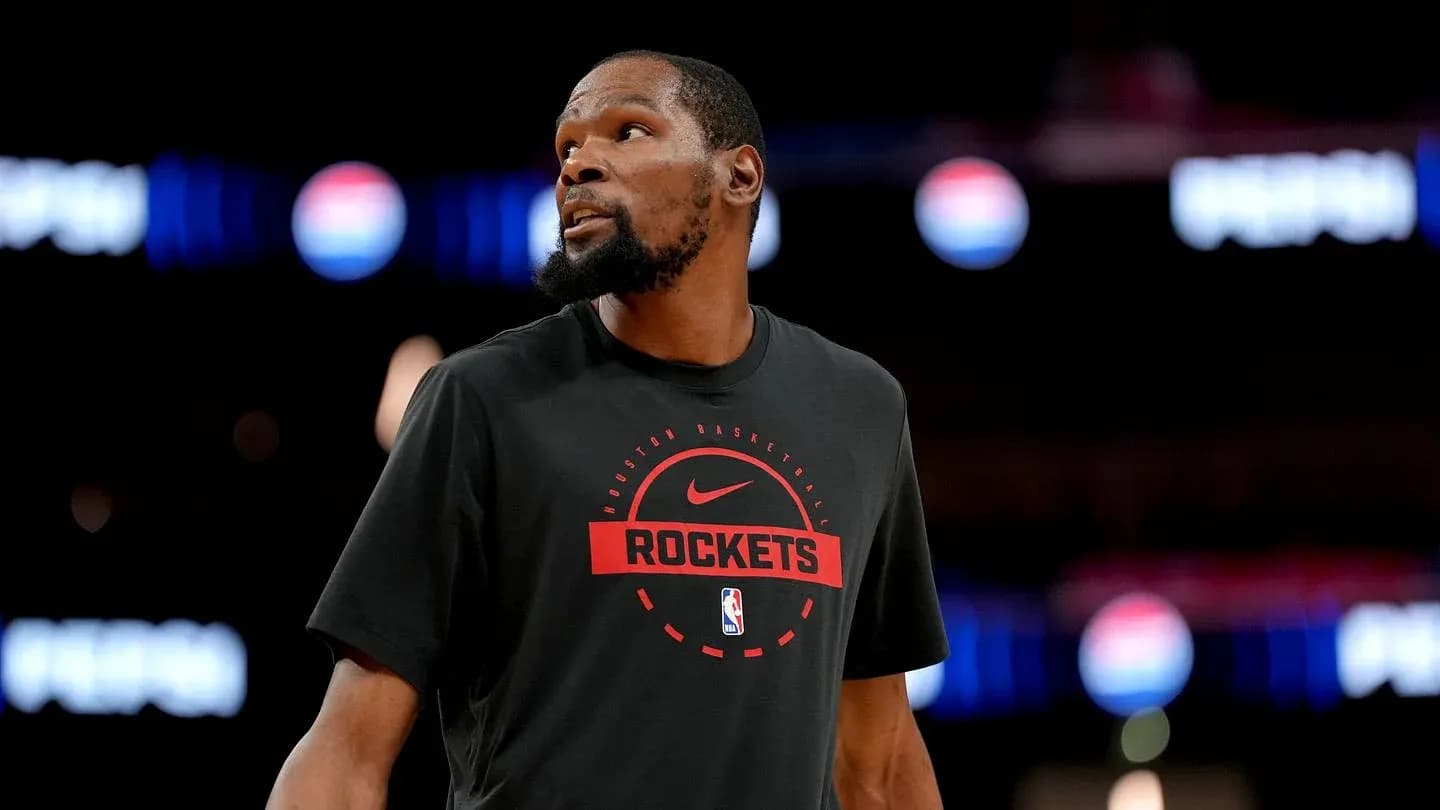
Kevin Durant has spent a career bending the sport to his will. Now, in Houston, he’s trying to bend something bigger.
Two NBA titles. Two Finals MVPs. A league MVP. Six All-NBA First Team nods. Four scoring crowns. Sixteen All-Star appearances. The résumé already reads like a Hall of Fame plaque, yet Durant is still adding lines, still chasing something that can’t be measured on a box score.
And he’s honest about it.
“I like to say that I don’t care about legacy, but I actually do,” Durant said during a Zoom seminar hosted by O.U.R. Mothers, speaking to Houston Rockets OnSI. “I want to be known for actually impacting lives in a positive way. It’s that simple. It don’t really matter if the masses know it or a few people do. I just want to know internally that I made sure that we try to do the right things every time that we step up.”
For a player whose name has been debated, dissected, and dragged through every corner of the basketball internet, that’s a different kind of scoreboard.
A Legacy That Stretches Beyond the Arc
Durant’s influence has long spilled beyond the hardwood. Through the Durant Family Charitable Foundation, he has built a structured answer to the question of what his career should mean when the sneakers are finally unlaced.
The mission is clear: enrich the lives of at-risk youth from low-income backgrounds. Not as a slogan, but as a framework. The foundation leans into more than just basketball courts and camps. It pushes into entrepreneurship, STEM programs, and college readiness, trying to widen the path for kids who rarely get one.
It fits the way Durant talks about impact. Not loud. Not performative. Targeted, consistent, and, in his words, something he can live with “internally.”
That off-court ambition runs parallel to another chase—one that’s far more public.
Houston’s New Center of Gravity
Durant arrived in Houston with the weight of his reputation and the urgency of time. The Rockets’ first season with him in uniform finished at 52–30, a significant step forward but one that ended abruptly in the first round of the playoffs.
Houston never really saw the full version of the team it imagined. Durant missed the majority of the series against the Los Angeles Lakers, and the Rockets bowed out before they could test their true ceiling. The result stung, but it didn’t close the window. It simply underlined how narrow the margins are in the Western Conference.
Durant, even at this stage of his career, still changes those margins. Last season he played 78 games, a reminder of his durability as much as his brilliance, averaging 26.0 points, 5.5 rebounds, and 4.8 assists. The All-NBA Second Team selection was a nod to how steady he remains as a two-way force and primary option.
He is no longer the young phenom in Oklahoma City or the devastating closer in Golden State. In Houston, he is something else: the veteran superstar asked to guide a rising core into the chaos of contention.
The Kids and the Climb
The Rockets’ future doesn’t rest on Durant alone. It bends around the development of two teammates who haven’t yet turned 25 but already carry serious expectations.
Alperen Sengun, a two-time All-Star, has become the offensive hub many projected, a big man with touch, vision, and feel that make him a matchup puzzle. Amen Thompson brings a different edge, a defensive specialist whose length and athleticism give Houston a disruptive presence on the perimeter.
If those two make the leap the franchise believes they can, Durant’s presence becomes the difference between a fun young team and a legitimate threat. His scoring still warps defenses. His experience still settles fourth quarters. His voice, sharpened by years of deep playoff runs, still carries weight in the huddle.
The Western Conference, though, offers no soft landings. The San Antonio Spurs and Oklahoma City Thunder sit at the top of the conversation, armed with youth, depth, and star power of their own. Houston’s task is blunt: close that gap, then blow past it.
Durant has done this before—walked into a team with talent and turned ambition into banners. The question now is whether he can do it again, older but no less dangerous, in a city waiting for its first title in over three decades.
One More Banner, One More Chapter
A third NBA championship would reshape Durant’s story yet again. Doing it in Houston, with a franchise that hasn’t lifted the trophy in more than 30 years, would carve his name into Rockets history alongside its most revered figures.
It would also force a fresh look at his place in the game. Not just as a scorer without a weakness, not just as a champion who found different routes to the top, but as the veteran who anchored a new generation’s rise.
If the Rockets fall short, Durant’s standing as one of basketball’s greats remains secure. The numbers, the awards, the moments—they already guarantee that. His legacy off the court, through his foundation and his broader ventures like Boardroom, will keep expanding regardless of what happens in May and June.
But if he does drag Houston back to the summit, if he delivers that long-awaited title while still living up to his own standard of “doing the right things every time that we step up,” then the conversation around Kevin Durant changes again.
Not whether he’s a Hall of Famer. That’s settled.
The real question becomes: how many different ways can one player define greatness?