
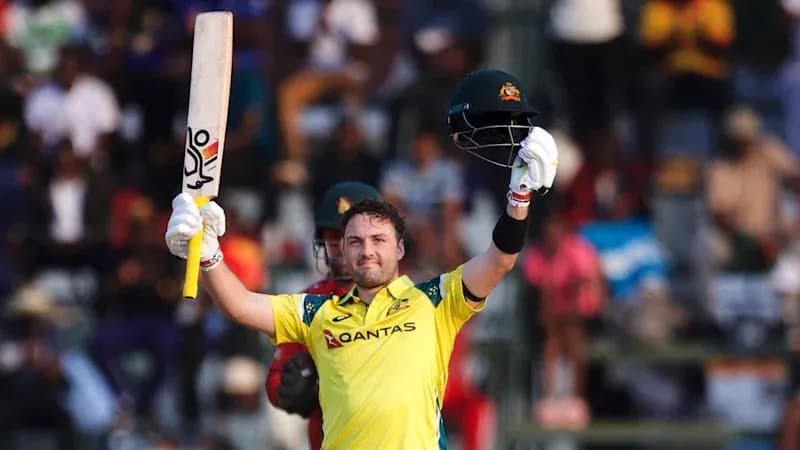
Josh Inglis leads Australia to thrilling one-wicket win over Zimbabwe
Josh Inglis steadied his helmet, took guard, and refused to blink.
On a tense Harare afternoon that veered from routine chase to looming embarrassment, the wicketkeeper-batter carved out a nerveless 103 from 102 balls to drag Australia to a one-wicket win over Zimbabwe with a single ball left. It sealed a 3-0 series sweep. It also said something louder: this is a player – and a team – already thinking about a World Cup defence in South African conditions.
Australia chased down 272, but they did it the hard way. Again.
Inglis stands tall in a wobbling chase
Australia were never strangled by the run rate. That was never the problem. The issue was the procession.
Travis Head nicked off for 6. Mitchell Marsh followed for 8. Each time the innings seemed to settle, another wicket fell and the game twitched back to life for Zimbabwe.
Inglis ignored the noise. He played late, he played straight, and when Zimbabwe erred in length he cashed in, threading 11 fours in an innings that mixed calm accumulation with sharp, calculated aggression. He reached three figures at almost a run a ball, holding together an innings that kept threatening to come apart.
Around him, the scorecard frayed. Middle-order partners came and went, Zimbabwe’s seamers and spinners sharing in the spoils as pressure built. Brad Evans, in particular, drove the hosts forward, his 4-47 from 10 overs repeatedly ripping momentum away from the visitors.
Yet every time the chase crept towards panic, Inglis found a gap or a release stroke. His dismissal, with the finish line still not quite in sight, opened the door to a finale that swung wildly in the space of a few deliveries.
Ellis, Johnson and a dropped chance
At 10 down, Australia still needed runs. The series whitewash suddenly felt very fragile.
Nathan Ellis, who had already impressed with the ball, decided he wasn’t done. The seamer, more accustomed to lower-order cameos than match-defining stands, produced 36 from 44 balls, farming the strike and refusing to let Zimbabwe close the trap. At the other end, number 11 Spencer Johnson dug in, scratching his way to seven from 13 balls, each defensive stroke drawing out the tension.
The game flipped on a single moment.
With Australia still under the pump, Wessly Madhevere put down a crucial chance to remove Ellis in the penultimate over – a catch that could have sealed a famous home win. Instead, the reprieve proved fatal. Ellis walked back on strike in the final over needing nine. First ball, he launched Madhevere over the rope for six. The equation shrank, the pressure shifted, and Zimbabwe’s grip slipped for good.
Australia got home by one wicket with one ball to spare. A thriller, yes. But also a warning about fine margins and the value of composure under fire.
Raza leads from the front, Zimbabwe left to rue
Zimbabwe had earned the right to dream of an upset.
After choosing to bat, captain Sikandar Raza played the anchor and the accelerator in one. His unbeaten 81 from 72 balls was the innings of a man who understands both his responsibility and his team’s limitations. He marshalled the back end expertly, pushing his side to a competitive 271.
He was well supported at the top. Craig Ervine’s 59 from 79 balls and Innocent Kaia’s 55 from 66 set the base, giving Zimbabwe a platform from which Raza could launch. Australia’s bowlers never quite lost control, but they never fully dominated either.
Ellis was the standout, taking 3-50 from his 10 overs, varying his pace and length smartly on a surface that offered just enough to keep him interested. His day’s work looked good when Zimbabwe closed on 272. It looked decisive once he finished the job with the bat.
Raza, though, refused to dwell on the heartbreak. He saw something else in the defeat.
He spoke of par being closer to 280-290, of pride in his side’s fight, and of preferring this kind of contest to watching Australia canter home in 40 overs. Zimbabwe had dragged one of the game’s heavyweights deep into the final over. They will know they should have finished the job. They will also know they are getting closer.
Marsh’s mixed emotions and a bigger picture
For Mitchell Marsh, the day came with a split screen: relief on one side, realism on the other.
He acknowledged Australia had been “lucky” to escape in Harare, but he also saw what selectors and coaches crave in the four-year World Cup cycle – fresh faces holding their nerve when the lights burn brightest. Inglis’s hundred, Ellis’s all-round performance, Johnson’s composure at number 11: these are the building blocks of depth, the kind of contributions that turn a squad into a tournament side.
Australia rested several regulars for this tour, yet still walked away with a 3-0 result and a dressing room full of players who have tasted pressure and survived it. That matters.
Because the next step is no gentle climb.
South Africa calling – and old scars in the background
The squad now heads to South Africa for three ODIs, starting in Durban on Thursday, before a tantalising three-Test series in Durban, Gqeberha and Cape Town.
Australia have not toured South Africa for Tests since the 2018 ball-tampering scandal, a rupture that still shadows any mention of Cape Town. The return will come with its own noise, its own narratives, yet inside the camp the talk is of conditions, combinations and the World Cup in 12 months’ time.
Inglis framed it simply: this is a trial run. Same pitches, similar pressures, same need to find methods that work when the ball grips, seams and swings in unfamiliar ways. Most of next year’s World Cup games will be staged in South Africa, with others in Zimbabwe and Namibia. This is rehearsal territory now, not just another bilateral tour.
Reinforcements are on the way. Pat Cummins and Mitchell Starc are expected to join for the ODI leg, adding world-class firepower to a group that has already banked confidence and minutes in the middle.
Australia leave Harare unbeaten, but not untested. They have seen how quickly a chase can unravel, how one dropped catch can change a series, how emerging players respond when the game shrinks to its rawest form: you, the bowler, the target, and no way back.
Those are the lessons that count when a trophy is on the line in 12 months’ time.





