Jon Jones Takes Responsibility for Gable Steveson's Exit After UFC 331 Knockout
Jon Jones has stepped forward to take the blame for Gable Steveson’s dramatic exit from the octagon after his brutal knockout defeat at UFC 331.
The Olympic gold medallist suffered his first professional loss in the harshest way possible – a thunderous left hand from Sean Sharaf that ended the heavyweight prospect’s night just 12 seconds into the opening round in Los Angeles. As Steveson crashed to the canvas and the arena erupted, the boos that had followed him all week suddenly morphed into a roar of shock.
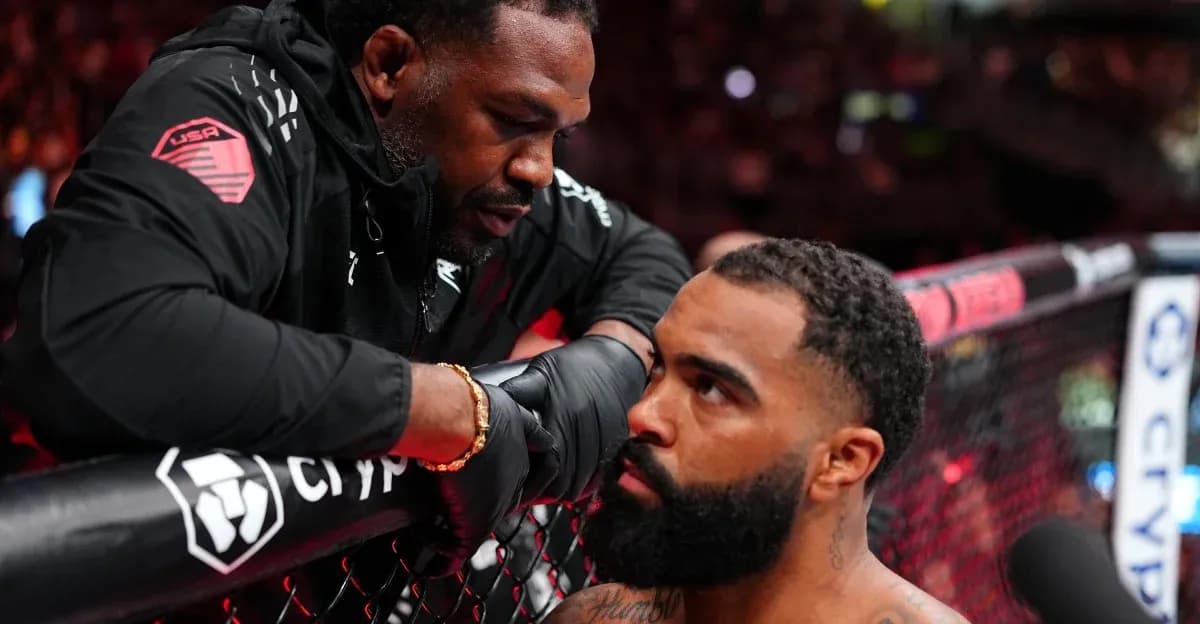
Before Bruce Buffer could even lift the microphone to read the official result, Steveson was gone. No handshake. No nod to Sharaf. No post-fight interview. He headed straight to the back for medical attention, a decision that sparked criticism from fans and pundits who saw it as poor sportsmanship from one of the UFC’s most hyped newcomers.
Jones says that’s on him.
“I’ve seen some reports on line and I really wanted to clear the air. It was my decision to take Gable straight to the back after the fight,” Jones wrote on Twitter, stepping between his friend and the backlash. “Honestly it was the first time in this situation for me and my instant reaction was to get my friend to the back to make sure he was ok.
“Gable’s work ethic and will to win is there and I stand by him and believe he will go on to be one of the best heavyweights in the UFC. He will be back I’m sure of it.”
Those words carry weight. Steveson didn’t arrive in the UFC as just another prospect. He arrived as a phenomenon. An Olympic freestyle wrestling champion in 2020, he had long flirted with the idea of crossing over into MMA, but it was his time inside Jones’ training camp – helping the former light heavyweight king prepare for Stipe Miocic – that finally pushed him to make the leap.
The early returns looked terrifying. Four fights. Four first-round finishes. A heavyweight wrecking ball with elite wrestling credentials and the kind of athletic profile that made matchmakers and marketers alike start sketching out future title scenarios.
All of that collided with reality in 12 seconds on Saturday night.
Sharaf’s left hand didn’t just hand Steveson his first professional loss; it stripped away the aura of invincibility that had been building around him. The crowd that had booed him all week sensed vulnerability and turned up the volume. The walkout became a sprint to the tunnel. The moment that was supposed to showcase a rising star instead exposed how quickly the sport can turn.
Jones’ intervention shifts the narrative. It doesn’t change the result, it doesn’t erase the highlight-reel knockout, but it reframes Steveson’s exit as a protective call from a veteran champion rather than a snub of Sharaf or the fans.
For Steveson, the numbers are still impressive: 4-1, all five fights ending in the first round. The difference now is that one of those endings belongs to someone else. How he responds to that reality – and how he looks the next time the cage door closes – will say far more about his future than any hype ever could.