.svg&w=384&q=75 "logo")
Javagal Srinath: From Star Bowler to Everyday Commuter
On a Bengaluru morning like any other, the “Mysore Express” stood still.
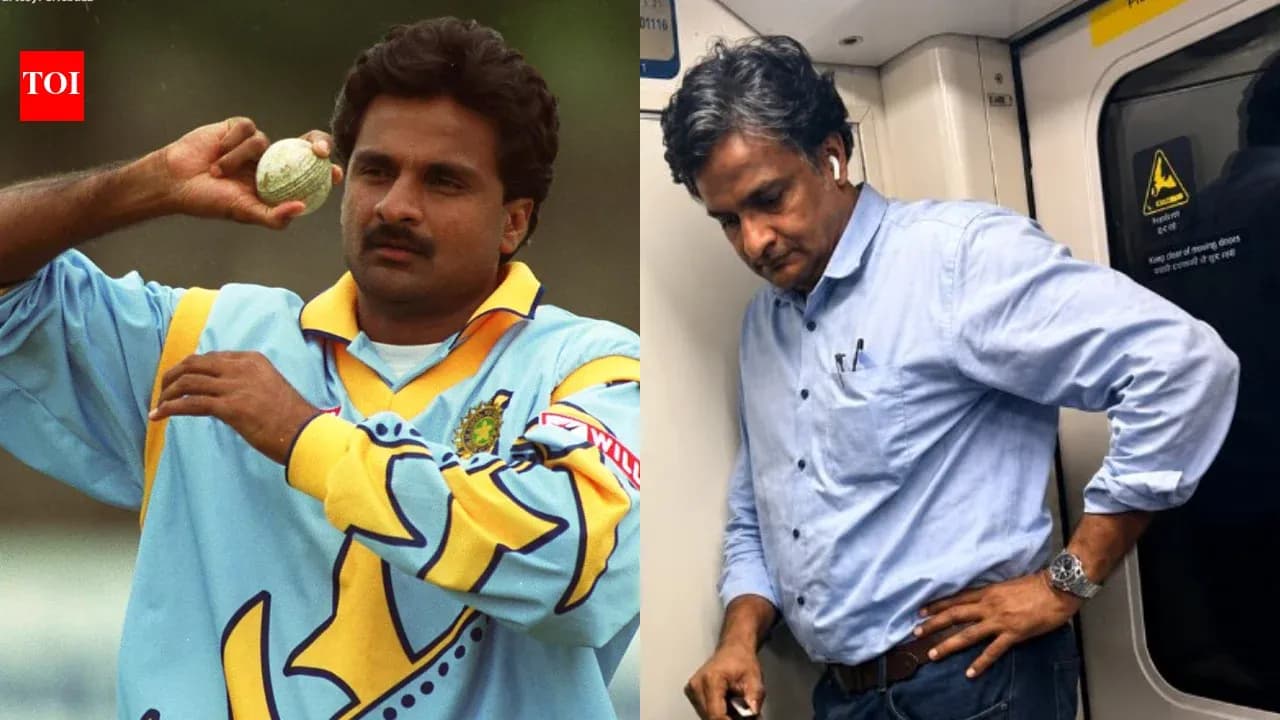
No roaring run-up, no white ball in hand, no TV cameras tracking every move. Just Javagal Srinath in jeans and a light-blue shirt, a trolley bag by his side, riding Namma Metro like any other office-goer trying to get across the city.
One photograph was enough.
Someone clicked him inside the coach, luggage parked neatly, eyes set ahead. No one in the frame seems to be asking for a selfie. No one appears to be pointing and whispering. To most commuters, he is just another passenger. To Indian cricket fans scrolling through their feeds, the image landed with the force of a memory.
This was the man who once led India’s pace attack. Now he was simply another face in the crowd.
From spearhead to silent traveller
For a generation, Srinath was the heartbeat of India’s fast bowling. The Karnataka quick, nicknamed the “Mysore Express”, carried the new ball and much of the country’s pace burden through the 1990s, at a time when India still searched desperately for a reliable fast-bowling core.
He played 67 Tests and 229 ODIs for India. His spells shaped series, his wickets swung tournaments. For years, television replays and newspaper scorecards framed his life.
Yet it is not a yorker, not a five-for, not a World Cup spell that has sent his name trending again. It is a quiet Metro ride.
In that viral shot, there is nothing to hint at the old thunder. No India blazer, no ICC accreditation around his neck, no fan mob. Just a middle-aged man in casuals, standing in a corner of a coach. The ordinariness of it all is exactly what stopped people in their tracks.
The contrast hit home: one of India’s most recognisable fast bowlers, reduced—beautifully—to anonymity.
‘This is Srinath’
Once the picture surfaced online, the reactions flowed. Not with disbelief, but with recognition.
“This is Srinath,” many fans wrote, as if the image had simply confirmed what they already believed about him. The simplicity, the low profile, the absence of fuss—none of it surprised those who have followed his life beyond the scoreboards.
Several users chimed in with their own sightings: Srinath in Bengaluru traffic, Srinath at a local spot, Srinath walking without an entourage or security detail. No tinted windows, no cordon of guards. Just a former India cricketer getting on with his day.
The conversation soon widened to a familiar Karnataka theme. Names like Rahul Dravid, Venkatesh Prasad and Anil Kumble entered the thread. Fans recalled an era of Karnataka cricket defined not only by runs and wickets, but by a particular kind of public presence—measured, private, almost stubbornly modest.
One widely shared comment captured that sentiment: “Anil Kumble, Javagal Srinath, Rahul Dravid, and Venkatesh Prasad represented a unique era of Karnataka cricket, proving that immense sporting success can coexist with absolute humility and grace.”
In a cricket culture increasingly intertwined with celebrity, that line struck a nerve.
A pattern of quiet moments
This is not the first time Srinath’s everyday life has gone unexpectedly viral.
Another photograph, shared earlier by a fan, showed him waiting at Mysuru railway station, a bag slung over his shoulder. No VIP lounge, no special assistance—just a man on a platform, checking the time like everyone else.
That image too drew admiration. People were struck by how naturally he seemed to inhabit that space, as if decades of international cricket had never happened.
The Metro picture has followed the same path. It surfaced online, without context or timestamp, and began to race across social media. The exact date of the Bengaluru shot remains unclear, but the response has been unmistakable: a mix of nostalgia, respect and a quiet sense of pride that one of India’s old warhorses has chosen this path.
No statement. No explanation. Just a life.
Still part of the game
Srinath did not vanish from cricket when he stopped bowling.
After retirement, he moved into officiating, taking up the role of an ICC match referee. From the players’ balcony to the match referee’s room, he stayed inside the game’s inner circle, now responsible for order rather than breakthroughs.
The job keeps him close to the sport, but in a different light. No longer the one charging in with the new ball, he is now the figure in a blazer, watching, recording, ruling. The spotlight belongs to others.
Yet for many Indian fans, he remains frozen in a different frame: the fast bowler sprinting in, shoulder high, wrist strong, carrying India’s hopes on unhelpful pitches. That is why a simple Metro journey, caught in a single photograph, has resonated so sharply.
It reminds them that the heroes of their childhood can step off the pedestal. That the man who once led India’s pace attack can stand in a crowded coach, holding a bag, and be content with the quiet.
In a sport increasingly defined by private jets, luxury boxes and curated social feeds, the question lingers: how many modern stars will ever be seen this way?