
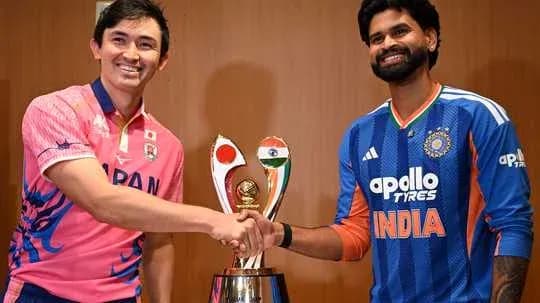
Japan vs India: A Historic Cricket Match in Sano
For years, when Naoki Alex Miyaji spoke about bringing India to Japan, it sounded like a romantic notion more than a realistic plan. The CEO of the Japan Cricket Association kept the dream alive anyway: the world champions, flying to Tokyo to face the 41st‑ranked Associate. On paper, it bordered on fantasy.
Then the Asian Games arrived, and fantasy started filling out paperwork.
On Tuesday, at Sano International Stadium, that long-shot idea becomes a fixture: Japan vs India, in Japan, with the hosts led by Kendel Kadowaki Fleming and the eyes of the cricket world briefly turning to a country where bats and balls usually mean something else.
“The CEO has had this dream for a long time,” Kendel, the Japan captain, tells Cricbuzz. The way he says it, you can hear how often he must have heard Miyaji repeat the line over the years. “When news first came up that we were hosting the Asian Games, Naoki had been talking about the concept of having India here for a game. So, for it to turn into reality is extremely special for a lot of people involved, and as a men's team, we can't wait.”
This is not a fixture that fell from the sky. It has been engineered, pushed, negotiated into existence.
“It's taken a massive effort from a lot of people involved to make it happen,” Kendel says. The Board of Control for Cricket in India had to say yes to a proposal that, historically, would never have reached the table. Japan’s leadership, and Miyaji in particular, had to convince a powerhouse that a trip to Sano was worth its time.
Credit, in Kendel’s mind, is shared. “Also to our leadership team here at the Japan Cricket Association (JCA), and in particular, the CEO,” he notes. Without that persistence, India’s first game against an Associate nation in a bilateral setting would still be an abstract talking point, not a date on the calendar.
Japan understand exactly what has landed in their lap. This is not just a match; it is a rare crack in the door.
The players know India have never played a bilateral series or even a single bilateral match against an Associate team. They know what that means. For them, it is, as Kendel calls it, an “extremely exciting opportunity” — a chance to measure themselves against the reigning world champions and to drag cricket a little further into Japan’s sporting consciousness.
“It's got the potential to accelerate the growth of cricket across the country,” he says. On Tuesday, Sano will look different. “There's going to be more people here than ever before for a cricket match. And clearly the best quality players that we've ever had here as well.”
Those “best quality players” are not faceless names on a team sheet. Jasprit Bumrah steaming in at Sano. Abhishek Sharma taking aim at short boundaries. Shreyas Iyer walking out in the middle of rural Japan. For a country still finding its cricketing vocabulary, these are living, breathing reference points.
“It still does sound quite surreal to be hearing about them playing here in Japan,” Kendel admits.
Surreal, but not intimidating. At least, that is the message from the dressing room.
“I can't guarantee any outcome, but what I can guarantee is that we will try our best. We'll compete and hopefully we'll give it our best shot.” It is the sort of line that could sound like a cliché. From a captain whose team has had to fight for every scrap of recognition, it lands as a statement of intent.
Kendel himself is 30, a left-handed batter and right-arm off-spinner, the kind of dual-role cricketer that Associate teams tend to produce out of necessity and design. Around him, Japan have built a squad that blends hardened campaigners with a few bright sparks from the pathway system.
One of those sparks is Charlie Hara-Hinze, a 17-year-old all-rounder who bowls left-arm spin and represents something important: a generation that has grown up with cricket as a realistic sporting option, not just an imported curiosity.
Historically, Japan have leaned heavily on spin. The reason is simple: conditions. Not just at home, but in the places they most often travel — PNG, Thailand, Oman. Surfaces that grip, outfields that can be slow, matches where guile beats raw pace. It has shaped their identity.
They have also developed a habit of swinging above their weight. At the ICC Men’s T20 World Cup Qualifier 2026, Japan produced a landmark win, beating Kuwait by five wickets. It was not a title, not a trophy, but it was proof: they can stand up to higher-ranked opposition and land a punch.
That is the context in which Tuesday’s game sits. The gap to India is enormous, but Japan are not walking into the unknown.
The significance of this match is not lost on the sport’s powerbrokers either. The International Cricket Council has circled September 22 on its calendar.
“It's enormous, one of our aspirations as an international federation,” says William Glenwright, ICC Head of Global Development. He has the numbers at his fingertips: more than 1,000 bilateral games last year, over 860 already this year. Among all those fixtures, this one stands out.
“Having a full member and the world champions playing any associate member is hugely important to us from a cricket perspective,” Glenwright explains. That’s the on-field piece. The other, in his words, is what it means for Japan itself, for “cricket's significance in Japan” and the “ripple effect of a fixture like this.”
In plain terms, this is a test of belief — not Japan’s belief in themselves, but the full members’ belief in what Associate nations can do.
“It reflects a growing confidence in the game and in the full members' belief in the abilities of our associate members to host full members in major international cricket,” Glenwright says. For the ICC, that is not a slogan; it is a strategy.
Back in Japan, Kendel is acutely aware that he and his teammates do not walk through airports like superstars. They are not plastered on billboards. Their faces do not sell soft drinks.
The country’s biggest sporting icon is Shohei Ohtani, the two-way phenomenon who has bent Major League Baseball to his will. “He’s the Virat Kohli of baseball,” Kendel says. In Japan, that is the scale. Baseball is the sport that fills stadiums and dominates highlight shows. “It’s definitely a sport that many of the supporters get behind in Japan.”
Cricket, by comparison, is a whisper. But whispers can grow.
Kendel is not naive about the distance between where Japan are and where the full members live, yet he refuses to see that distance as a ceiling. “There's no reason why we can't aspire to become like that in cricket someday,” he says. The road, he admits, is long. The benchmarks set by full-member countries are daunting. “We've got a long road ahead if we can try to replicate the full-member countries for sure.”
On Tuesday in Sano, that road bends in a new direction. The result will go into a scorebook. The real question is what it does to the sport’s place in a country still ruled by Ohtani and baseball — and whether a single afternoon against India can convince a new generation in Japan to pick up a bat and dream a little bigger.





