.svg&w=384&q=75 "logo")
Israel's World Cup Dream Ends in Riga with Loss to Latvia
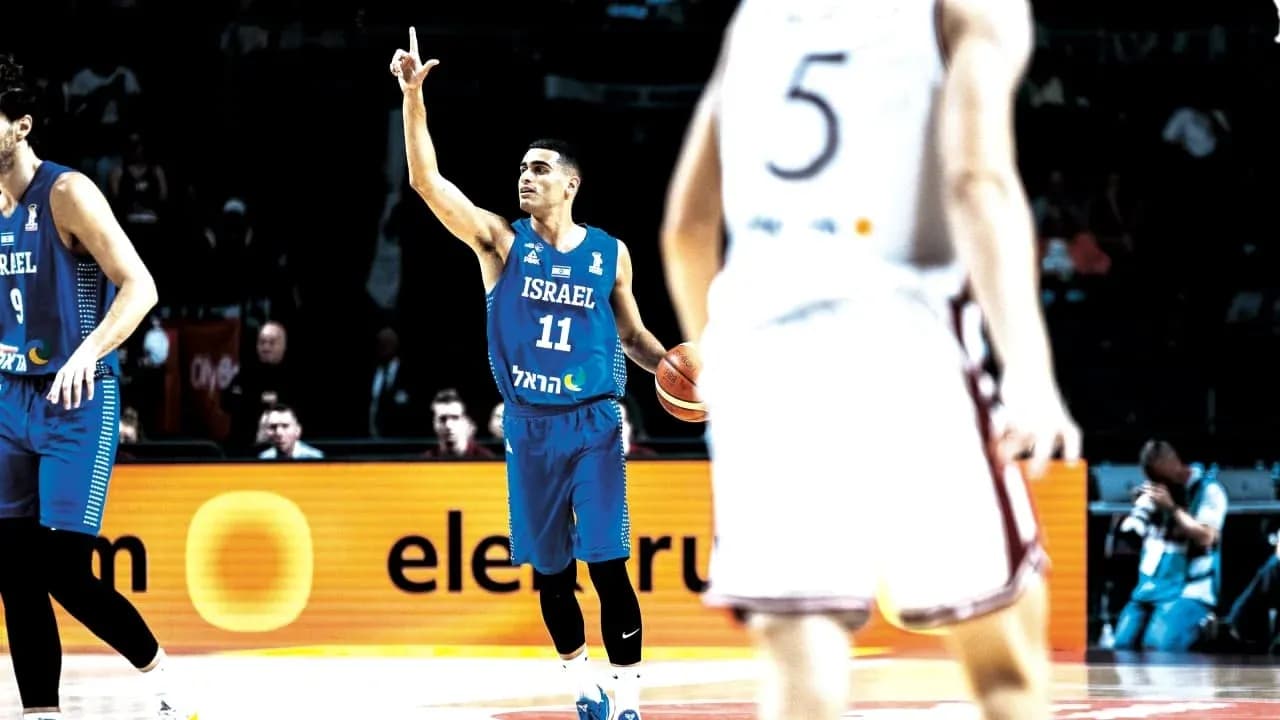
Israel’s World Cup qualifying campaign ended with a whimper in Riga on Sunday night, undone by cold shooting, foul trouble and a ruthless Latvian perimeter barrage in an 85-70 defeat.
Two games. Two heavy losses. Elimination confirmed.
After the 20-point setback to Poland earlier in the window, Ariel Beit Halachmi’s team needed a response. For a while, it looked like they might have one.
A lead built, then lost
Israel started with purpose. Lior Carrera and Netanel Artzi set the tone early, attacking confidently and pushing the blue-and-white in front. Latvia answered with physical play inside, and an Arturs Strautins three briefly swung the advantage the other way, but Eitan Burg stepped in with a burst of energy.
A couple of sharp plays from Burg turned the tide again, and Israel edged the first quarter 22-21. It was exactly the kind of platform they had lacked against Poland.
The second period brought their best spell of the window.
Guy Palatin and Burg drilled back-to-back three-pointers to open the quarter, forcing an early Latvian timeout as Israel moved the ball crisply and dictated the pace. When the hosts briefly cut the gap to 28-27, Israel punched back hard, stringing together a 12-2 run and stretching the lead to 40-29 — their biggest of the night.
Then it all unraveled.
Latvia regrouped out of a timeout and flipped the game with a 12-1 surge. Israel’s offense stalled, the ball stopped moving, and the turnovers crept in. By halftime, the scoreboard read 41-41. The double-digit cushion had vanished.
“We started the game well, but toward the end of the second quarter we lost the momentum,” Beit Halachmi admitted afterward. “In the second half, we got into foul trouble, and that changed the momentum of the game. They shot a high percentage from 3-point range and took advantage of the mistakes we made.”
Latvia turn the screw
Artzi tried to drag Israel back into control to open the third quarter, pouring in five straight points. It didn’t last. Latvia answered with an 8-2 run for a 49-48 lead and never looked back.
Strautins kept punishing every defensive lapse, stretching the gap to 58-52 and forcing Beit Halachmi into another timeout. The adjustments didn’t stem the flow. Strautins stayed hot, the Latvian shooters found their rhythm, and Israel’s foul problems only deepened as the hosts built a 67-58 advantage.
The knockout blows came quickly at the start of the fourth. Latvia rattled in three triples in rapid succession, the lead ballooning to 76-62 with seven minutes still on the clock. Israel had no answer. The offense that had sparkled briefly in the second quarter disappeared, and with it went any realistic hope of salvaging the contest — or the campaign.
Yam Madar led Israel with 15 points, Artzi added 11, and Itay Segev and Roman Sorkin chipped in 9 apiece, but it never felt like enough against a Latvian side that repeatedly found daylight from beyond the arc.
“We can’t look like this”
The defeat capped a bruising window that began with a 106-86 loss to Poland, also in Riga.
Poland had set the tone from the opening tip in that one. Mateusz Ponitka, Jordan Loyd and Aleksander Balcerowski powered them to an early eight-point lead, and by halftime Israel were already in a 55-42 hole. Sorkin, Madar and Tamir Blatt tried to ignite a response after the break, but Poland’s depth and shooting — with Andrzej Pluta and Jarosław Zyskowski stepping up — kept Israel at arm’s length. A late Israeli surge only trimmed the margin; the damage was long done.
Across both games, the pattern was familiar: short bursts of quality, undone by long stretches where defensive cohesion slipped and the offense lost its edge.
Beit Halachmi did not hide from the wider structural issues.
“I think we don’t have the luxury of showing up for international windows without our leading players,” he said. “We were missing quite a few players, and that had an impact. Different players have been available for each window, and it’s difficult to implement a style of play. Israeli basketball doesn’t have the option of throwing away games; we need everyone with us. Other national teams have been playing with the same roster for a long period of time, but unfortunately, that’s not the case for us.”
This window, again, highlighted that instability.
Sorkin, one of the few constants, turned the spotlight on the players’ responsibility.
“I can say that from the players’ side, which I’m part of, we have to look better. We can’t look like this. We need to play better,” he said. “I’m speaking about myself right now and not criticizing anyone else. I have no excuses; the only thing I know is that we have to play better and show up differently for games.”
A campaign cut short
The numbers are now brutal and simple: two games, two defeats in the second round, and Israel are officially out of World Cup contention.
There were small consolations. Stretches of sharp ball movement. A double-digit lead against Latvia. A fourth-quarter push against Poland. None of that changes the outcome, and inside the camp they know it.
Beit Halachmi took a moment to acknowledge the hosts, noting the assistance provided by the Latvian Basketball Association during Israel’s stay in Riga. Off the court, the support was there. On it, Israel could not match the continuity, cohesion and shooting of their opponents.
The World Cup door has closed. The question now is whether Israel can turn this painful window — the squandered lead against Latvia, the defensive lapses against Poland, the revolving-door roster — into the starting point of something more stable, or whether these same issues will resurface the next time the stakes rise.