.svg&w=384&q=75 "logo")
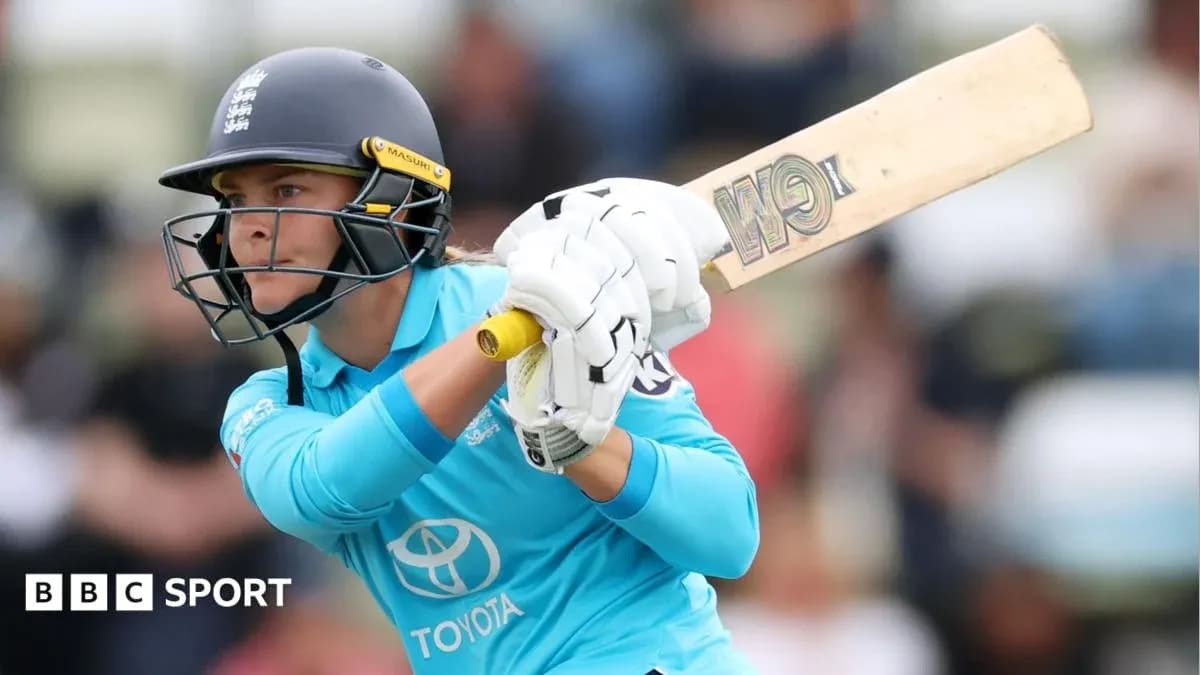
Ireland's Late Surge Challenges England in ODI
For most of the afternoon, England’s innings looked set to cruise past 300. Then Cara Murray and Ireland’s fielders ripped up the script.
From 257-4 with momentum and wickets in hand, England suddenly found themselves eight down, the innings unravelling in a flurry of miscued strokes, sharp catching and clever spin. Three wickets tumbled for 10 runs, the run rate stalled, and what once felt like a statement total began to look more like a target to chase rather than fear.
Murray leads the fightback
The turning point belonged to Murray. Her spell had already carried threat, but in the closing overs she seized full control of the narrative.
First came Freya Kemp. On 23 and looking ominous, Kemp advanced and tried to loft Murray straight, a clean, confident swing that seemed destined for the sightscreen. Instead, she picked out Gaby Lewis at long-off. The Ireland captain judged it perfectly, stretching to her left and somehow keeping her balance inches from the rope. A regulation clearance turned into a dismissal, and England’s middle order took a jolt.
The pressure tightened. England, 260-5, were suddenly wary of risk. Singles followed, the big shots briefly shelved. The platform for a charge remained, but the mood had shifted.
Then came the double strike that truly rattled the hosts.
Charlie Dean, England’s captain, walked in and announced herself with intent, thumping her first ball from Murray through mid-wicket for four. It looked like a statement blow. It also proved her only one. Next ball, Dean feathered an edge behind. Amy Hunter did the rest, pouching the chance and whipping off the bails in the same movement, so alert that for a moment the dismissal method itself felt in question. Caught or stumped, it didn’t matter. Dean was gone for four. England, suddenly, were 264-4 and wobbling.
Two balls later, the wobble became a collapse. Mady Villiers tried to break free, aiming to launch Murray over mid-wicket. She never got the distance. Louise Little, stationed some 10 metres in from the rope, held her nerve and the catch. Villiers departed for 3. England had lost three wickets for 10 runs. Ireland, who had “chipped away” for much of the innings, now had a full grip on it.
By the time Murray removed Ryana MacDonald-Gay – another catch in the deep, this time by Cara Murray herself running in from the boundary off Arlene Kelly’s bowling – her figures told their own story. Four wickets in the match, eight in the series, the standout bowler across these ODIs. Her lines were more direct, her lengths more probing, one in three balls attacking the stumps. England’s hitters, who had eyed the final overs as a launchpad, instead found a trap.
Ireland’s discipline, England’s flashes
Ireland’s seamers and spinners shared the workload, but the closing stages underlined their discipline. Kia McCartney became the first to complete her full allocation, closing out with a tight over that cost just four and left her with 1-53. It wasn’t spectacular, but it was exactly what Ireland needed: control, dots, and just enough scoreboard pressure to keep England’s batters thinking.
Hunter’s work behind the stumps matched that control. She reacted sharply to edges and half-chances, her glovework adding an extra layer of tension to every advance down the track. Dean’s frustration as she walked off told its own tale; there was no real complaint to make. Ireland’s keeper had simply been quicker.
Yet through the squeeze, England still found pockets of power. Dani Gibson, in particular, refused to be hemmed in. She carved Lara McBride through the covers for her third boundary, then showcased her range with a deft scoop for four off Orla Prendergast, stepping across her crease and helping the ball fine. When she stood tall and thumped straight down the ground, the shot looked almost simple: a small step out, high backlift, clean swing through the line. Pure timing, pure muscle.
Those strokes kept England moving, even as wickets fell around her. At 278-7 and then 286-7, the scoreboard still suggested 300 remained on the cards. The problem was the bodies left to get them. Every attacking stroke carried risk; every miscue felt fatal.
A chase with edge
By the time England slipped to 288-8, the innings had a very different complexion. What once threatened to be a demoralising total for Ireland now sat in that awkward middle ground: challenging, but not out of reach.
Ireland’s bowlers had earned that. Murray’s four-for, Kelly’s late strike in her final international, Lewis’ outstanding catch on the rope, Little’s composure in the deep, McCartney’s control at the death – each contribution chipped away at England’s ambition.
England, for their part, will look at the platform they built and wonder how a surge to 320 or beyond drifted away in the space of a handful of overs.
Ireland will walk off knowing they’ve kept themselves alive in this contest. The chase will be difficult, no doubt. But with the ball, they have already proved they can dictate terms. Now the question hangs over the outfield: can their batters match the discipline and nerve their bowlers showed when it mattered most?