
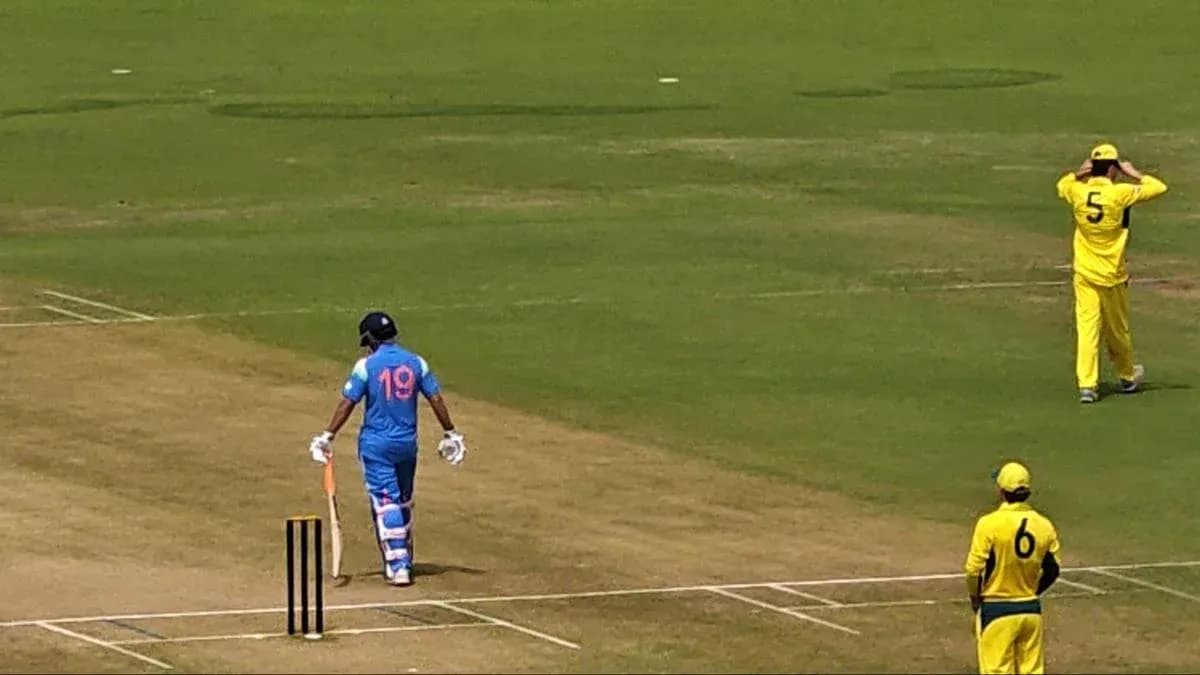
India U-19 posts 182 in rain-shortened clash with Australia
The first Youth ODI between India and Australia in Rajkot never quite became the full-day contest it promised to be. The rain won that battle early. The cricket, once it finally appeared in a reduced-overs shootout, fought back hard.
What began as a scheduled 50-over game at the Niranjan Shah Stadium morphed into a T20 after persistent morning showers, waterlogging near the 30-yard circle and repeated inspections. The toss, delayed for hours, finally came and went: India would bat. The parents who had flown in from Australia, the local families who had waited under umbrellas, and the groundstaff who had toiled all morning finally had something to watch.
Sehwag’s name, Sehwag’s intent
Aaryavir Sehwag walked out to open with captain Lakshya Raichandani, carrying a surname that instantly tugged at Indian nostalgia. Kasey Barton began with three dot balls, teasing the crowd into silence. Then came the release: Sehwag punched a four to get going. The sentence that once belonged to Virender now belonged to Aaryavir – Sehwag off the mark with a four.
India’s openers moved briskly. At 20 without loss after two overs and 25 without loss after three, the home side had the start any captain wants in a shortened game. Sehwag, 16 off 14 with three boundaries, set the tempo while Raichandani settled in. By the fourth over, India had reached 31 for no loss, the platform laid on a damp, still-gripping surface.
Australia’s new-ball attack, led by Barton and supported by Will Byrom and Eli Brain, searched for control more than magic. They found a quiet eighth over from Byrom, but India, buoyed by the PowerPlay, could afford a pause.
Australia hit back through the middle
The pause didn’t last. The contest changed shape in the space of a few overs as Australia’s seamers and spinners dragged the innings back.
At 62 for 1 in the eighth over, India looked set for 180-plus. Then Brain intervened. He had Raichandani caught for 15 off 15, a captain’s knock that never quite broke free despite two boundaries. The dismissal at 65 for 2 in the ninth over opened the door, and Australia barged through it.
Byrom struck next. First he removed Kushagra Ojha, who had chipped in with 16 off 14, to leave India 74 for 3 at the 10-over mark. The double blow slowed the scoring and stiffened the Australian shoulders in the field.
Arjun Rajput tried to hit back. He launched Eli Brian over deep square leg and then, in a brief cameo, raced to 15 off 8 balls with a six and a four. But Spencer Green cut him off at 89 for 4 in the 12th over, trapping him in front just as he threatened to turn momentum again.
At that stage, India’s innings stood at a crossroads: 89 for 4 after 12 overs, the early dash blunted, the platform wobbling.
Dravid and Chauhan light the fuse
The response came from a pair of young middle-order hitters who refused to let the innings drift.
Anvay Dravid, off the mark with a single, took a couple of overs to size up the surface. Then he went after Byrom, collecting his first four to push India to 100 for 4 after 13 overs. The intent was clear. The risk, unavoidable.
The real explosion arrived in the 14th over. Yashbardhan Chauhan, already looking fluent, launched Green for a six first ball. He handed the strike to Dravid, who promptly deposited his first six of the day. The over didn’t end there. Chauhan finished it with two more fours, ripping 22 runs off it and yanking the innings back into overdrive.
The pressure finally told on Australia’s bowlers. Brain, who had earlier removed the Indian captain, watched Dravid step out and clear him for another maximum in the 15th over. By then, India had surged to 134 for 4, the innings transformed from recovery to assault.
Dravid’s cameo was pure modern youth cricket: 38 off just 18 balls, three sixes and two fours, no time wasted. His dismissal, bowled by Brain in the 18th over with the score on 159 for 5, halted the charge but did not kill it.
Chauhan’s finishing touch
With Dravid gone, the responsibility fell squarely on Yashbardhan Chauhan. He had already shown touch and timing; now he had to show temperament at the death.
He did exactly that.
Chauhan kept finding the boundary, nudging and then hammering India towards a formidable total. By the final over, he had moved into the 50s, his strike-rate soaring, his shot selection forcing Australia to keep shuffling fields and bowlers.
He finally fell in the last over, dismissed after a superb 54 off 34 balls, an innings studded with five fours and two sixes. It was the kind of knock that doesn’t just pad a scorecard; it shapes an innings, especially in a rain-reduced contest.
India still squeezed eight runs from that final over, finishing on 182 for 6 from their 20 overs. From 89 for 4 in the 12th to 182 at the close, the late surge had effectively doubled the total.
A long day, a short game, a big chase
The numbers tell one story. The day told another.
Parents of Australian players, some having travelled from Sydney and beyond, spent much of the morning watching the rain from the stands. Among them, the father of Australia’s Neel Patel, back in Gujarat where he once played college cricket, waited for a glimpse of his son in national colours. The groundstaff, drenched and relentless, worked against the clock and the forecast to keep the match alive.
Their efforts delivered a 20-over-a-side contest and a stage for India’s young batters to showcase both flair and resilience.
Now the chase belongs to Australia’s next generation. A target of 183 in a youth T20 is no stroll, especially on a surface that spent most of the morning under covers. But if India could double their score in eight overs, what might Australia’s top order manage under lights and pressure?
For a day that almost disappeared into the Rajkot rain, the finish promises something far brighter.





