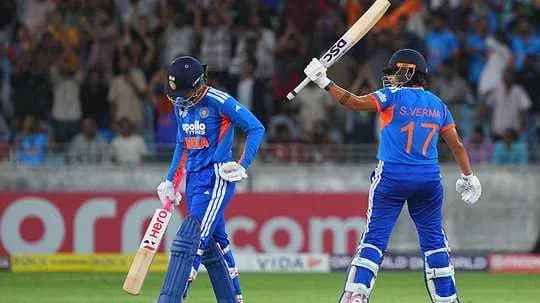
India Dominates Sri Lanka to Secure Fourth Women’s T20 Asia Cup Title
India did not just reclaim the Women’s T20 Asia Cup on Sunday. They stamped their name all over it.
A 72-run hammering of Sri Lanka, built first on the elegance and power of Smriti Mandhana and Shafali Verma and then ruthlessly finished by a clinical spin attack, delivered India a fourth title and confirmed what the tournament had hinted at all along: one side was operating on a different level.
Mandhana and Verma light up the final
The final inched into life with two gentle strokes. Shafali Verma opened her account not with a slog, but with touch – guiding Mithali Ayodhya past gully for four, then nudging the next ball to the midwicket rope. Soft hands, hard statement.
The tempo rose quickly. Chamari Athapaththu came on, and Verma went from measuring the pitch to owning it. Two sixes in four balls, both struck with that familiar, clean swing, flipped the mood of the contest. Sri Lanka’s fields spread, their shoulders dipped. India’s openers settled in.
Mandhana had begun with a first-ball boundary of her own, then slipped into the role of quiet enforcer. Singles, doubles, the occasional release shot – she let Verma tear at the bowling while she threaded gaps and ran hard. It was the kind of selfless, senior-figure innings that never quite screams from a scorecard but shapes a final.
Verma’s acceleration was brutal. Having started steadily, she suddenly shifted gear, racing to the fastest fifty in Women’s T20 Asia Cup history – reaching the landmark in 24 balls, one delivery quicker than Mandhana’s record from 2022. Against Chamudi Praboda she cashed in again, punishing anything remotely loose, peeling off another set of back-to-back fours. By the eighth over, she had her third fifty of the tournament. Sri Lanka were already chasing shadows.
Together, the pair marched towards a number that spoke to their dominance beyond this one night. When they crossed three figures, they also matched the world record for the most 100-plus stands for any wicket in women’s T20Is – six of them now, a partnership that has become a habit of destruction. By the end of the 12th over, India were cruising at 120 for 0. The final was slipping away from Sri Lanka long before the halfway mark.
They needed a break. It finally came.
Verma fell in the very next over, and with that wicket came a sliver of hope. The pressure nudged its way back into the middle, and it told almost immediately. Harmanpreet Kaur and Mandhana, usually so sharp between the wickets, got themselves into a terrible tangle. Mandhana, set and looking primed to surge, was run out. The roar from Sri Lanka’s fielders carried the sound of a side that knew this was their opening.
The innings lost its early fluency. India’s middle order, chasing the high bar set by the openers, went hard to keep the run-rate surging and paid for it. Wickets fell, momentum stuttered. Yet the damage had already been done, and the lower order still found enough late punch. A last-ball six from G Kamalini – brought in for Pratika Rawal – pushed India beyond 180, a total that loomed as imposing as the occasion.
Sri Lanka’s chase unravels
History weighed heavy on Sri Lanka as they walked out. In the entire history of the Women’s T20 Asia Cup, a chase of more than 150 had been pulled off only once. They had done it, against India, in the 2024 final. That memory flickered in the background. But the script this time was very different.
Kranti Gaud made sure of that within four balls.
Imesha Dulani, who had started the innings with a lap shot, tried to repeat the stroke. This time, her stumps were shattered. Gaud, fired up, sent her on her way with a pointed send-off. The tone of the chase shifted sharply: India were in their opponents’ faces, not just on the scoreboard but in the contest’s emotional space.
For three overs, Sri Lanka struggled to break free. Then Athapaththu, as she so often does, tried to rip the game out of its pattern. She slog-swept Verma for six, took 12 off her first over, and suddenly there was some defiance in blue and yellow. Vishmi Gunaratne settled alongside her, and the pair began to stitch together a stand that at least asked a question of India’s bowlers. Sri Lanka went past 50 without further loss. The chase, for a brief window, had life.
Athapaththu then went after Prema Rawat, taking 11 from the over with a six and four off consecutive balls. India’s grip loosened. The noise around Athapaththu grew. This is how upsets are born: one senior player refusing to accept the script.
Deepti Sharma ended the rebellion with cold precision.
Her second over became the turning point of the night. Athapaththu charged, looking to dominate the off-spinner, but Deepti dragged her out of position and had her smartly stumped. The dismissal did more than remove Sri Lanka’s captain; it ripped out the belief that had been building.
Three balls later, Gunaratne’s stumps were rattled as well. Two set batters gone in one over. Sri Lanka’s chase collapsed from a precarious situation into outright crisis.
Spinners shut the door
From there, India’s spinners squeezed the life out of the innings.
Shree Charani, in the middle of a standout 2026, took over the dismantling job. She sliced through the middle order, turning the game from a contest into a procession. Sri Lanka’s batters prodded, poked, and perished, unable to find the power or placement that Athapaththu and Gunaratne had briefly mustered.
Beyond the top three, only Nilakshika Silva reached double figures. That told its own story. As the overs ticked by, the chase did not so much race against the required rate as limp towards inevitability. Wickets kept tumbling, dot balls piled up, and the scoreboard inched rather than surged.
Eventually, Sri Lanka folded for 111. The margin – 72 runs – underlined India’s dominance. It is now the second-biggest victory margin in the final of a five-plus team tournament in Women’s T20Is, behind only Australia’s 85-run win over India at the 2020 T20 World Cup final at the MCG.
On this night, though, India were the ones dishing out the lesson. A record-equalling opening stand, a blistering fifty from Verma, Mandhana’s poise, and a spin unit that knew exactly how to close a final – all of it combined to restore their grip on a tournament they have long treated as their own.
The rest of the continent has a clear question to answer now: who can live with this version of India when it really matters?