The Importance of Fielding in Cricket: Insights from T Dilip
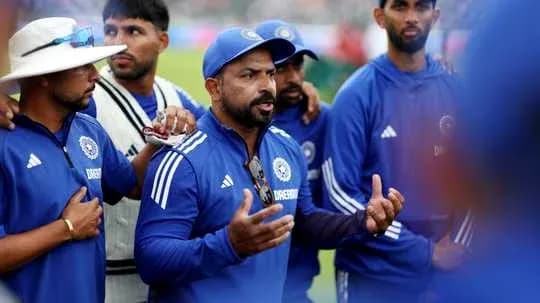
T Dilip has spent the last four years living in the part of cricket most people only notice when it goes wrong. While the cameras chase sixes and yorkers, India’s former fielding coach has been obsessing over first steps, head position and the angle of a fielder’s wrist as the ball rockets towards him.
To him, fielding is not an add-on. It is a craft with layers, and modern cricket is still struggling to measure even half of it.
The anatomy of a catch
For Dilip, a catch does not begin when the ball is in the air. It starts with where the fielder stands and what he sees.
“With catching, we look at the player’s starting position, how early he picks up the ball, whether his head remains stable and how his hands move in relation to his body,” he explains. Every detail counts. A slip catch, a steepler in the deep and a flat chance inside the ring might all end in the same column on a scorecard, but they live in different worlds technically.
So the training splits. A slip fielder learns to stay low, read edges and react in a fraction. A man on the rope works on judging trajectory, wind, lights, and the fine art of staying inside the boundary while still getting two hands to the ball. Inside the circle, it is about sharp angles, low hands and bracing for balls that fizz at chest height.
Ground fielding, he insists, begins before the bat meets the ball. The fielder must anticipate, stay balanced and make that first movement count. Just reaching the ball is not enough. He should arrive under control, body low, ready for a clean pick-up and a throw that leaves his hand in one smooth motion.
Throwing, too, is not a raw power contest. Speed of release, accuracy and decision-making sit alongside arm strength. Where a player usually fields dictates how he works. A slip catcher, a ring fielder and a boundary rider do not get a copy-paste programme. The basics connect them, but the drills mirror the situations they will actually face.
Multi-sport kids, single-sport demands
Dilip believes children who play multiple sports gain a quiet advantage. Different games throw up different movement problems. You learn to twist, turn, leap and recover in ways a single sport cannot teach.
Fielding feeds off that chaos. The ball never behaves the same way twice: different heights, speeds, angles. Adaptability becomes a weapon. Yet he is clear – football or hockey alone will not turn anyone into a complete fielder. Cricket brings its own demands: reading the bat, judging a cricket ball’s flight, understanding surfaces, picking up cleanly, throwing flat and true.
Those are skills you only sharpen in the game itself.
How the IPL rewired India’s fielding
On one point, Dilip is unequivocal: the IPL has changed Indian fielding.
“Without any doubt, the IPL has had a positive influence on Indian fielding,” he says. It has not just nudged standards up; it has rewritten the importance of fielding in the Indian game.
A teenager can now walk into an IPL dressing room and suddenly share a training ground with some of the best fielders in the world. He watches how they warm up, how they attack every ball, how involved they stay even if they have not faced a delivery or bowled an over. That daily exposure can fast-forward a career.
Recent data has shown some fluctuation in catching efficiency, and Dilip agrees that needs a closer look. But he rejects the idea that the IPL has damaged Indian fielding. For him, it has expanded the pool of capable fielders and taught an entire generation that a stop in the covers or a diving catch on the rope can swing a match as decisively as a fifty or a four-wicket haul.
The numbers that do not exist
Cricket drowns in data for bowlers and batters. Degrees of swing, seam position, bat speed, wagon wheels. Fielding, by contrast, lives in the shadows.
Dilip knows why. Fielding is messy. Position, distance, angle, surface, anticipation and decision-making all collide in a single moment. The current numbers – catches taken, run-outs made – barely scratch the surface.
He wants more. Where was the fielder when the ball was struck? How quickly did he react? Did he take the most efficient route to the ball? How long did it take to move from pick-up to release? For throws, velocity and accuracy matter, but so does the decision: did he choose the right end?
Even catching percentage, a favourite stat, needs context. A supremely athletic fielder might reach a ball that most would never get near, touch it, and be marked down for a drop. Another player does not get close, and his numbers stay clean. The difficulty of each chance should be part of the picture – reaction time, distance covered, ball speed, movement direction, position near the boundary, all tied to the fielder’s athletic profile.
Runs saved deserve the same treatment. If a fielder turns a likely two into a single, that small win should be visible. Over a long tournament, these margins pile up and can decide seasons.
Bowlers who started to care
Ask Dilip about players who improved “under him” and he pulls back. The credit, he insists, belongs to the players who juggle state teams, IPL franchises, India duty and a carousel of coaches.
Yet one group clearly gave him satisfaction: the bowlers.
Their transformation was not just technical. What struck him was the change in ownership. They began to take pride in the ugly work – saving a run, backing up at the non-striker’s end, holding a catch after a draining spell. That shift in attitude, that willingness to embrace fielding as part of their identity, stands out as one of the most rewarding threads of his tenure.
He refuses to single out a name. The appreciation, in his eyes, belongs to the entire bowling unit.
The unseen skill before the ball is bowled
At the highest level, Dilip does not believe any fielding skill is truly underestimated. Players arrive with awareness. They know fielding matters.
Yet one area, he feels, still has room to grow: what a fielder does before the ball is struck.
This is not guesswork or blind gambling. Anticipation grows from game awareness, knowledge of angles and a commitment to stay locked in before every delivery. A sharp first step can turn a half-chance into a routine stop. A lazy one can make a simple ball look impossible.
He does not label it a neglected skill, more a permanent frontier. From junior cricket to the international arena, players can keep shaving off tiny inefficiencies in that first movement.
T20’s double-edged sword
T20 cricket often gets blamed for everything from loose technique to short attention spans. Dilip does not put fielding on that list.
He sees the format as a driver of standards. Players are quicker across the turf. Boundary catching has evolved dramatically. The pick-up and release are sharper than ever.
The problem lies elsewhere – in the schedule. Matches, flights, recovery sessions, team meetings: they pile up. Under that load, players naturally pour more time into their primary skill, batting or bowling. In franchise cricket, fielding practice can become optional, tailored around individual workloads.
That is where trouble creeps in. When the volume of catching practice drops, the first few chances in a match effectively become a player’s warm-up. That is the last place you want to be rehearsing.
Dilip does not argue for marathon fielding sessions. He argues for protected time. A small, consistent block of high-quality catching work, even on optional days. Players, he believes, must own that preparation – not just during tournaments, but in pre-season and the off-season. Reliable catching comes from reliable effort.
Feel, rhythm and the coach’s real job
Even the best fielders in the world need to find their touch at the start of a series or a tournament. Catching is as much about feel as it is about technique. A new venue changes how the ball carries. Wind and lights alter the flight. A player might be stationed in a different position or fielding to a different type of bowler.
A few focused repetitions help the hands and body adjust. Sometimes the coach is not there to fix anything. He is there to tune the player to the demands of that specific event.
In a sport obsessed with what happens at the crease, Dilip’s world lives in the spaces in between – the half-second when a ball leaves the bat, the first step of a man in the ring, the split decision of a throw to the right end. Those moments rarely make the highlights reel, but they keep deciding matches.
The question now is simple: will cricket finally start measuring them with the seriousness they deserve?