
Harry Brook's Dominant Return to T20 Cricket
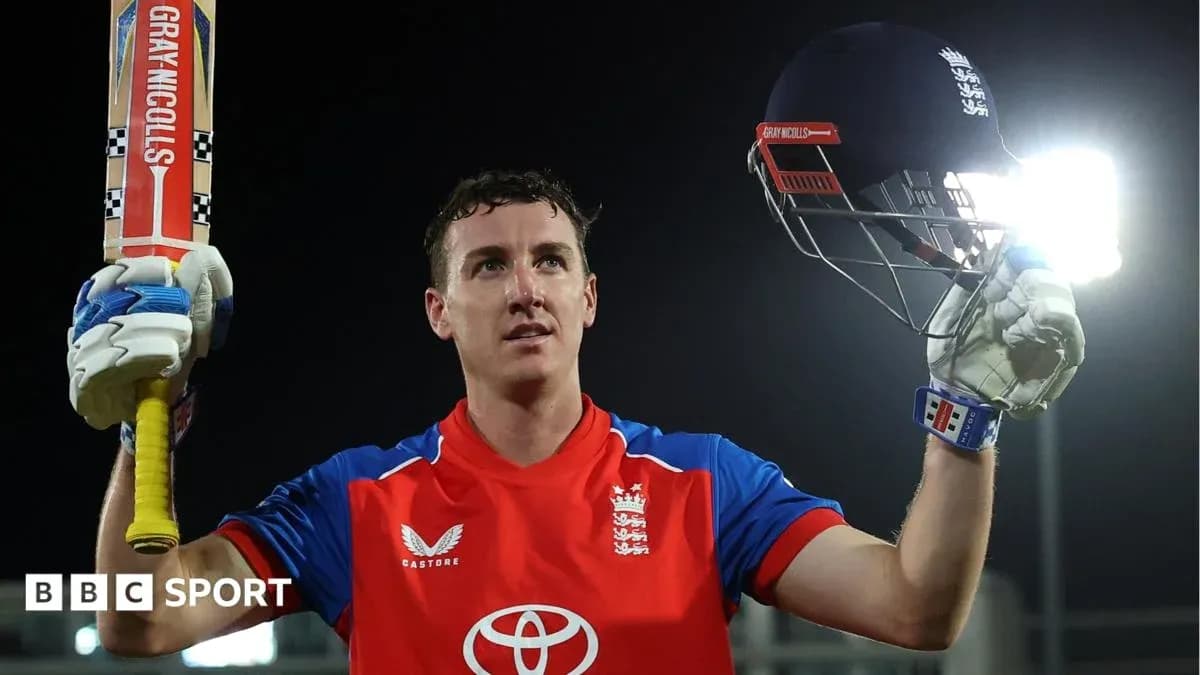
Harry Brook did not just return to international cricket in Southampton. He stormed back, ripped up the script and walked off with England’s T20 side in the palm of his hand.
On a warm night at the Ageas Bowl, Brook produced an innings that crackled with menace and control: 114 not out from 49 balls, 10 fours, six sixes, and the unmistakable sense that England’s next great batting argument has properly begun.
Sri Lanka were flattened. England’s 254-4 was a mountain; their 135 all out a distant echo.
Brook channels the Pietersen spirit
The comparison arrived almost before Brook had reached three figures. Kevin Pietersen is back in the England set-up as a mentor; on this evidence, he might just be mentoring his cricketing heir.
Brook, who has spent the summer searching for a Test hundred that would not come, found violent clarity in the shortest format. He walked in at number three after Aneurin Donald’s brisk 12 on debut and, alongside Jos Buttler, turned a good start into a demolition job.
The tempo was relentless. Brook drove on the up, clubbed through mid-wicket, carved square of the wicket and, when Sri Lanka dared to go full, launched straight. He barely needed the party tricks. The tumbling scoop that has become a TikTok favourite stayed in the locker. This was orthodox brutality.
What stood out was how early he picked length. Spinners dragged back a touch, seamers tried the heavy ball, and Brook simply adjusted – pulling, flat-batting, cutting from positions most batters never reach. It was pure Pietersen in that regard: seeing the ball sooner, reacting faster, hitting harder.
Buttler, no stranger to T20 carnage himself, almost slipped into a supporting role. His 80 from 44 balls would usually dominate a scorecard. Here, it felt like the perfect foil. Together they added 128, a partnership that broke Sri Lanka’s plans and their spirit.
The numbers behind the noise
Strip away the nostalgia and the name-checks and the numbers are startling enough. Since being promoted to number three in England’s T20 side at the World Cup earlier this year, Brook now averages 95.20 at a strike-rate of 200.84. He has not been dismissed in the format for 288 runs.
This was his second T20 international century. Pietersen, for all his white-ball brilliance, never managed one.
Across formats, the debate is already simmering. At 27, Brook’s Test average sits at 53.08, ahead of Pietersen’s mark at the same age, though the older man had banked two more hundreds by then. In one-day internationals, Pietersen still holds the edge with an average of 47.87 and six centuries to Brook’s 37.43 and three.
Where Brook cannot yet compete is in the scrapbook moments. Pietersen’s 158 at The Oval in 2005 delivered the Ashes in his fifth Test. He repeated the score in Adelaide against Shane Warne and Glenn McGrath. Brook’s Test best, that monumental 317 on a Pakistan road, is a feat of endurance and skill, but it has not yet carried the same historic weight. His highest Ashes score remains 85. He has not lifted the urn.
That gap is about time, not talent. As former seamer Steven Finn put it, watching this latest assault, Brook is now in the conversation as “maybe the best all-format batter in the world,” name-checking only Travis Head and Shubman Gill as peers.
A maverick England can live with
Mavericks divide opinion. Pietersen did. Brook already has. The shot selection, the aggression, the refusal to dial down – it thrills and infuriates in equal measure.
Ben Stokes, watching from afar, leant firmly into the admiration. “I don't even think the genius of KP could come close to what Harry Brook has talent-wise,” he said, calling Brook “an absolute freak” and urging fans to stop berating players who operate at a level most cannot even imagine.
Brook himself has never hidden his influences. He grew up watching Pietersen take bowlers apart, loved the way he hunted pressure rather than avoiding it, and has tried to live in that same space. “He always looked to take the attack to bowlers and put them under pressure. In that aspect, I'm quite similar,” he has said previously.
The parallels extend beyond the boundary rope. Both bat like they are one shot ahead of the game. Both have sparked arguments in pubs, on sofas, across social media. Both play in a way that makes coaches nervous and crowds lean forward.
Yet Brook already holds one trump card. Overlooked for the Test captaincy, he has quietly built a formidable T20 leadership record: 18 wins in his past 20 games as England captain. Pietersen’s reign with the armband lasted five months.
England’s attack backs up the show
All of this would have felt slightly hollow if England had sleepwalked through the second half. They did not. Without Jofra Archer or Sam Curran, Brook marshalled an attack that went for the throat.
Sri Lanka, staring at 255, needed a freakish powerplay to stay relevant. It never came. Wickets fell, the rate climbed, and the chase drifted from improbable to impossible.
The standout was Sonny Baker. On a night dominated by Brook’s fireworks, the young seamer delivered his best performance in an England shirt: 3-12 from four overs, full of heavy lengths, sharp bouncers and the kind of composure that hints at a longer future in this side.
Brook called the display “near perfect” afterwards, and it was hard to argue. England were ruthless in the field, clinical with their changes, and utterly untroubled as Sri Lanka folded for 135 in 19 overs.
Pietersen in the wings, Brook at centre stage
Pietersen has been brought into the England set-up to help plot a route to next year’s 50-over World Cup. It is a bold, nostalgic move, a nod to a previous golden era. On this evidence, the new man he is supposed to guide is already operating in his orbit.
Brook is not there yet. No urn, no Ashes epic, no defining World Cup innings. But nights like Southampton suggest those moments are coming.
The question for England now is not whether to build around him.
It is how far they can go if this is only the beginning.





