
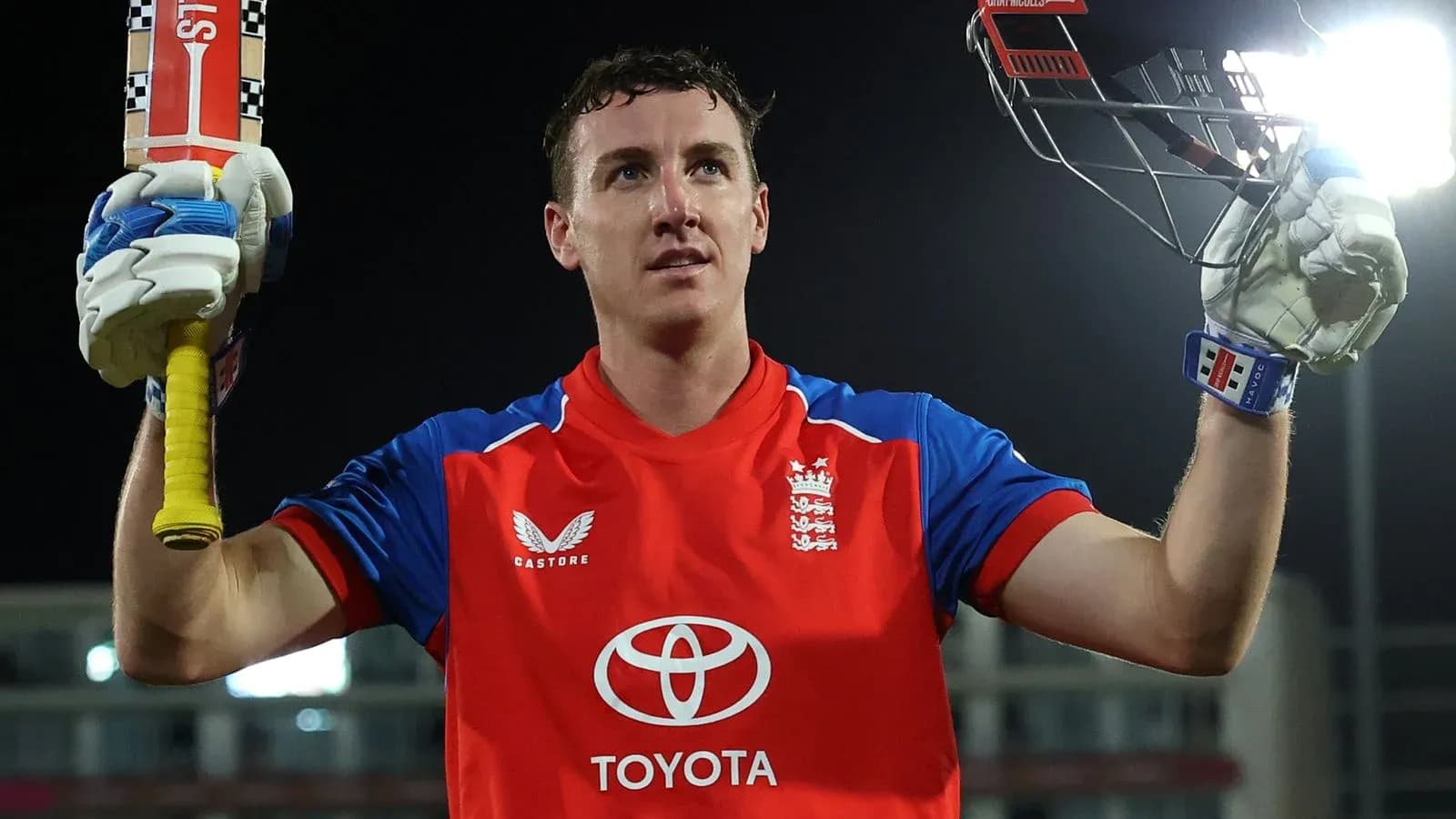
Harry Brook Stars as England Crush Sri Lanka in T20
The first night of the Kevin Pietersen era in England’s white-ball set-up was never going to be quiet. It turned into an onslaught.
Under a late-summer sky in Southampton, England belted 254-4 and then routed Sri Lanka by 119 runs, a demolition that said as much about their intent as it did about their opponents’ fragility. This was their first T20 since Pietersen’s appointment as white-ball mentor. It looked like a statement.
At the heart of it, Harry Brook. Again.
Brook and Buttler light the fuse
Brook, now white-ball captain and batting like a man liberated by the title, smashed an unbeaten 114 from 49 balls. Jos Buttler, his predecessor and long-time standard-bearer of England’s white-ball revolution, thundered 80 from 49. Together they tore Sri Lanka apart, adding 128 from just 60 deliveries for the second wicket.
The tone had already been set. Debutant Aneurin Donald, a local story with a big swing, walked out for his first England innings and immediately went aerial – a six over the leg side, a crisp four through extra-cover. Twelve runs from five balls, all intent and adrenaline. Then it ended in a rush, a miscue down the ground off Dunith Wellalage.
Donald walked off, but England’s aggression stayed right where it was.
Brook joined Buttler and the pair simply picked up the tempo. They had done this before. In July, at the same ground, they shredded India with a stand of 233 from 103 balls in a 257-3 total, Buttler hitting a century, Brook 95 not out. This time they swapped roles. Buttler missed out on a hundred; Brook did not.
Buttler, playing his first competitive innings since the Hundred final at Lord’s on August 16, eased himself in, then unfurled the full range – the pick-up over midwicket, the inside-out drives, the late cuts that make third man irrelevant. Brook, at the other end, went from dangerous to absurd.
One over, six boundaries, total control
The fifth over of England’s innings turned the night into a spectacle. Wellalage, Sri Lanka’s left-arm spinner, ran in. Brook dismantled him.
Six balls. Six boundaries. Three sixes, three fours. Thirty runs.
The first, a heave down the ground that just cleared long-on, carried a hint of fortune. After that, it was pure command. A straight four back over the bowler’s head. Another drilled down to long-on. A scooped six over fine leg that made a good length irrelevant. A clean strike over long-off. Finally, a late cut behind point to finish the over and leave Sri Lanka staring at a scoreboard that already felt out of reach.
Brook’s hundred came from 42 balls, only Phil Salt having reached three figures faster for England in T20 internationals – Salt’s 39-ball effort against South Africa in Manchester in 2025 still the benchmark. Brook now sits right behind him, and on nights like this he looks destined to keep rewriting that list.
In the dugout, Pietersen watched, smiling. One of England’s original white-ball trailblazers, a man with over 14,000 international runs, now seeing a new generation bend the format in ways even he didn’t. On social media, Ben Stokes weighed in, calling Brook the more gifted of two “freak talents” when compared with Pietersen himself. The old guard recognising the new.
Sri Lanka blown away by pace and precision
Once the hitting stopped, the gulf only widened.
Chasing 255, Sri Lanka needed a flyer. They never came close. The early overs drifted by without the necessary risk, and when they finally tried to catch up, England’s attack ripped through them.
Sonny Baker, quick, accurate and utterly unfazed, claimed his first white-ball wicket for England by bowling Kamil Mishara for 10. It set the tone for a spell of 3-12 from four overs that strangled any faint hope of a contest. His lines were tight, his length unforgiving, his pace too much for a side already chasing shadows.
By the halfway stage of the chase, Sri Lanka had slumped to 69-5. The target was a fantasy by then.
Wellalage, the bowler brutalised by Brook, showed defiance with the bat, striking 33 from 21 balls with four fours and two sixes. It was spirited, but it barely dented the margin. Jamie Overton (2-20) and Liam Dawson (2-23) shared four wickets, while Adil Rashid, so often England’s control valve, produced the moment of the night with the ball.
Dasun Shanaka had just launched Rashid for back-to-back sixes, a rare win in a one-sided evening. Rashid’s response was ruthless. He drew Shanaka into the drive, found the edge, and ended the cameo with a ball that dipped, gripped and kissed the bat on its way through. A reminder that in this side, the bowlers carry their own brand of theatre.
Sri Lanka were bundled out for 135 in 19 overs. It was their 13th consecutive T20I defeat to England, a run stretching back to 2014. For England, it was a 21st win in their last 24 T20 internationals. The numbers tell their own story.
Brook’s team, Brook’s tempo
This was more than a standalone thrashing. It felt like a first look at what a Brook-led white-ball side might become.
He captained with the same clarity he batted with. Bowlers rotated sharply, match-ups used smartly, no sense of drift once the game was effectively won. Baker was trusted with key overs. Rashid was backed even after being hit. Overton and Dawson were brought on to press the advantage, not just soak up deliveries.
Behind those decisions, Pietersen’s presence loomed. Not in the way of a man overshadowing the dressing room, but as a reminder of England’s white-ball identity: aggressive, unapologetic, relentless.
Cardiff awaits – and a local subplot
The series now moves to Cardiff on Thursday night, where England can wrap it up with a game to spare before heading to Emirates Old Trafford on Saturday. For Donald, it is a chance to leave more than just a blur of early boundaries on his international debut.
The 29-year-old came through the Glamorgan academy and is the county’s first homegrown international since 2005 Ashes hero Simon Jones. Southampton gave him a taste. Cardiff offers the stage he grew up dreaming about.
If Brook and Buttler go anything like this again, the crowd in Wales might see something even more savage. And if this is what England look like at the very start of the Pietersen mentorship, what happens when this batting order really hits its ceiling?





