.svg&w=384&q=75 "logo")
Harpreet Brar: The Constant in Punjab Kings' Turbulent IPL Journey
Harpreet Brar has lived through almost everything a franchise can throw at a cricketer without ever really being at the centre of it.
Seven seasons at Punjab Kings. One rebrand. Seven captains. A revolving door of overseas stars, support staff and tactical fads. Through it all, the left-arm spinner from Moga has stayed put, quietly ticking along since 2019 while the rest of the squad churned around him.
He has played only two full seasons in that time. Yet no PBKS spinner has taken more wickets since his debut.
In a team addicted to change, Brar has become the rare constant – and still, more often than not, he’s watching from the dugout.
The night that won’t go away
Ask the average IPL fan about Harpreet Brar and one image surfaces immediately.
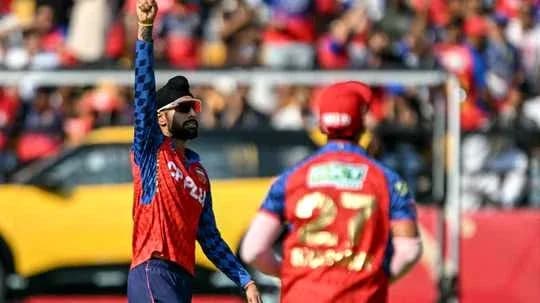
RCB. A young, unheralded left-arm spinner. Virat Kohli, then Glenn Maxwell, then AB de Villiers. Three giants, gone in a blur.
Kohli bowled. Maxwell bowled next ball. De Villiers undone soon after. It was only his second season in the league, but that spell branded him into IPL folklore.
It hasn’t left him either. “Yes, they asked me in another interview ten minutes ago,” he says with a half-smile when the subject comes up again.
The victims’ list has lengthened since. Rohit Sharma. More Maxwell dismissals. Kohli again. A scatter of established names and hopefuls, from superstars to domestic nearly-men.
For Brar, though, there is still one glaring omission.
“After Virat paaji, there’s no batsman whose aura is such that their wicket can be remembered,” he told Cricbuzz. “But still, I haven’t yet dismissed Shubman Gill in the IPL… I would definitely like to take Gill’s wicket in my career. But for the last 3-4 years, whenever there’s a match against him, I am not playing.”
That last line isn’t a throwaway remark. It’s the story of his recent IPL life.
A bowler in the age of the Impact Player
Across the last two seasons, Brar has spent more time in a bib than with the ball in his hand.
In IPL 2026, he played just twice – once in April, once in May. Both outings came in the kind of high-scoring chaos where spinners are usually fed to the wolves.
Against Rajasthan Royals, he sent down four overs for 25 in a 222 vs 228 shootout. Against RCB, he took 2 for 35, removing Jacob Bethell and Devdutt Padikkal in a game where PBKS again posted 222.
On paper, those are the sort of numbers that should buy you a longer run. Especially for a bowler with his body of work in the league. Instead, his role has shrunk in a way that reflects modern IPL more than it does his own form.
The Impact Player rule has cut into his value. In the old structure, Brar was a classic T20 package: frontline spinner, handy lower-order bat, often slotted at No. 7. Now, his batting barely figures. Teams stack extra hitters or an additional quick instead, and the all-rounder who once balanced the XI has been recast as a match-up option.
On flat decks, Punjab often decide they can live without a second spinner. They rarely decide they can live without another batter or pacer.
“Sir, main na sirf kaam hi kar sakta hu (I can only work on things),” he says when asked about his batting. The shrug is in the words. The reality is harsher.
“The way cricket is going on now, there is the Impact Player (rule), because of which I have gone down one spot further… If I play, there’s only Arshdeep (Singh) and Yuzipaaji (Chahal) after me. Because Marco Jansen also bats. Even if Azmatullah (Omarzai) plays, he will go above me.”
The logic is brutal. “If our batting comes first, I will not be in the team,” he explains. “If bowling comes, I will be in the team. If the total is more, the pacer plays. This is how it is.”
He doesn’t hide his wish: he wants the rule gone.
“Personally, Impact Player is not good for me because I want to play all games. Every player wants to play more. So yeah, I have been working on my batting – I have been doing that for eight years. But I am not getting enough chances.”
The league may not oblige him any time soon. The rule came up at a Captains’ Meeting before the 2026 season, and several senior players have spoken against it. Franchises will be asked for feedback, but the signs point to at least one more year with Impact Players in place.
For specialists like Brar, that means another season of uncertainty.
A spin team that barely spins
Brar’s frustration is sharpened by Punjab’s own numbers.
In 2026, PBKS bowled the lowest percentage of spin overs in the tournament – just 18.7%. They also took the fewest wickets with spin: 14 all season. For a franchise that has twice ridden strong spin returns all the way to the final, the contrast is stark.
In 2014 and 2025, their best campaigns, spin delivered 33 and 32 wickets respectively – their highest share of scalps through slow bowling in any season.
This year, beyond Yuzvendra Chahal, the spin cupboard was barely opened. Brar, despite being the most prolific PBKS spinner of the last seven years, was left to watch as games drifted by with barely a slow over bowled.
The lack of IPL action has bled into the rest of his calendar. His reputation elsewhere is strong: since 2023, no spinner has more wickets in the Syed Mushtaq Ali Trophy. He has broken out of the “white-ball only” bracket too, playing Ranji Trophy for the first time last season.
Yet after May, he didn’t play any professional cricket at all.
The work behind closed doors
Last month, PBKS held an off-season camp. Six players turned up. Brar was one of them.
No crowds. No cameras. Just long sessions with the strength and conditioning staff and assistant coaches, picking apart his game.
“I worked on plenty of things in detail,” he says. “How can I get better… how can I bowl better?”
The harder part isn’t the technical grind. It’s the emotional jolt of being dropped when you feel you’ve done your job.
“When you do well for your team, and suddenly, you are not in the first XI for the next game. Dukh lagta hai (it hurts) but as a cricketer, team always comes first, which is our motto,” he says. “We must go as per the demands of the team. But it doesn't mean that if I am not playing, I’ll just sit and feel low.”
He leans heavily on the people around him. Shreyas Iyer and Ricky Ponting, both part of the PBKS setup, have become sounding boards.
“They are very similar kinds of people. And they are very practical people,” Brar says. “If I have a question in mind, I will go and ask them. They will always answer it in the right manner.”
He catches them whenever they’re alone – not just to talk about his own omission, but to dig into their playing days, how they handled being in and out, how they navigated selection calls that didn’t go their way.
It’s a quiet education, away from the glare of match days.
Chasing cricket, wherever it is
If he can’t play for Punjab, he’ll play for someone. Somewhere.
His life offers him an unusual escape route: his wife works as a doctor in the United Kingdom, so the couple often spends time there after the IPL. Brar uses those trips to hunt for games.
This year, he turned out in club cricket across English weekends. No fanfare, no television, just a professional cricketer desperate not to let his skills rust.
“Even when you go for some free time after the IPL, say for a vacation… Even if matches are on the weekend, I want to play and stay associated with the game whenever I have free time,” he says.
Last year, that restless search for cricket took him a step closer to the highest level.
During India’s Test tour of England, Brar happened to be in Birmingham when the national team was training. He had Shubman Gill’s number. He had his kit. He didn’t have a reason not to try.
He sent a message to the India captain, asking if he could join practice.
“He said, ‘Yes, you can come,’” Brar recalls. “So, I managed to practice with the team. I think Shubman himself didn't come that day. It was optional practice. But I practiced with the rest and really liked it. Also, it’s always great to meet your own people on foreign soil!”
It was a small window into the world he wants to inhabit permanently.
Red ball, bigger dream
Right now, Brar is back in Punjab, playing the state T20 league, rolling out the white-ball variations he’s honed for years. But the real examination lies ahead.
Later this year, he will step into his second Ranji Trophy season. Away from the lights and noise of the IPL, that competition offers him something the Impact Player era has taken away: time in the middle, long spells, the chance to shape games over days rather than overs.
His first taste of red-ball cricket at that level, in 2025/26, could hardly have gone better. He took 23 wickets at 21.26, the most for Punjab. Among the dismissals was a ball KL Rahul will remember – a delivery that ripped past his defence and crashed into middle stump, a highlight that would have led any TV package if it had happened in an IPL night game.
Those numbers have stiffened his belief.
“Personally, I feel I can play Test cricket for India,” Brar says. “And for that, I am willing to put in all the hard work needed and will even exceed that in the future.”
The irony is hard to miss. In the world’s most glamorous T20 league, one of its most effective homegrown spinners is fighting for scraps of game time. In the grind of domestic red-ball cricket, he sees his clearest path to the India cap.
If the Impact Player rule keeps squeezing out the all-rounders and match-up bowlers on the fringes, players like Harpreet Brar will keep looking elsewhere for opportunity. The question now is simple: will his next big breakthrough come under white lights and coloured clothing, or in the quiet, unforgiving hours of a Ranji afternoon?