Fantasy Basketball Centers to Watch for the 2026-27 Season
When draft rooms open for the 2026-27 fantasy season, the conversation at center starts and ends with Nikola Jokić and Victor Wembanyama. For almost everyone else, it’s a different reality. You’re not getting them. The real edge lives in the middle and late rounds, where changing roles, new uniforms and injuries have cracked the position wide open.
In Yahoo’s High Score format — where only your best game of the week counts — volatility isn’t a problem. It’s a weapon. These are the big men who can swing a matchup with one spike performance at a fraction of the cost.
Center Risers
Kel’el Ware, Milwaukee Bucks
Kel’el Ware is the kind of fantasy profile that makes managers lean forward.
The shot came first. He jumped from 31.5% to 39.5% from three in his second season, turning from a theoretical stretch big into a real one. Even in a limited 22-minute role with Miami, he still managed 11.1 points, 9 rebounds, 0.8 steals, 1.1 blocks and 1.2 threes per game.
Then came the taste of real volume. In the 10 games where he cleared 30 minutes, Ware exploded: 18.1 points, 14 rebounds, 1.1 steals, 3.3 blocks and 1.8 threes. Those are league-warping numbers in any format.
Miami couldn’t clear the runway with Bam Adebayo in place, so Ware headed to Milwaukee in the blockbuster that delivered Giannis Antetokounmpo to South Beach. The Bucks view him as a long-term pillar up front. Myles Turner still starts, but this is a roster easing into a new phase, and Ware’s role should grow with it. Around 25 minutes early in the season is a fair expectation, with obvious room for more.
In High Score, those 30-minute nights are the whole selling point. A line with 14 boards and 3 blocks is worth roughly 23 fantasy points before you even touch his scoring or shooting. His ceiling games stack up with anyone in his draft range, and because only your best outing counts, the off nights barely sting.
He’s a swing-for-upside pick with the scoring system tilted in his favor.
Mitchell Robinson, Boston Celtics
Mitchell Robinson quietly played a crucial role in New York’s title run last season, anchoring the second unit behind Karl-Anthony Towns. He stayed on the floor more than he has in years — 60 games, his highest total since 2021-22 — even if the workload stayed modest at 19.6 minutes a night.
Within that limited window, he still delivered his trademark line: 5.7 points, 8.8 rebounds, 1.2 blocks on a ridiculous 72.3% from the field.
Boston saw enough to pry him away on a three-year deal. Neemias Queta gave them solid minutes at center, and the late-season addition of Nikola Vučević never quite clicked. The door is open. Robinson doesn’t need 30 minutes to matter, and given his injury history, he probably won’t get them. But 24-25 minutes? That’s very much in play.
That’s all he needs.
High Score formats strip away his biggest flaw — free-throw percentage. Once that disappears, Robinson looks almost purpose-built for this scoring system. A 16-rebound, three-block night is well within his range and translates to roughly 25 fantasy points without a single made jumper.
He’s not flashy. He doesn’t have Ware’s scoring upside. What he does have is a clear path to impact in a format that rewards exactly what he does best.
Nic Claxton, Chicago Bulls
Chicago’s decision to move on from Nikola Vučević at last season’s deadline signaled a philosophical shift at center. The Bulls wanted something different. They found it in Nic Claxton.
His raw numbers in Brooklyn last year dipped on a young, chaotic roster: 11.7 points, 6.9 rebounds, 3.7 assists and 1.1 blocks per game. The assist bump stands out. That’s not noise — it’s a hint at a more complete offensive role.
Claxton isn’t far removed from back-to-back seasons of at least 11.8 points, 9.2 rebounds and 2.1 blocks. Now he lands in Chicago alongside a more defined young core: Caleb Wilson, Matas Buzelis and Josh Giddey running the show. Giddey is one of the league’s sharpest passers, and the lob game with Claxton should become a staple of the Bulls’ offense.
Under High Score rules, Claxton is the most rounded scorer in this group. He can fill every column. A 10-point, 10-rebound, 3-assist line with two blocks translates to around 32 fantasy points — and that’s a realistic outcome, not a dream scenario.
He offers a blend of floor and ceiling that’s rare once the elite names are gone.
Center Sleepers
Hannes Steinbach, Charlotte Hornets
Charlotte found unexpected stability last season when Moussa Diabaté grabbed the starting center job in December with relentless energy and rebounding. His offensive role, though, shrank into the background. He shot 63.1% from the field but averaged just 7.9 points on an 11.2% usage rate.
The Hornets clearly wanted more punch up front. They traded for Naz Reid from Minnesota, and with Miles Bridges moving on, Reid should split his time between power forward and center. Then they added another wrinkle: Hannes Steinbach.
Steinbach arrives with polish. At Washington last season, he averaged 18.5 points, 11.8 rebounds and 1.2 blocks, showing a scoring touch that neither Diabaté nor Reid consistently brings in a pure five role. The path to immediate minutes isn’t wide open, but it exists — and as the season wears on, his skill set could force Charlotte’s hand.
In High Score leagues with only 10 roster spots, stashing a rookie is a real cost. Steinbach is more of a “watch closely” than “draft aggressively” name. But the rebounding profile and offensive upside mean that if the minutes appear, he’ll matter right away.
He’s the kind of rookie you want to be early on, not chasing a week too late.
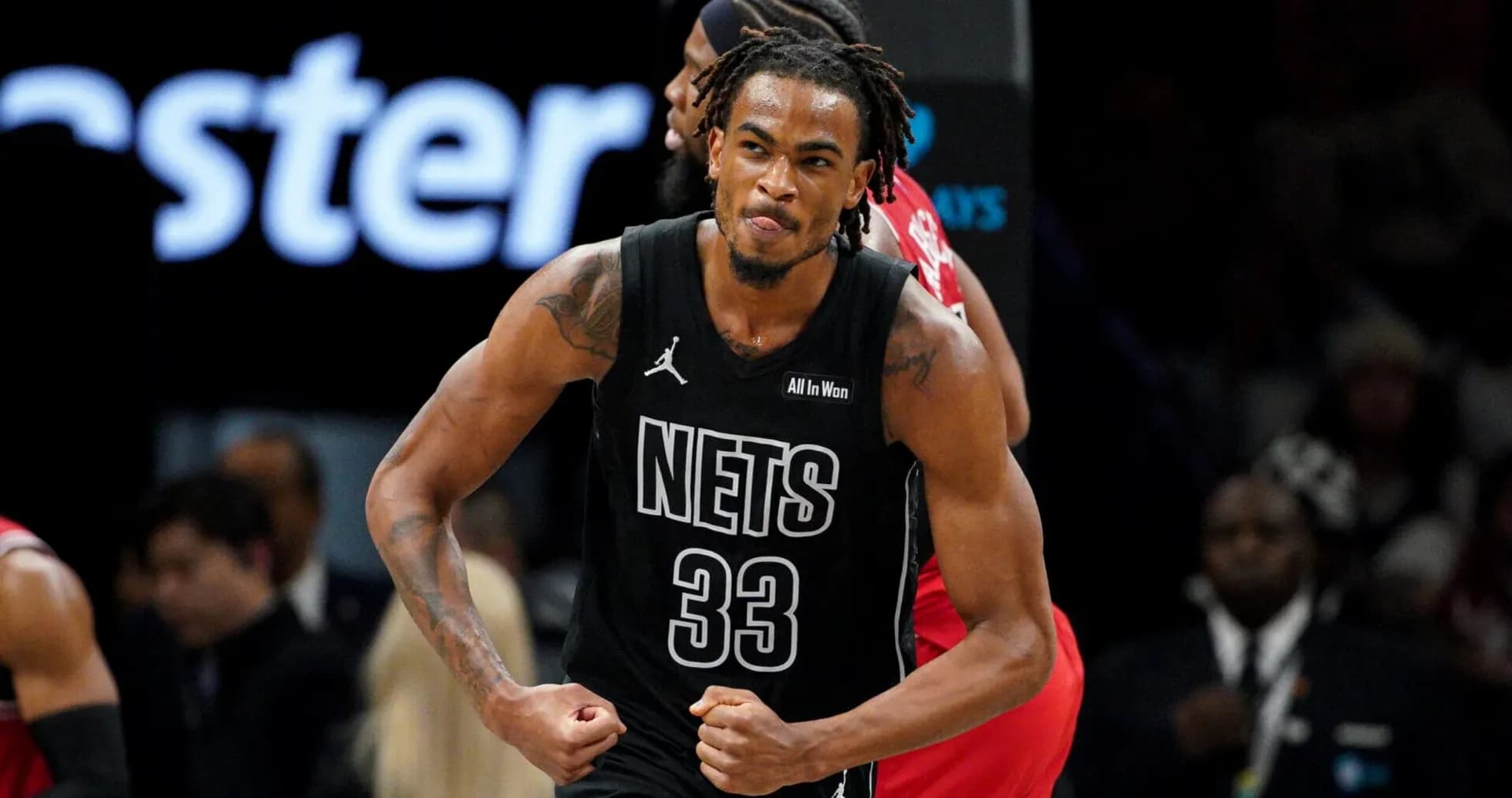
Day’Ron Sharpe, Brooklyn Nets
Brooklyn’s frontcourt is under construction again. Julius Randle has arrived. Mikel Brown Jr. joined via the draft. Moritz Wagner offers depth. But the player most likely to inherit the starting center spot vacated by Nic Claxton is already in-house: Day’Ron Sharpe.
He got a brief audition last season. In seven starts, Sharpe averaged 28 minutes. In that role, he produced 11.1 points, 7.9 rebounds, 3.6 assists and 1 block per game. Off the bench, he sat closer to 18 minutes.
The difference is massive.
Randle can slide to the five in smaller lineups, but the Nets still need a traditional center for long stretches, and Sharpe is positioned to claim those minutes first. If he simply replicates his starter sample across the season, he becomes one of the best late-round values at the position.
That starter line translates to more than 30 fantasy points in High Score, a mark that pushes into top-30 territory for centers. Sharpe doesn’t need to live there every night. He just has to get there once a week.
For a late pick, that’s the exact profile you want: a clear path to a role and a proven fantasy-friendly stat line when the minutes arrive.
Khaman Maluach, Phoenix Suns
Khaman Maluach arrived in the league with plenty of buzz. Phoenix took the Duke product 10th overall in the 2025 Draft, betting on his long-term upside. His rookie year barely scratched the surface: 46 games, 8.9 minutes per night, more apprenticeship than impact.
The depth chart in front of him is straightforward. Mark Williams returns as the starter on a new three-year deal. Oso Ighodaro, who filled in last season, remains in the mix. On paper, Maluach sits third in line.
But Williams’ health changes everything. He has battled injuries throughout his career and underwent surgery to repair a torn labrum in his left shoulder. An extended absence is very much on the table. If those minutes open up, someone has to take them.
Maluach carries the higher long-term ceiling of the two backups. The short-term mission is simple: win the share of the role that Williams leaves behind and hold it.
Right now, he’s going undrafted in most leagues, and with 10-man rosters in High Score, that’s understandable. He doesn’t belong on your bench yet. He does belong at the top of your waiver watchlist.
If Phoenix’s rotation breaks the way it’s expected to with Williams sidelined, Maluach is the first center you move on. In a format where one big night can tilt a week, he might be the kind of late-season pickup that decides a title.