.svg&w=384&q=75 "logo")
ESPN’s Credibility Crisis After Clippers Ruling
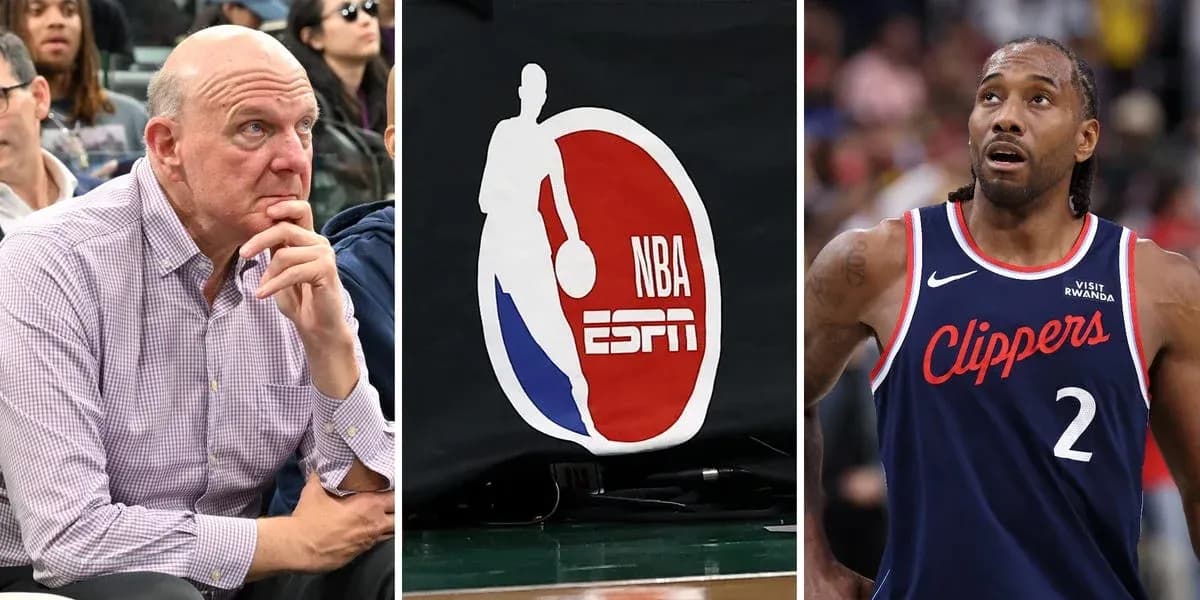
The NBA’s landmark punishment of the Los Angeles Clippers hasn’t just shaken a franchise and its superstar. It has dropped ESPN, the self-styled Worldwide Leader in Sports, into the middle of a credibility storm.
What began as a salary-cap investigation has turned into a referendum on how the most powerful name in sports media covers the leagues it depends on.
ESPN’s report vs. the ruling
On August 17, ESPN published a story that leaned heavily on three unnamed sources. Those sources insisted the NBA had “no evidence” that Clippers owner Steve Ballmer funneled money through team sponsors to pay Kawhi Leonard. One anonymous voice went even further, predicting that any argument about sponsorship introductions being salary-cap circumvention would be “dead on arrival.”
That framing did more than just preview the league’s thinking. It set up a clash.
Pablo Torre, the former ESPN journalist now at The Athletic, had already produced a Pulitzer Prize–winning investigation detailing Leonard’s ties to Clippers sponsors and raising exactly the red flags the league would later confirm. The contrast was stark enough that the saga quickly turned into a kind of media undercard: “ESPN vs Pablo” across social platforms.
Then came Wednesday.
After a nearly yearlong probe, the NBA announced that the Clippers and Ballmer had, in fact, violated league rules by facilitating sponsorship deals with Leonard. Commissioner Adam Silver hit the team with a $30 million fine, docked Leonard $700,000, and suspended Ballmer from league activities for a year — an unprecedented penalty in this space.
The Clippers fired back in a statement, saying they “vehemently reject the NBA’s findings,” blasting the process as “the result of a heavily biased investigation.” Leonard, in his own statement, said he accepts “full responsibility for lapses in judgment by people within my inner circle.”
The league’s findings landed squarely on Torre’s side of the ledger. They also cast ESPN’s pre-ruling story in a harsh new light.
A miss on framing, not facts
ESPN has not issued corrections. On the narrow question of wording, the piece may survive a fact-check. That’s not the point, say communications professionals watching from the outside.
“While it might be accurate in the wording, the substance of the story was very misleading,” said Brian McWilliams, VP at LA-based firm Spelling Communications.
The issue isn’t a typo. It’s tone, emphasis, and timing. ESPN’s story strongly suggested the Clippers were unlikely to face serious punishment — just days before the NBA unloaded the biggest penalty of its kind.
Fans don’t parse sourcing language. They remember the thrust of a story. Here, the thrust ran head-on into reality.
McWilliams warned that ESPN, which has staked its future on direct-to-consumer streaming and constant engagement across TV and social media, now “risk[s] a lot of damage to the brand.” After the investigation, he said, “fans see the outcome, which is starkly in contrast with ESPN’s reporting.”
Sam Gauchier, a New York-based brand and communications consultant, put it more simply: “The audience just needs an explanation.”
So far, they haven’t gotten one. An ESPN spokesperson said the company stands by its mid-August Clippers story and declined to comment further.
The league pushes back
The tension didn’t start with the ruling. It surfaced almost immediately after ESPN’s August piece went live.
ESPN reported that the NBA had not responded to requests for comment before publication. Later, NBA spokesman Mike Bass took to social media and blasted the story, saying it “contains numerous and significant inaccuracies” that would “be made clear once the investigation is concluded.”
That was a flashing warning sign. The league was effectively promising a receipts day.
When the report finally dropped, it did more than just settle the Clippers’ fate. It validated Torre’s investigative work and raised uncomfortable questions about how ESPN had framed its own reporting — and why the story seemed to undercut one of the most detailed public examinations of the case.
Torre said on Thursday that he had actually provided ESPN with a statement for that August story, saying he stood by his reporting and was eager to see the NBA’s findings. He says ESPN didn’t publish it. The omission sharpened the sense that the network had positioned itself opposite his work rather than engaging with it.
Now ESPN’s PR team must do something harder than issue a clarification. They have to convince viewers that the organization’s processes reflect “not only the technical accuracies, but the overall expectation of truth that their readers have,” said Bradley Akubuiro, a partner at PR firm Bully Pulpit International.
Shams, access, and the insider’s tightrope
The scrutiny isn’t limited to one article.
On Thursday, Shams Charania — one of the league’s most wired reporters and a fixture on NBA news shows — added another wrinkle. On air, he said Leonard “did not have any knowledge” of the salary-cap circumvention, then, in the same breath, noted that Leonard “pocketed tens of millions of dollars” from Clippers sponsors.
That juxtaposition raised eyebrows. Torre quickly responded on X, posting a screenshot of Leonard’s signature on what he described as a copy of a contract with former Clippers sponsor Aspiration Partners.
For media insiders, the moment crystallized a broader tension. Charania and reporters like him live on speed and access. They are the first to break trades, signings, and injuries, and that access depends on relationships with agents, teams, and the league office.
McWilliams summed up the dilemma: insiders walk “a very fine line between wanting to be first, wanting to be accurate, and also wanting to maintain access, which can be revoked.”
When the league’s official findings collide with earlier, access-driven narratives, that fine line becomes a fault line — one that runs straight through the heart of ESPN’s coverage model.
Trust, not just traffic
This is where the stakes rise for ESPN.
The network isn’t just another outlet covering the NBA. It is a rights holder, a promotional machine, and a primary storyteller for the league’s global audience. It is also racing to convert that audience into paying subscribers on its streaming platforms.
That business plan rests on trust. Not blind loyalty, but a baseline belief that when ESPN tells you what’s happening in sports, the framing isn’t tilted by relationships, rights deals, or the comfort of powerful owners like Ballmer.
The Clippers ruling, and the way it has intersected with Torre’s work and ESPN’s reporting, has cracked that assumption for some fans. The facts of the case are now public. The question that lingers is not what happened with the Clippers — it’s how ESPN chose to tell the story while the investigation was still in the dark.
In a media landscape where every misstep is screen-capped, replayed, and dissected, the next move belongs to ESPN. Will it explain how it got here, or let the silence speak for itself?